Ecuador Power Rationing Reaches Two Guayaquil Ports as Exporters Warn of Delays
ECONOMY · ECUADOR
Key Facts
- —The country Ecuador, a dollarised economy of about 18 million people, relies on hydropower for most of its electricity and is in a dry season.
- —What happened Two privately run Guayaquil ports, Posorja and Contecon, are among large users told to disconnect from the grid since 22 September, Primicias reported on 1 October.
- —Who is involved The ports’ operators DP World Posorja and Contecon Guayaquil, the Ministry of Environment and Energy, and exporters’ federation Fedexpor.
- —What it means for you Fedexpor says 85% of exports are perishable. Shippers of shrimp, bananas or cocoa may face slower terminal handling during scheduled cuts.
- —Still open Neither port operator has commented publicly, and the government has not said whether ports will be exempted.
Ecuador power rationing now reaches two of its main container ports, government sources told the news site Primicias on 1 October. Exporters warn that terminal outages could break the cold chain for perishable cargo.
The government counters that both terminals have their own generators. It says foreign trade must not be allowed to stop while the country rations electricity through its dry season.

Which ports are affected
One is the Posorja deep-water port, run by DP World Posorja. The other is Guayaquil’s Libertador Simón Bolívar port, run under concession by Contecon Guayaquil. Both sit in the top industrial tariff band, known as high voltage 1 (AV1).
That band covers 185 medium and large companies, from cement plants to factories. The government first asked them to switch off voluntarily one day a week from 22 September, as reported in Ecuador Power Rationing Orders 185 Large Industrial Users to Cut One Day a Week.
On 29 and 30 September all 185 were cut from the national grid for 48 hours. Officials said the companies had missed the consumption cuts agreed earlier, Primicias and the Colombian daily La República reported.
Why exporters are worried
Xavier Rosero, president of the Ecuadorian Federation of Exporters (Fedexpor), said factories can still protect perishable goods with backup generators and well-timed cuts. Ports, he argued, are different.
“The disconnection of the ports can break the cold chain,” Rosero told Primicias. He warned that containers pile up and ships may sail before loading is complete, forcing cargo onto later vessels.
Fedexpor wants both ports declared strategic zones and kept on the grid. Rosero also said lit, powered terminals matter for security, a live concern in Guayaquil after years of gang violence.
The government’s case and the energy squeeze
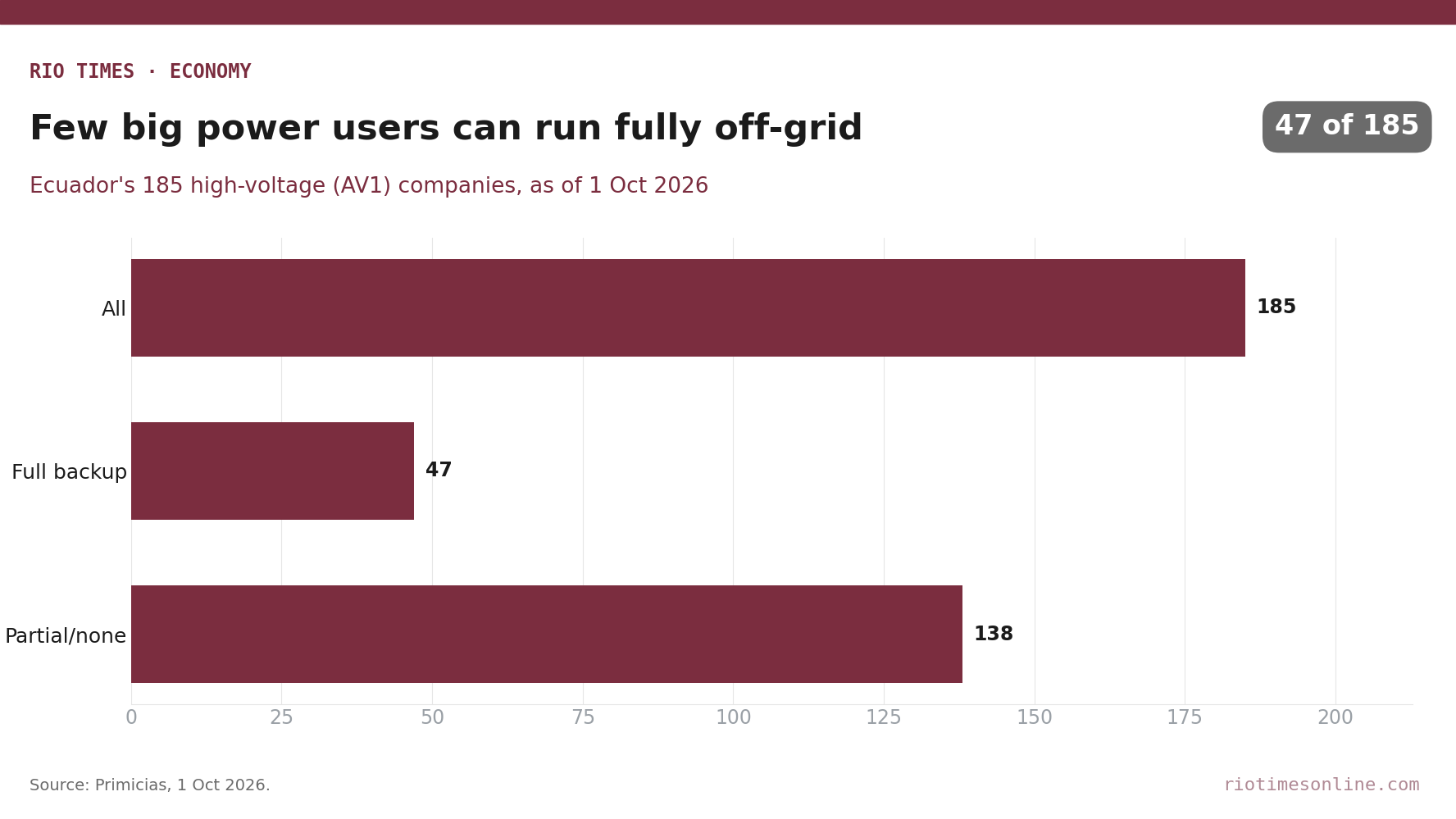
Government sources told Primicias that DP World Posorja and Contecon Guayaquil both have self-generation. Primicias reported that only 47 of the 185 AV1 companies can cover their entire demand on their own power.
The pressure comes from low river flows. Water reaching Coca Codo Sinclair, Ecuador’s largest hydroelectric plant, has been falling since mid-September, Primicias reported.
The government is also fast-tracking new plants of up to 100 megawatts, as covered in Ecuador Power Decree Fast-Tracks New Plants Up to 100 MW in Dry Season. Those units will take months to come online, so rationing remains the near-term tool.
What Is Not Yet Known
It is not clear how long the two ports have run on generators, or whether any vessel missed a loading window. Neither operator had published a statement by Thursday afternoon.
The government has not said whether it will grant Fedexpor’s request for an exemption. The account of the ports’ inclusion rests on unnamed government sources and has not been independently confirmed.
Sources: Primicias, 1 October 2026, citing Ecuador government sources and Fedexpor president Xavier Rosero; La República (Colombia), 1 October 2026.
LatAm Markets: Live Signals → — real-time movers, turnover leaders and FX across Latin America.
Read More from The Rio Times