A Hundred Days In, Congo’s Ebola Outbreak Is Still Getting Bigger
DR CONGO · HEALTH
Key Facts
—The scale: DR Congo reported 5,656 confirmed cases and 2,715 deaths on 25 August, from data collected to 24 August.
—Still climbing: That was 72 new confirmed cases and 35 further deaths in a single reporting day.
—Where: Fifty-eight of the 151 health zones in six affected provinces, with Ituri accounting for 4,716 cases.
—How deadly: Roughly 48% of confirmed cases have died, in line with past outbreaks of this virus.
—No vaccine for it: There is no approved vaccine or treatment for Bundibugyo virus; the licensed Ebola vaccine was made for a different member of the virus family.
—Declared: Congo declared its 17th Ebola outbreak on 15 May 2026, and the World Health Organization called it an international emergency two days later.
The Bundibugyo outbreak in DR Congo has passed 5,656 confirmed cases and 2,715 deaths, making it the largest Ebola epidemic the country has recorded and the second largest anywhere. A little over a hundred days after it was declared, it is still growing.
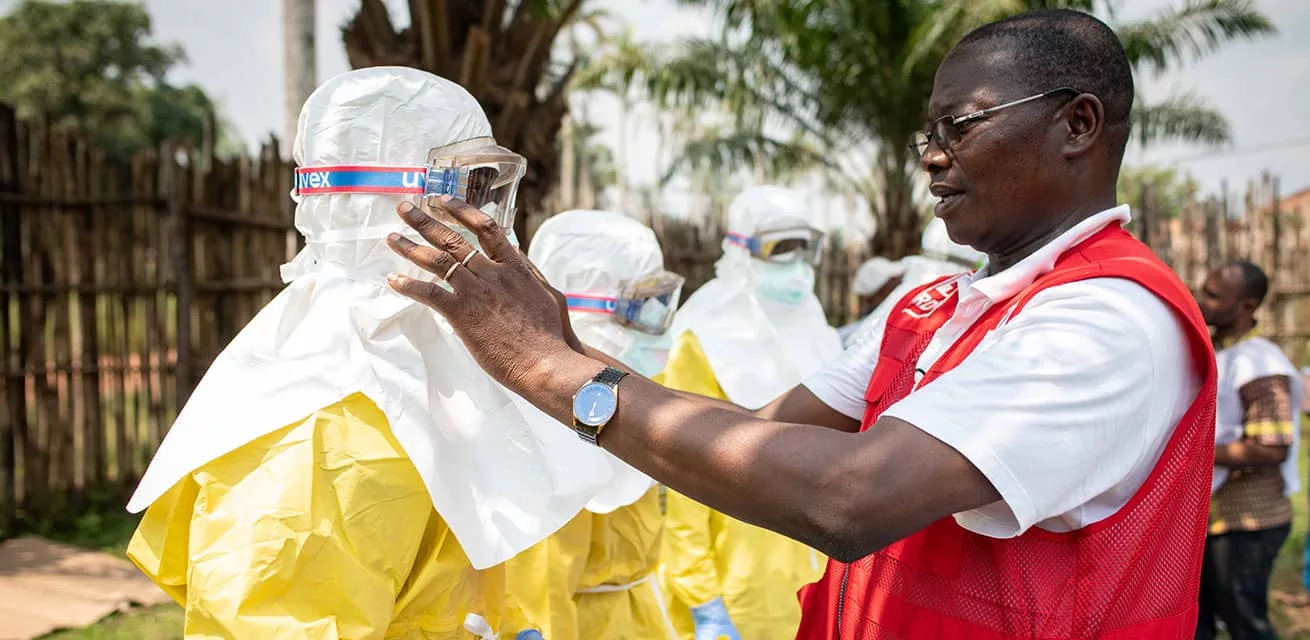
Where the Bundibugyo outbreak stands
The Democratic Republic of the Congo reported 5,656 confirmed cases and 2,715 related deaths on 25 August, from data gathered up to 24 August.
That was 72 new confirmed cases and 35 further deaths in a single day.
Ituri province carries most of the burden, with 4,716 cases and 2,119 deaths, followed by North Kivu with 735 cases.
South Kivu, Haut-Uele, Tshopo and Bas-Uele make up the rest, and the outbreak has now reached 58 of the 151 health zones across the six affected provinces.
A health zone is Congo’s basic unit of local health administration, usually covering a town and its surrounding villages.
The figures come from Congo’s national institute of public health, and European monitors note they are under continuous review.
Read them as the best current count, not a final one.
Why this strain is harder to fight
Ebola is not one virus but a small family. Bundibugyo is one of its rarer members, named after the Ugandan district where it was first identified in 2007, and seen in Congo once before, in 2012.
The crucial practical point is that no approved vaccine or treatment exists for it.
Ervebo, the licensed Ebola vaccine, was approved against the Zaire species. The World Health Organization says it is not known whether it protects against Bundibugyo in people, though early laboratory and animal data suggest it may offer some protection.
That uncertainty shaped the 70,000 doses released to Congo in mid-August: 20,000 for a clinical trial designed to find out, and 50,000 offered to frontline and health workers who give informed consent.
Care is therefore mostly supportive: fluids, oxygen and treatment of complications, delivered in full protective equipment.
That is demanding work to sustain across dozens of health zones, month after month.
A hundred days of it
Congo declared its 17th Ebola outbreak on 15 May 2026, after the virus was confirmed in eight samples from Ituri, in health zones including Bunia, Rwampara and Mongbwalu.
The World Health Organization had been alerted ten days earlier, on 5 May, to a deadly illness of unknown cause that was already killing health workers.
Two days after the declaration, the WHO named the epidemic a public health emergency of international concern, its highest alert level, reserved for outbreaks that cross borders and need a coordinated world response. That status still holds.
The WHO says the country has averaged around ninety confirmed cases a day over the first three months, a faster pace than the same period of either the 2014 to 2016 West Africa epidemic or Congo’s own 2018 to 2020 outbreak.
The count of affected health zones has moved from 54 in mid-August to 58 now.
Each of those numbers was accurate on the day it was published, which is itself a measure of the speed involved.
The people treating it are among the dead
As of 9 August, at least 155 health workers had been infected and 45 had died, according to the WHO.
Around 792 patients were in isolation in late August, and 1,245 people had recovered.
Roughly four in five identified contacts were being followed up, a workable share, but not a comfortable one at this scale.
A trial of possible treatments, the first ever run for this virus species, began enrolling patients in Ituri on 2 July.
Losing experienced clinicians compounds itself, because each death removes capacity exactly where it is scarcest.
It also makes recruiting new staff harder.
What the emergency committee is asking for now
Updated WHO recommendations published on 24 August read less like clinical guidance and more like social policy.
They ask for mass gatherings in transmission areas to be postponed, for crowding in bars and nightclubs to be reduced, and for motorbikes to carry only one passenger.
They also call for round-the-clock health checkpoints on roads linking affected and at-risk areas, and for surveillance on boats using inland waterways, including routes towards Kinshasa.
At the same time, the organisation is explicit that closing borders is not recommended, arguing such steps disrupt the response without stopping transmission.
Recommendations of this kind are easier to publish than to enforce in provinces where the state’s reach is thin.
They also carry an economic cost that falls on the same communities already carrying the epidemic.
The one piece of good news
Uganda, which recorded twenty confirmed cases and two deaths, declared its own outbreak over on 28 July.
Its last confirmed case was reported on 21 June, and the final monitoring period for an imported case ends this week.
That shows the chain of transmission can be broken, which matters when the neighbouring epidemic is moving faster than any previous one on record.
The WHO rates the risk in Congo as very high, in Uganda and the countries bordering the affected area as high, and in the rest of the world as low.
More: DR Congo news in English, every day from The Rio Times.
Frequently Asked Questions
How many people have died in the Bundibugyo outbreak?
DR Congo reported 2,715 deaths among 5,656 confirmed cases on 25 August 2026, from data collected to 24 August. That means about 48% of confirmed cases have died.
Is there a vaccine for Bundibugyo virus?
There is no approved vaccine or treatment. The licensed Ebola vaccine, Ervebo, was made for the Zaire species, and it is not known whether it protects against Bundibugyo in people; a clinical trial in Congo is now testing that question.
How large is this outbreak compared with others?
It is the largest Ebola outbreak ever recorded in DR Congo and the second largest anywhere, behind the West Africa epidemic of 2013 to 2016.
Is the outbreak still active in Uganda?
No. Uganda recorded twenty confirmed cases and two deaths, and declared its outbreak over on 28 July 2026, after its last confirmed case on 21 June.
Sources
WHO Africa: Over 5,200 cases recorded as DR Congo crosses 100 days since Ebola outbreak declaration (24 August 2026)
European Centre for Disease Prevention and Control: Ebola outbreak in DRC and Uganda (updated 27 August 2026)
WHO Disease Outbreak News: Ebola disease caused by Bundibugyo virus (14 August 2026)
WHO and Africa CDC welcome the allocation of Ebola vaccines to DR Congo (20 August 2026)
WHO: Second IHR Emergency Committee meeting, temporary recommendations (24 August 2026)
Connected Coverage
We have followed this epidemic as it grew, from the point at which it had killed 1,707 people to its arrival as the second largest on record, and the travel measures it has prompted, including Madagascar’s decision to bar travellers from affected countries.
This article was drafted with automated assistance and reviewed before publication. How we use AI · Report an error · Editorial responsibility: Matthias Camenzind, Editor-in-Chief
LatAm Markets: Live Signals → — real-time movers, turnover leaders and FX across Latin America.