CRA County Revenue Allocation Formula in Kenya Explained

KENYA · DEVOLUTION
Key Facts
- —The country Kenya has 47 counties that run local health care and other devolved services, paid mainly from a share of national revenue that Parliament sets each year.
- —Why it matters The share decides whether counties can pay doctors, nurses and suppliers on time. Late pay has already sparked strikes by county staff.
- —Why now The Commission on Revenue Allocation proposed Sh440.84 billion (about US$3.4 billion) for 2027/28, and the governors rejected it on Wednesday 14 October.
- —What happened Governors demand at least Sh500 billion (about US$3.9 billion). The commission says its figure is 21.5% of audited revenue, above the 15% floor, and will weigh their views.
- —The numbers The proposal is Sh12.84 billion (about US$99 million), or 3%, above this year’s Sh428 billion (about US$3.3 billion). The governors’ demand is Sh59 billion (about US$456 million) higher still.
- —What it means for US readers Firms that sell to county governments, and visitors who use county clinics, face payment and strike risk until the final figure is set.
- —Still open Parliament must pass the Division of Revenue Bill before the financial year starts in July 2027. Last year the two houses needed a mediation committee.
The CRA county revenue allocation formula in Kenya is under fresh pressure after governors rejected the proposed county share. The Council of Governors says Sh440.84 billion (about US$3.4 billion) for 2027/28 is too small for wages and new duties.
The Commission on Revenue Allocation (CRA) is the independent body that recommends how national revenue is split. It presented the proposal to the Senate Finance and Budget Committee in Nairobi, which People Daily dated to 5 October.
For a foreign reader the dispute is a test of how well Kenya funds health care and local services before the August 2027 general election. All sums here use the Central Bank of Kenya rate of Sh129.81 per US dollar, posted on 15 October 2026.
How the CRA County Revenue Allocation Formula in Kenya Works
Two separate decisions are often confused. The first splits national revenue between the national government and the 47 counties, and the second splits the county pot among the counties.
The first decision is made each year in the Division of Revenue Bill, which both houses of Parliament must pass. The constitution sets a floor of 15% of the latest audited revenue approved by the National Assembly, as CRA chair Mary Wanyonyi told the governors, as The Star reported.
The CRA’s website names Mary Wanyonyi as chair since her swearing-in on 17 July 2023 for six years, and the National Assembly approved her appointment in June 2023. Several Kenyan outlets print her married name, Mary Chebukati, after her husband, the former electoral commission chair Wafula Chebukati.
The second decision follows the Fourth Basis, which covers the years 2025/26 to 2029/30. The Senate approved it in June 2025, and the National Assembly resolved on 19 June 2025 to concur with the Senate without amendments, according to Parliament’s record of the motion.
Under the motion, a baseline of Sh387.425 billion (about US$3.0 billion) is shared by each county’s 2024/25 allocation, and a few billion shillings go equally to 12 marginalised counties. The additional money above that is weighted 45% to population, 35% to an equal share, 12% to poverty and 8% to land area.
What the Commission Proposed for 2027/28
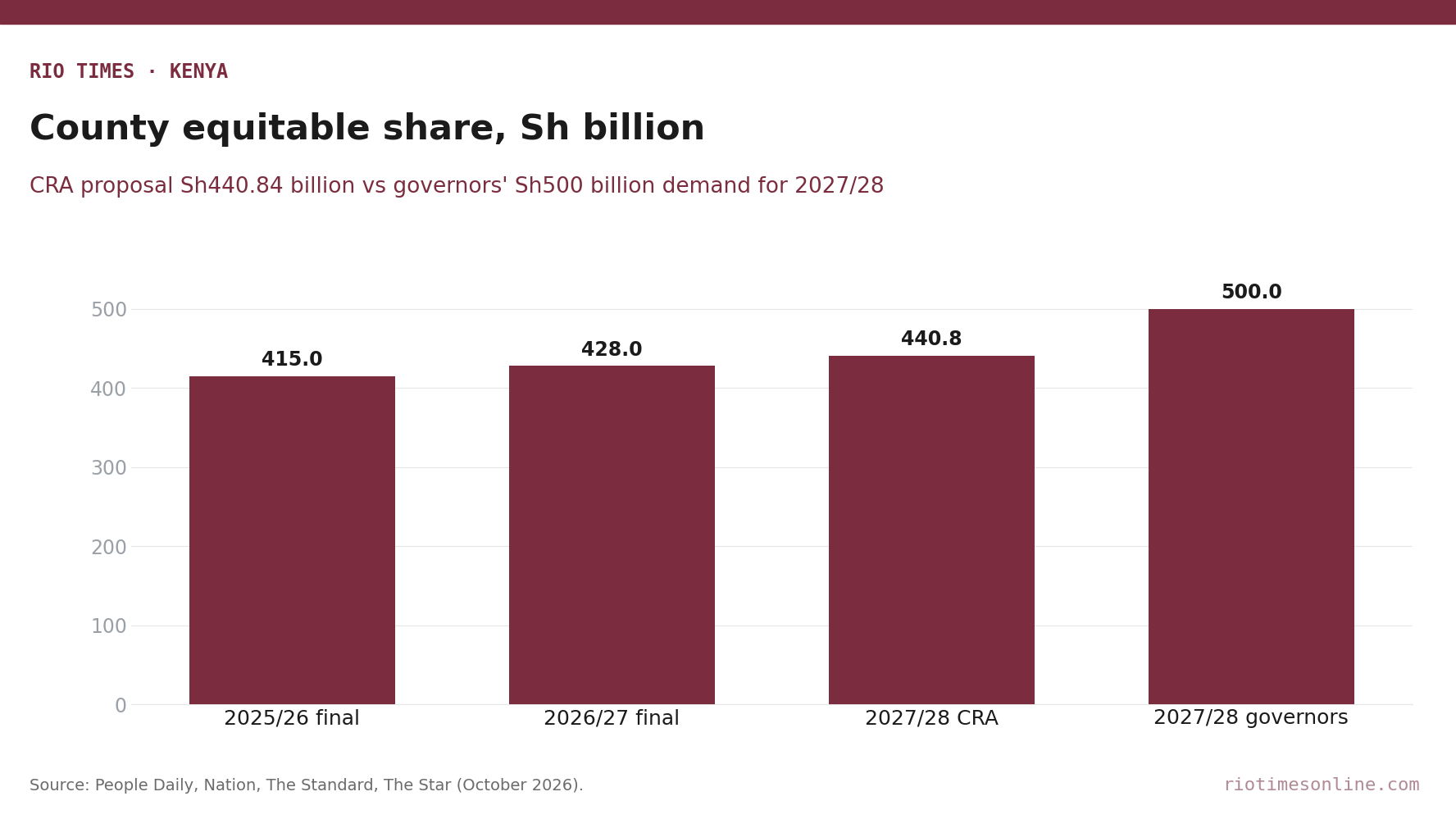
The CRA recommends Sh440.84 billion (about US$3.4 billion) for counties, up 3% on this year’s Sh428 billion (about US$3.3 billion). The Standard says that equals 21.5% of audited revenue of Sh2.05 trillion (about US$15.8 billion) for 2022/23.
Shareable revenue is projected to rise 8.12% to Sh3.24 trillion (about US$25.0 billion), according to People Daily. The Equalisation Fund for marginalised areas would get Sh10.25 billion (about US$79 million) on top.
The commission also warned that revenue has fallen short in past election years. Its chair called the revenue projection highly vulnerable, as The Standard quoted her.
Why the Governors Say No
Council of Governors chair Muthomi Njuki, who is governor of Tharaka-Nithi, called the approach mischief by the Treasury and the CRA. He asked how audited accounts for 2022/23 can set money for 2027/28, almost five years later, The Standard reported.
Njuki listed Sh21 billion (about US$162 million) for salary rises approved by the Salaries and Remuneration Commission. He added Sh2 billion (about US$15 million) for health-worker agreements and Sh8.6 billion (about US$66 million) to keep Universal Health Coverage staff, The Star and Nairobi Law Monthly said.
Governors also want money for functions moved from national ministries, which they put at Sh65 billion (about US$500 million). Njuki said counties should get at least half if the full sum is not available.
Kakamega governor Fernandes Barasa, who sits on the council’s finance committee, urged the CRA to cost services instead of using old accounts. He said counties had already been audited for 2025/26, with statements due before the end of the year.
How Earlier Rounds Ended
A year ago the gap was similar. For 2026/27 the CRA recommended about Sh459 billion (about US$3.5 billion), the Treasury offered Sh420 billion (about US$3.2 billion) and senators wanted Sh454.7 billion (about US$3.5 billion).
A mediation committee of both houses settled on Sh428 billion, the Nation reported, up Sh13 billion (about US$100 million) on the Sh415 billion (about US$3.2 billion) of 2025/26. That outcome landed nearer the Treasury figure than the Senate figure.
The CRA’s Counter Argument on Wages
The CRA has its own complaint about counties. Its review of county fiscal strategy papers, covered by The Star on 16 October, found that 42 counties broke the 35% cap on pay and benefits in 2024/25.
Only Siaya, Tana River, Kilifi and Narok complied, and Taita Taveta spent 64% of revenue on pay. The commission urged payroll audits and hiring limits, which The Star expects to draw a backlash from county workers.
Governors cite wage bills as a reason for more money, while the commission cites them as a reason for tighter control. The final bill will not settle that argument by itself.
What It Means for US Readers
Counties buy medicines, build roads and award contracts, so late transfers can mean late payments to suppliers. A US company or charity working with a county should check payment terms and any strike warnings before it commits.
Visitors rarely see the dispute directly. A county strike would hit public county clinics first, and the sources describe a warning, not a strike notice.
Investors in Kenyan debt watch the split, because the county share is money the national Treasury does not keep. Our guide to Kenya Explained: The Country, Its Politics, Its Economy and What to Watch covers the wider setting.
Politics adds pressure, because the general election is due in August 2027. See Who Can Challenge Ruto in Kenya’s 2027 Election for the contest ahead.
What Is Not Known
It is not known whether the CRA will raise its figure after it said it would consider the governors’ proposals. The commission has not published a revised number.
The Standard printed the governors’ Sh8.6 billion (about US$66 million) item as university staff, while The Star and Nairobi Law Monthly say Universal Health Coverage staff. We use the latter, which fits the Sh8.86 billion (about US$68 million) health-staff grant the CRA proposed, as People Daily reported.
The final county figure for 2027/28 depends on a Division of Revenue Bill that has not yet been tabled. The Senate and the National Assembly may also differ on the figure, as they did a year ago.
Frequently Asked Questions
What is the Commission on Revenue Allocation?
It is the Kenyan body that recommends how national revenue is shared between the national government and the counties. Its chair, Mary Wanyonyi, was sworn in on 17 July 2023 for six years.
Why do governors want at least Sh500 billion?
They say Sh440.84 billion (about US$3.4 billion) cannot cover pay rises, health-worker deals and functions moved to counties. They also object to the use of 2022/23 audited accounts.
Does the CRA decide the final county figure?
No, it only recommends, and Parliament decides through the Division of Revenue Bill. Last year a mediation committee of both houses settled on Sh428 billion (about US$3.3 billion).
How is county money split among the 47 counties?
The Fourth Basis, approved by the Senate and the National Assembly in 2025, starts from a baseline and then weights population, equal share, poverty and land area. The weights are 45%, 35%, 12% and 8% for the additional money.
Will the dispute disrupt services for visitors?
The sources describe a warning of industrial unrest, not a strike notice. Public county clinics would be affected first if staff stopped work.
Sources: The Standard, governors reject county allocation (15 October 2026) and CRA proposal; The Star, 15 October, 16 October and 28 March 2026; Nairobi Law Monthly, 15 October 2026; People Daily, 5 October 2026 and 19 June 2025; Nation; CRA, chair swearing-in; Senate motion and National Assembly motion on the Fourth Basis; Capital FM, 29 June 2023; Central Bank of Kenya exchange rate, 15 October 2026.
This article was produced by The Rio Times’ automated newsroom system. How we use AI · Report an error · Editorial responsibility: Matthias Camenzind, Editor-in-Chief
Part of our ongoing coverage
Africa: The New Scramble — the great-power contest over the continent.