Absa Kenya Banker Denies Leaks in US$11.5m Data Suit

BANKING · KENYA
Key Facts
- —The country Kenya is East Africa’s largest economy and its banking hub. Absa Bank Kenya is listed in Nairobi and controlled by South Africa’s Absa Group.
- —Why it matters The case tests where a bank’s background checks on a borrower end and a breach of client confidentiality begins under Kenyan law.
- —Why now An Absa credit manager was questioned in the High Court in Mombasa about M-Pesa payments from the claimant’s director, as reported on Friday 9 October.
- —What happened Transport firm New Mega Africa seeks Sh1.5 billion (about US$11.5 million). The banker admitted personal money dealings with its director but denied any bribe or leak.
- —The numbers Goodwill Sh1.2 billion (about US$9.2 million), lost income Sh192 million (about US$1.5 million), grounded trucks Sh92 million (about US$0.7 million).
- —What it means for US readers The claim is small for the bank, but it shows how Kenyan courts weigh customer data, a live issue for any US firm banking in Kenya.
- —Still open No judgment date is public. Absa denies every allegation and has asked the court to dismiss the suit.
An Absa Bank Kenya credit manager has told the High Court in Mombasa that he took M-Pesa payments from a borrower’s director, but denied any bribe or data leak. The evidence is the latest turn in the Absa data breach suit brought by transport firm New Mega Africa Ltd. The firm wants Sh1.5 billion (about US$11.5 million), and the case is a court test of client confidentiality at a foreign-owned bank in Kenya.
The testimony was reported on Friday 9 October by Kenya’s Nation newspaper. All dollar figures in this article use the Central Bank of Kenya (CBK) rate of 129.91 shillings to the US dollar for Friday 9 October 2026.
New Mega Africa hauls clinker, the raw material for cement, between Kenya and Tororo in Uganda. It says Absa mishandled its 2021 loan restructuring and leaked its confidential financial position to third parties, including competitors. Absa denies all of it.
What the Banker Told the Court
The witness was Wycliff Makori, Absa’s corporate credit manager supporting business banking. He was pressed on M-Pesa transfers worth more than Sh100,000 (about US$770) between him and David Abai, the director of New Mega Africa.
The company says the transfers fell on dates when its loans were approved or money was paid out. Its case also includes WhatsApp messages, which it says link the payments to its loans.
Mr Makori did not deny the money. “I had financial dealings with Mr Abai on a personal basis. He is a personal friend, and my wife also received money from him. I did not disclose this financial relationship between us to the bank,” he told the court, according to the Nation.
He gave a separate reason for each payment. Sh100,000 (about US$770) sent to his wife on 22 April 2020 was, he said, a refund of cash he had lent for a car wash in Nyali. Smaller sums of Sh40,000 (about US$308) and Sh30,000 (about US$231) were repayments of a personal loan of Sh150,000 (about US$1,155).
A final Sh27,000 (about US$208), received on 8 April 2021, was a contribution to a church fundraiser at which Mr Abai was guest of honour, he said. He said the WhatsApp messages did not prove any link to the loans.
On the leak claim, he denied sharing the firm’s statements with Jared Makori, an engineer at the Kenya National Highways Authority. He said he had called him to ask whether delayed payments from Mombasa Cement had hurt the firm’s ability to repay. He also said his system access did not allow him to pull client statements, and that an internal Absa investigation found no wrongdoing.
He blamed loan delays on the company itself, saying it had not supplied information the bank requested. The restructuring was approved in the end, on condition the firm repaid arrears at Sh1.6 million (about US$12,300) a month.
What the Company Is Claiming
Before Mr Makori testified, New Mega Africa presented a forensic audit by George Munga that puts the total claim at about Sh1.5 billion (about US$11.5 million). Most of it is for lost goodwill, based on the assumption that the business would have kept growing at 7.5 percent a year indefinitely.
 .71 million" data-lazy-src="https://www.riotimesonline.com/wp-content/uploads/2026/10/rt-chart-kenya-absa-data-breach-suit-2026-1.png" />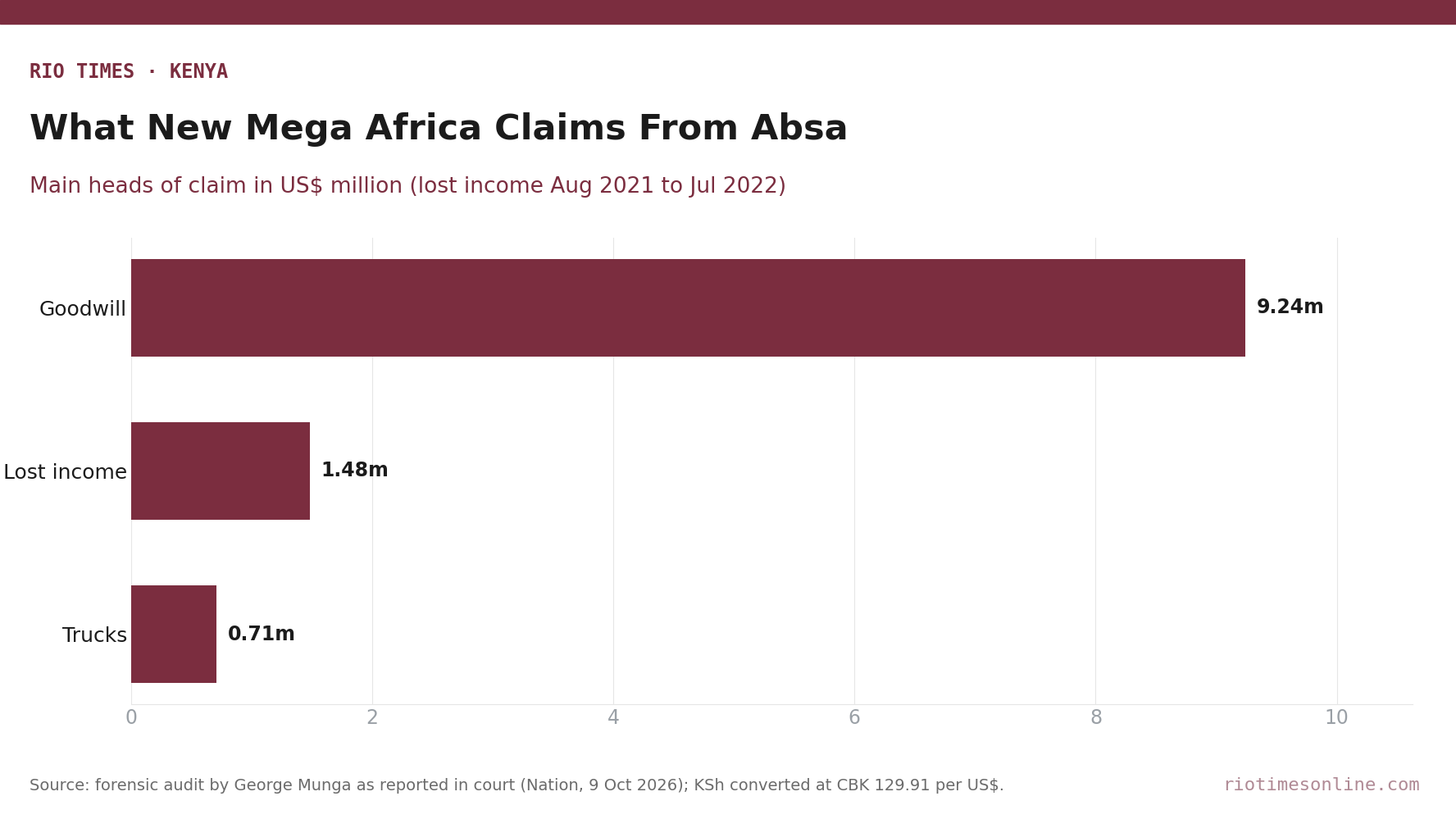
The firm says it was operating normally and meeting its obligations, including to Absa, until June 2021. It alleges the bank then withheld working capital and leaked sensitive information. These are allegations that have not been tested in a judgment.
How the Absa Data Breach Suit Got Here
The case has run for four years. In November 2022 the firm won an interlocutory judgment for Sh1.5 billion (about US$11.5 million) after Absa missed the deadline to file a defence, the Nation reported then. Justice Njoki Mwangi then suspended enforcement, according to Business Daily.
The High Court later set that award aside so the full case could be heard on its merits. In June 2023, Justice Josephine Mongare certified as urgent the firm’s bid to stop Absa auctioning its assets over unpaid loans of more than Sh80 million (about US$616,000).
In January 2025, Justice Julius Ng’arng’ar allowed former Absa employee Evans Murumba to testify for the company, Business Daily reported. Absa had opposed it.
The process has worked as designed so far. Absa’s missed deadline did not cost it the case, and the claims are now being tested through witnesses and documents.
What It Means for US Readers
For investors, the money is modest. Absa Group, which trades on the Johannesburg Stock Exchange, raised its stake in the Kenyan unit to about 72 percent through a tender offer this year. A US$11.5 million claim would not move a bank of that size.
The wider point is legal. Kenya passed a Data Protection Act in 2019, and courts are now sorting out what lenders may share when they vet a borrower. US companies and exporters that bank in Kenya have a direct interest in that line.
The Absa data breach suit also shows how M-Pesa, Kenya’s mobile-money system, now produces a digital paper trail that ends up as court evidence. For context on the sector, see Kenyan Banks Strengthen as South African Rivals Enter and Who Runs Kenya’s Economy, the Key Players in 2026.
What Is Not Known
The exact day Mr Makori testified, the presiding judge at this stage and the next hearing date were not published. No date for a judgment has been set publicly.
The WhatsApp messages themselves have not been made public. It is also not known whether any regulator has opened its own inquiry. Mr Makori told the court he was not aware of any report to the authorities about the alleged bribes.
No public statement from Absa on the latest testimony has been published. Its court position is to deny data leakage, sabotage and bribery and ask for the suit to be dismissed.
Frequently Asked Questions
Who is suing Absa Bank Kenya?
New Mega Africa Ltd, a transport company that hauls clinker between Kenya and Uganda. Its director is David Abai.
How much is the company claiming?
Sh1.5 billion (about US$11.5 million), mostly for lost goodwill, plus lost income, grounded trucks and costs.
What does Absa say?
Absa denies leaking data, sabotaging the firm or taking bribes, and has asked the court to dismiss the suit. Its credit manager said his payments with the director were personal.
Has a court found Absa liable?
No. An interlocutory judgment from 2022 was set aside, and the case is now being heard on its merits in the High Court in Mombasa.
Is Absa listed in the United States?
Absa Bank Kenya is listed on the Nairobi Securities Exchange, and its parent, Absa Group, trades on the Johannesburg Stock Exchange.
Sources: Nation, court report on the Absa data breach suit, 9 October 2026; Nation, interlocutory judgment, November 2022; Nation, Absa defence; Business Daily, stay order, 14 November 2022; Business Daily, auction injunction, 27 June 2023; Business Daily, witness ruling, 23 January 2025; Central Bank of Kenya indicative exchange rates, 9 October 2026.
Editorial responsibility: Matthias Camenzind, Editor-in-Chief · Editorial standards · Report an error