
Key Facts
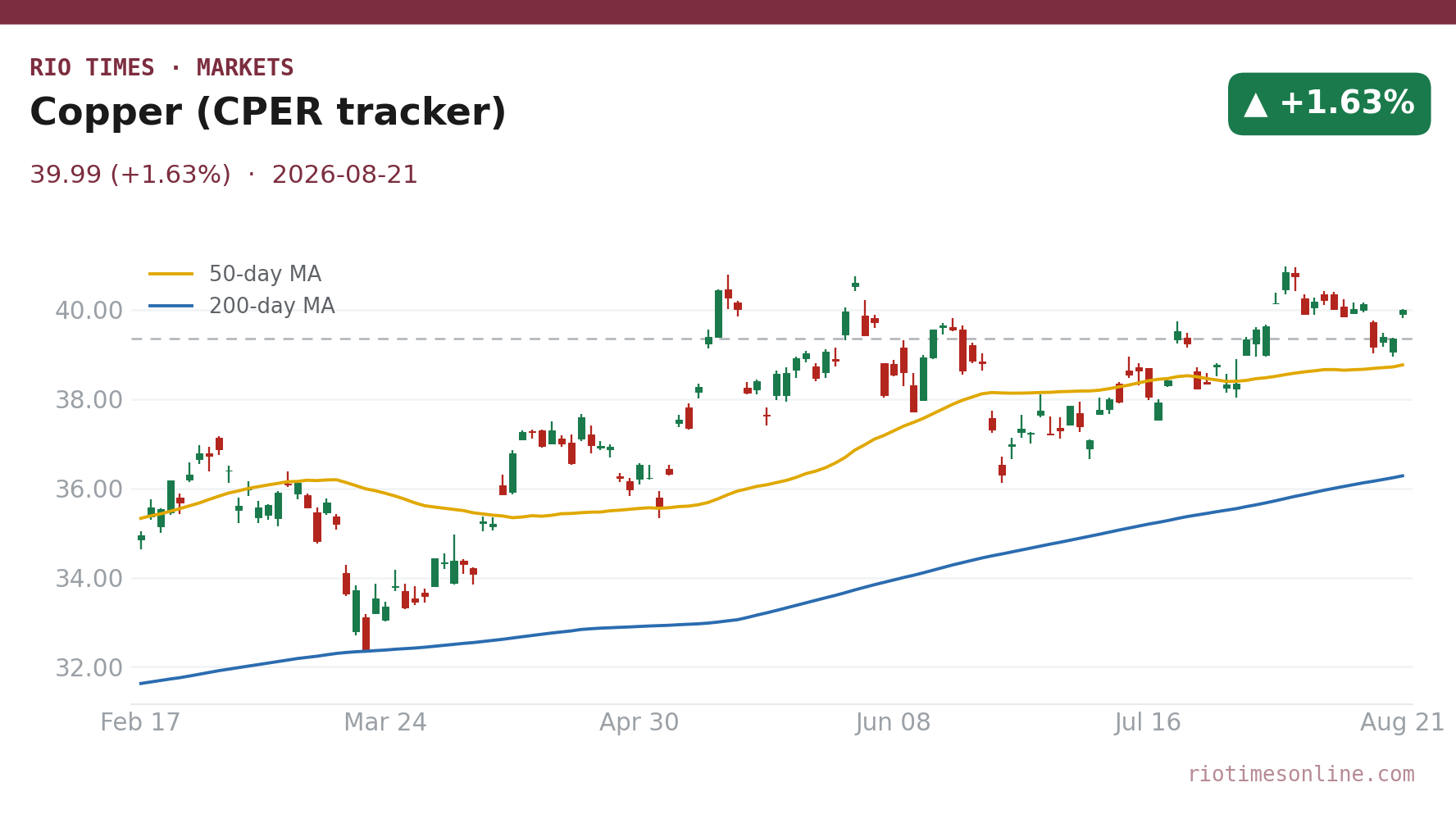
- —Copper tracked higher The copper-futures fund CPER settled at US$39.99, up 1.63 per cent on Friday, August 21, 2026.
- —The dollar did the work A retreating US dollar broadly lifted dollar-denominated commodities, pulling copper up to around US$6.58 per pound.
- —China was the other pillar Expectations of proactive Chinese fiscal policy targeting infrastructure and renewable energy bolstered demand bets on Friday.
- —Supply fears are not easing Declining ore grades across key Latin American mining operations continue to provide a structural price floor for copper.
- —Chile is cutting forecasts Codelco expects lower production this year and has abandoned its 1.34 million metric ton output target as mine setbacks mount.
- —Miners ripped higher Southern Copper closed at US$216.00, a gain of 8.69 per cent, while Freeport-McMoRan rose 7.64 per cent to US$76.66.
Today’s Focus
Copper advanced on Friday, August 21, as a weaker dollar and fresh hopes for Chinese stimulus overpowered demand worries that had knocked the metal lower earlier in the week.
The copper-futures tracker CPER gained 1.63 per cent to US$39.99, while the global spot benchmark firmed to roughly US$6.58 per pound.
Investors also paid up for the miners: Southern Copper jumped 8.69 per cent to US$216.00 and Freeport-McMoRan rose 7.64 per cent to US$76.66.
The move was a sharp reversal from Thursday’s muted close and a sign that traders were once again focusing on how few large copper mines the world is actually building.
What matters today. The case for copper is being rebuilt around constrained supply from Chile and Peru plus China’s promised infrastructure spending, even as near-term Chinese demand stays patchy.
01 The session in one read
Copper rebounded on Friday, August 21, wiping out the previous session’s hesitation as a softer US dollar and revived optimism about Chinese spending lifted the metal to around US$6.58 per pound globally.
The copper-futures tracker CPER closed at US$39.99, up 1.63 per cent, its strongest session in days.
That turned the tables after Thursday’s flat-to-lower close, which had followed a midweek slide tied to worries over China’s property sector and factory demand.
By Friday the market was no longer trading the near-term wobble; it was trading the idea that Andean supply is too fragile and Chinese policy too supportive to justify staying bearish.
Friday’s rise was less a verdict on immediate Chinese consumption than a bet that Andean supply constraints will outlast any short-term slowdown. With Codelco lowering its production outlook and Chile and Peru fighting declining ore grades, every bout of dollar weakness is translating quickly into higher copper prices. The variable to watch next week is whether China’s stimulus promises turn into visible restocking, because tighter supply alone rarely sustains rallies without a genuine demand pulse.
02 The board
The sharpest moves came from the big listed producers. Southern Copper, which mines in Mexico and Peru, surged 8.69 per cent to US$216.00, while Freeport-McMoRan, the world’s largest publicly traded copper miner, rose 7.64 per cent to US$76.66.
The more sedate CPER fund, which tracks a rolling strip of Comex copper futures rather than spot metal, added 1.63 per cent to finish at US$39.99.
That gap between the miners and the futures tracker is a reminder that equity investors were pricing in unusually strong earnings leverage to higher copper prices, not just a one-day bump in the underlying metal.
| Asset | Level | Change |
|---|---|---|
| Copper (CPER tracker) | US$39.99 | +1.63% |
| Southern Copper | US$216.00 | +8.69% |
| Freeport-McMoRan | US$76.66 | +7.64% |
Source: RT close, 2026-08-21. Where a commodity has no spot feed, an exchange-traded tracker or leading producer is shown as a labelled proxy.
Live Market IntelligenceThe live market board
Rio Times · Live Market Intelligence
Latin America — Cross-Market Board
| Instrument | Last | Change | YoY | Prev. | High | Low | Volume |
|---|---|---|---|---|---|---|---|
| IBOV | 206,220.24 | +0.94% | +21.85% | 204,302.33 | 168,310 | 167,142 | — |
| IPSA | 11,024.22 | +0.22% | — | 10,999.64 | 11,210 | 10,984 | 1,513,213,483 |
| IPC MEX | 64,871.81 | +0.34% | +12.17% | 64,653.33 | 66,121 | 65,405 | 108,886,187 |
| MERVAL | 2,832,472 | +0.30% | +30.51% | 3,022,485 | 3,042,365 | 2,991,150 | — |
| COLCAP | 2,525.90 | -0.36% | — | 9.04 | 9.05 | 9.02 | 4,133 |
| BVL PERÚ | 60,766.81 | -1.71% | — | — | — | — | — |
| USD/BRL | 5.16 | +0.01% | -5.13% | 5.16 | 5.18 | 5.14 | — |
| EUR/BRL | 5.95 | +1.01% | -5.83% | 5.89 | 5.98 | 5.94 | — |
| USD/MXN | 17.06 | -0.24% | -8.58% | 17.10 | 17.08 | 17.01 | — |
| USD/CLP | 913.98 | +0.04% | -5.67% | 913.65 | 915.11 | 906.68 | — |
| USD/COP | 3,140 | +0.03% | -22.04% | 3,139 | 3,141 | 3,105 | — |
| USD/PEN | 3.36 | -0.66% | -4.82% | 3.38 | 3.38 | 3.35 | — |
| USD/ARS | 1,493 | +0.10% | +12.96% | 1,491 | 1,494 | 1,480 | — |
| USD/UYU | 40.27 | +1.24% | +1.80% | 39.77 | 40.27 | 40.23 | — |
| USD/PYG | 5,939 | +1.68% | -19.54% | 5,841 | 5,939 | 5,925 | — |
| USD/BOB | 11.64 | -0.76% | +72.04% | 11.73 | 11.72 | 11.64 | — |
| USD/DOP | 58.34 | +1.25% | -3.44% | 57.62 | 58.34 | 58.04 | — |
| USD/CRC | 445.92 | +0.89% | -9.71% | 441.97 | 448.50 | 445.92 | — |
03 What moved it
First came the dollar. A retreating US dollar, pressured by bond-market jitters and debt concerns, broadly lifted dollar-denominated commodities on Friday, copper included.
Second came Beijing. Hopes of proactive Chinese fiscal policy aimed at infrastructure and renewable energy work supported demand expectations, especially after the July Politburo call for large-scale equipment upgrades and more power-grid investment.
Third, and more structurally, investors focused on supply rigidity. Declining ore grades across key Latin American operations and limited new mining projects were again cited as the reason copper refuses to stay down for long.
That combination of macro tailwind and supply fear was enough to override the lingering concern that Chinese buyers at high prices were still showing little urgency to restock.
04 The Latin American read
Chile and Peru together supply roughly 35 to 40 per cent of the world’s mined copper, which makes this region the market’s centre of gravity whenever supply turns tight.
Chile’s case is well documented: Codelco has abandoned its 1.34 million metric ton target for this year and expects lower production, with declines at Escondida, El Teniente, Spence and Los Pelambres only partly offset by higher output at Collahuasi and Quebrada Blanca.
Peru grew mined output in the first quarter thanks to Antamina, Las Bambas and Antapaccay, but that was offset by falls at Southern Peru Copper, Quellaveco and Marcobre.
China’s July import data captured the mixed picture: concentrate arrivals from Chile jumped 26.63 per cent from June, while shipments from Peru fell 13.32 per cent, evidence of uneven supply even between the two Andean giants.
05 The names to watch
Freeport-McMoRan remains the most direct listed proxy for global copper demand, with its US$76.66 close putting it in the middle of an unusually strong week for miners.
Southern Copper at US$216.00 is the region’s most important equity bellwether, its 8.69 per cent surge on Friday showing how quickly money rotates back into Peru- and Mexico-facing copper assets when the macro environment improves.
Codelco, though not listed, is the supply story to monitor: its production guidance keeps slipping, and every downgrade tightens the global balance that underpins both futures prices and miner profits.
On the demand side, the Yangshan copper premium remains the cleanest real-time signal of whether Chinese buyers are willing to pay more for imported metal, having earlier fallen from US$115 to US$96 per tonne.
06 The outlook
Copper now has two distinct forces pushing it from both sides: structurally weak supply growth out of Latin America and stubbornly uneven Chinese demand at elevated prices.
The energy transition still provides the long-term demand anchor, with electric vehicles, grid upgrades and renewable installations all requiring copper that ageing Andean mines are struggling to deliver.
Yet until Chinese restocking becomes visible rather than merely promised, the metal is likely to trade in a tight range with occasional sharp up-moves whenever the dollar softens.
For investors watching CPER, the futures curve will matter as much as the spot direction, because roll costs can eat into returns if the market stays in contango.
07 What to watch
- China stimulus follow-through: Whether infrastructure and grid spending announcements turn into actual metal orders will determine if Friday’s rally has legs.
- Codelco production updates: Any further cut to Chilean state output would tighten the global balance and push miners and futures higher.
- US dollar trajectory: Further dollar weakness, tied to debt and bond-market concerns, would leave dollar-denominated copper more room to rise.
- China copper import data: Monthly concentrate arrivals from Chile and Peru show whether Andean supply is truly recovering yet.
Frequently Asked Questions
Does CPER track the spot copper price?
No. CPER holds near-month Comex copper futures and rolls them forward monthly, so its return can diverge from spot when the futures curve shifts.
Why did copper miners rise more than copper futures?
Miners like Southern Copper and Freeport-McMoRan have high operating leverage, so investors often bid their shares up faster than the commodity when the supply outlook tightens.
Why does China matter so much for copper?
China accounts for roughly 58 per cent of global refined copper usage, so its infrastructure, power-grid and renewable spending plans move the whole market.
What makes Chile and Peru so central to copper?
The two Andean producers together supply roughly 35 to 40 per cent of world mined copper, and their aging mines and social hurdles are keeping global supply growth unusually slow.
This article was produced by The Rio Times’ automated newsroom system. How we use AI · Report an error · Editorial responsibility: Matthias Camenzind, Editor-in-Chief
LatAm Markets: Live Signals → — real-time movers, turnover leaders and FX across Latin America.