A couple of weeks ago, just as the Colombian government announced record seizures of hallucinogenic substances in 2022, the Attorney General’s Office was concerned about a substantial decrease in the number of tonnes of drugs seized and laboratories destroyed in the first month of 2023.
These reductions have been estimated (and projected) at approximately 78% with respect to the consolidated figures of previous years (671 tonnes in 2022 alone).
This concern of the Attorney General’s Office is added to that of the US International Narcotics and Law Enforcement Section (INS) regarding how the Colombian Police has been carrying out these processes and procedures under the direction of General Henry Sanabria, particularly those that are the responsibility of the Anti-Narcotics Directorate (Dirán).

These concerns began last year with the abrupt, unjustified, and inconsistent changes made at the top of the police force due to decisions made exclusively by the recently inaugurated President Gustavo Petro and his Minister of Defense, Iván Velásquez.
LACK OF EXPERIENCE
These decisions are based – in principle – on the lack of operational experience of several new men in command of directorates considered strategic for national security, among them the counter-narcotics and intelligence directorates.
They are now headed by officers – who would have neither the knowledge nor the expertise necessary for the challenges arising from these specialties – chosen under the personal criteria of General Sanabria and the deputy director, General Yackeline Navarro.
These decisions, based on unknown reasons, have caused the first results contrary to the main Colombian security policy, which is none other than counter-narcotics, the foundation, and the basis of hemispheric security and defense relations with its main ally: the United States.
However, these concerns have turned into increasingly tense relations, which are affected by episodes such as the recent capture of a lieutenant colonel of the intelligence directorate (a protégé of the sub-directorate of this institution) in the middle of a binational operation the Colombian Police had no prior knowledge.
This situation would have generated strong discussions between the heads of this force and the Prosecutor’s Office.
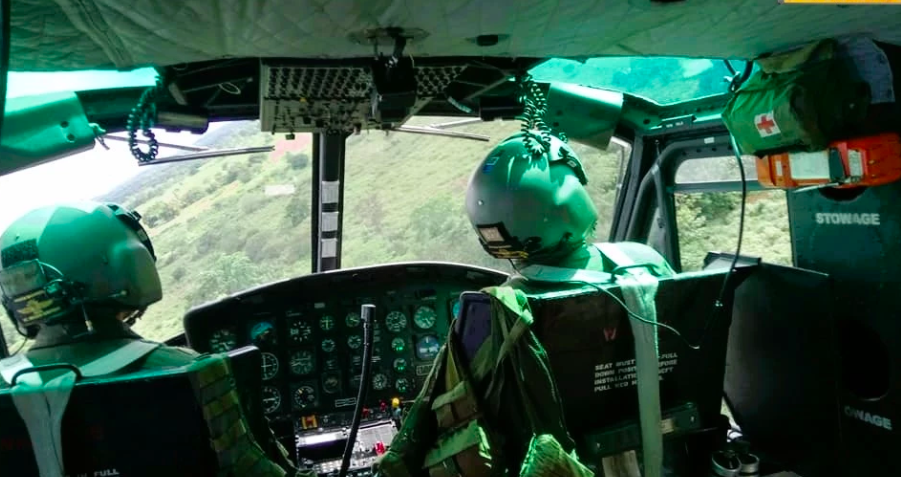
But there are also facts such as the restriction – ordered by General Sanabria – of the number of flight hours of those pilots who do not carry out anti-drug operations, increasingly less frequent by presidential directive, which has been significantly harming pilots with greater operational experience.
Added to this situation are the worrisome delays in personnel transfers at the national level, which require the constitution of shortlists of candidates (to replace vacancies), demanded by Deputy Director Navarro.
He evaluates them and makes the selection without considering the opinion of the departmental directors, in a process that has been causing delays of up to three months.
In addition, and unjustifiably, there have been actions (transfers, for example) that affect officers who identify themselves as members of the LGTBIQ+ community or whose sentimental situation does not fall within the canons of a Catholic or Christian marriage.
RELIGIOUS FERVOR
The latter is what has apparently been emphasized: the religious theme, to the point of taking into account the level of devotion and parish commitment of the officers, for their possible or probable selection for certain positions of direction, management, or administrative importance.
The excessive religious fervor exhibited – and demanded – by the leadership of this institution has reached the point of recommending spiritual retreats.
In the ceremonial acts carried out, there is always an image of the Virgin Mary, being common medals of the Virgin Mary and rosaries in pockets, lapels, and uniforms of senior officers of the force.
However, what generates greater concern not only in state institutions or international collaboration but mainly within the Armed Forces (including the Police) is an increasing lack of operational results due to a decrease in the missionary levels.
This is manifesting – and notoriously – in an increase in the perception of insecurity by the inhabitants of both large and medium-sized cities and in growing levels of criminal governance by organized armed groups, both in remote regions of the country and in medium-sized towns.
There are no signs of coherent responses by the new government to confront them beyond populist proposals that have no basis in reality and seem to favor not the citizen but, paradoxically, the criminal.
All this panorama in the midst of a global peace process, based on a ceasefire – and actions – by the Public Forces, carried out by 23 organizations.
This leaves the civilian population unprotected against violent acts of terrorism, which reflects a lack of care and attention in the design of peace processes (necessary for the termination of the conflict) that, in their effective development, are the main guarantors of the rights of citizens.
With information from Infodefensa
Editorial responsibility: Matthias Camenzind, Editor-in-Chief · Editorial standards · Report an error
Read More from The Rio Times