Colombian Peso Gains 1.7% to Close at 3,211 per Dollar

MARKETS · COLOMBIA
Key Facts
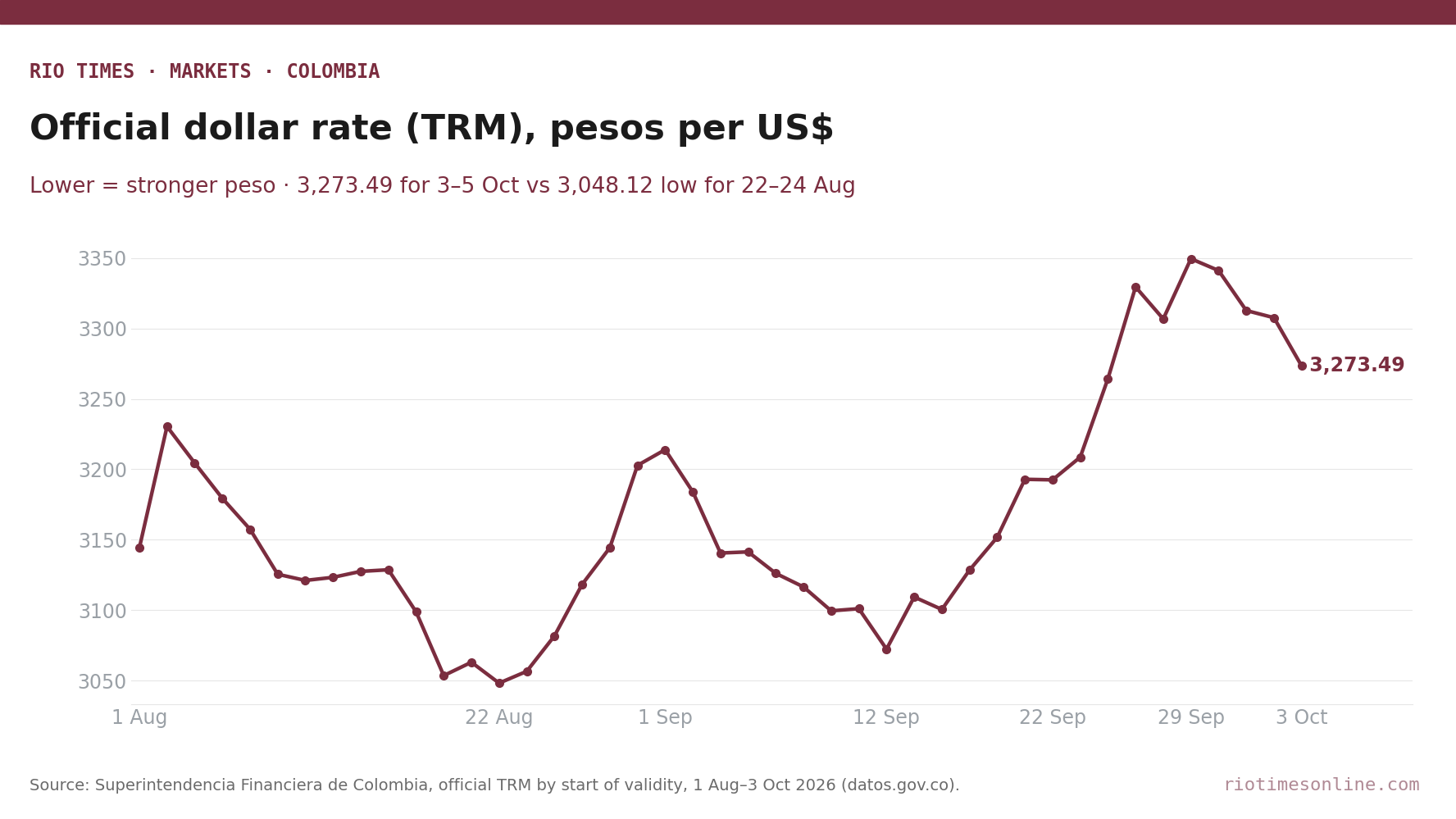
- —The country Colombia is an oil-exporting economy with a strong currency this year. The official dollar rate has fallen about 13 percent since 1 January, from 3,757.08 pesos per dollar, Superintendencia Financiera data show.
- —Why it matters Oil is the country’s main export, and Brent crude opened Monday at US$101.61 a barrel. The central bank, the Banco de la República, raised its rate to 12.25 percent on 30 September, against forecasts of a hold.
- —Why now The dollar fell about 2.9 percent last week, from 3,362 to 3,264.50 pesos per dollar at Friday’s close, El Espectador reported. It kept falling on Monday 5 October.
- —What happened The peso closed at 3,210.92 per dollar on Monday 5 October, when trading ended at 1 p.m. Bogotá time, La República reported. That is 1.9 percent below the official rate of 3,273.49.
- —The numbers The official rate (TRM) bottomed at 3,048.12 per dollar for 22–24 August, the lowest since 2018. It peaked at 3,349.63 on 29 September, Superintendencia Financiera data show.
- —What it means for you A US$1,000 transfer now buys about 4 percent fewer pesos than at the 29 September rate. Colombian holidays, coffee and flowers cost Americans a little more.
- —Still open Tuesday’s official rate (TRM), set from Monday’s trades; September inflation from the statistics agency DANE on Wednesday 7 October; the October rate decision.
- —Prediction markets Polymarket gives no change at the October central bank meeting a 38% chance and a 25-basis-point hike 37% (5 October, 2:15 p.m. ET).
The Colombian peso strengthened again on Monday, closing at 3,210.92 per US dollar in Bogotá’s spot market. For Americans, a dollar now buys fewer pesos than at any official rate since 23 September.
The currency sits about 5 percent short of its late-August best, the strongest official rate since October 2018. A surprise rate hike, oil above US$100 a barrel and a rally in Brazil’s real form the backdrop.
What the Market Showed on Monday
The exchange rate closed Monday’s session at 3,210.92 pesos per dollar, down 62.57 from the official TRM of 3,273.49, La República reported. It traded between 3,190.11 and 3,250 pesos per dollar.
Dealers closed 1,325 trades worth about US$1.1 billion, the paper said. Earlier, around 9:45 a.m. local time, El País and El Heraldo had put the average near 3,225 per dollar.
The TRM is the reference rate certified by the Superintendencia Financiera, Colombia’s financial regulator, from the previous session’s trade. Monday’s market sets the rate that will apply on Tuesday.
Friday’s session closed at 3,264.50 pesos per dollar, El Espectador reported. The week had opened with a close of 3,362, so the dollar lost about 2.9 percent in five sessions.
For the Colombian peso, the move extends a gain that began after last week’s policy meeting. That rally is covered in Colombia’s Peso Strengthens to Around 3,300 per US Dollar After a Surprise Rate Hike.
Why the Colombian Peso Is Strong
The first driver is the rate gap, detailed in Colombia Raises Its Policy Rate to 12.25%. The Banco de la República, Colombia’s independent central bank, raised its benchmark rate by 25 basis points to 12.25 percent on 30 September.
Most analysts had expected a hold at 12 percent. A higher local rate makes peso assets more attractive to foreign investors, even after the US Federal Reserve raised rates in September.
The second driver is oil. Brent crude opened Monday at US$101.61 a barrel, Caracol Radio reported, with markets watching the conflict between Iran and the United States.
US crude fell about 1.2 percent to around US$90, the EFE agency reported. The G7 had agreed on Friday to release 100 million barrels from emergency reserves.
The third driver is regional. Brazil’s real opened 3.87 percent stronger against the peso after Sunday’s first-round presidential vote, Caracol data show. Investors read the result as more market-friendly.
Steady remittances from Colombians abroad add to the supply of dollars as well.
Live Market IntelligenceColombia — Live Market Board
Rio Times · Live Market Intelligence
Colombia — Live Market Board
+2.43%
208,865.27
+8.72%
64,531.68
+1.10%
11,072.62
+1.43%
2,882,805
+4.16%
2,576.14
+2.43%
59,860.04
+0.55%
| Instrument | Last | Change | YoY | Prev. | High | Low | Volume |
|---|---|---|---|---|---|---|---|
| COLCAP | 2,576.14 | +2.43% | — | 9.04 | 9.05 | 9.02 | 4,133 |
| USD/COP | 3,140 | +0.03% | -22.04% | 3,139 | 3,141 | 3,105 | — |
| BRENT | 88.88 | -0.03% | +34.42% | 88.91 | 90.07 | 88.12 | 29,713 |
| WTI | 83.11 | -0.11% | +31.57% | 83.20 | 84.35 | 82.40 | 166,848 |
| ECOPETROL | 16.92 | -0.53% | +98.01% | 17.01 | 17.05 | 16.79 | 737,591 |
| BANCOLOMBIA | 95.87 | -2.18% | +96.15% | 98.01 | 100.36 | 95.73 | 188,740 |
| GRUPO AVAL | 5.40 | +2.66% | +76.89% | 5.26 | 5.49 | 5.32 | 146,447 |
| TECNOGLASS | 42.30 | -1.10% | -48.04% | 42.77 | 42.73 | 42.05 | 60,908 |
| CREDICORP | 375.17 | -0.49% | +49.60% | 377.00 | 384.43 | 372.27 | 88,375 |
| BUENAVENTURA | 34.45 | -1.02% | +88.07% | 34.80 | 35.62 | 34.33 | 275,831 |
| SOUTHERN COPPER | 193.97 | -0.26% | +104.01% | 194.48 | 199.36 | 192.59 | 367,102 |
Who Gains and Who Loses
A strong Colombian peso cuts the cost of imports and of dollar debt. It also eases pressure on prices, at a time when annual inflation stood at 6.24 percent in August.
The cost falls on exporters, who receive fewer pesos for each dollar of coffee, flowers or oil they sell. Former finance minister José Antonio Ocampo told BBC Mundo this year’s gain was excessive.
The fiscal picture is the main risk. In August, the credit-rating agency Fitch Ratings warned that the deficit could exceed 7 percent of GDP, El Tiempo reported.
Wage talks add a further question for prices. A report by the Colombian advisory firm JP Tactical, cited by Pulzo, expects a 2027 minimum-wage rise of about 8 percent, with inflation near 7 percent.
Higher US yields are a second risk. The 10-year Treasury yield rose to 5.305 percent on Monday, a multi-year high, according to EFE. Rising US yields usually draw money away from emerging markets.
What It Means for You
For American visitors, a firmer peso makes Colombia dearer. A US$1,000 transfer at Monday’s close buys about 4 percent fewer pesos than at the 29 September official rate.
Investors in peso bonds gain in dollar terms. Exporters such as Ecopetrol, whose shares also trade in New York, receive fewer pesos for each dollar of sales.
Families who send money home from the United States also feel it, as each dollar now converts into fewer pesos.
What Is Not Known
Tuesday’s official rate (TRM), set from Monday’s trades, had not been published at the time of writing. It is not known whether the rally will hold through the week.
It is not yet clear whether the central bank will raise rates again at its October meeting. September inflation, due from DANE on Wednesday, will weigh on that choice.
The Fed’s September minutes are also due on Wednesday. They could shift expectations for US rates, and with them the pull of the rate gap.
Oil remains the wild card for the Colombian peso. Cheaper crude after the G7 release would cut export receipts, while escalation between Iran and the United States could lift prices.
More: Colombia news in English, every day from The Rio Times.
What Prediction Markets Say
On Polymarket’s “Central Bank of Colombia decision in October” market, bets on no change stood at 38% at 2:15 p.m. ET on 5 October, about 7 points lower than a day earlier. A 25-basis-point hike was priced at 37%.
Bets on a hike of 50 basis points or more rose most on the day, to about 18%, while a cut was priced at 2% or less. About US$32,000 has been traded, a thin volume in which prices can jump.
Why we show this: prediction markets turn real-money bets into a live probability that moves within minutes of the news, which is why investors, campaigns and newsrooms in the United States now follow them closely. We show them next to polls and official results, never instead of them.
What is Colombia’s TRM?
The TRM, or Tasa Representativa del Mercado, is Colombia’s official peso-dollar reference rate. The Superintendencia Financiera certifies it from the previous session’s spot trades, and it applies for the following business day.
Why is the Colombian peso so strong in 2026?
Analysts point to high local interest rates, oil prices above US$100 a barrel and steady inflows from remittances. The official dollar rate has fallen about 13 percent since 1 January, Superintendencia Financiera data show.
When does Colombia’s central bank decide on rates next?
The Banco de la República holds its next policy meeting in October, after raising its rate to 12.25 percent on 30 September. Polymarket bets give a further 25-basis-point hike a 37% chance.
Sources: Superintendencia Financiera de Colombia, official TRM series (datos.gov.co), accessed 5 October 2026; La República, 5 October 2026; Vanguardia, 5 October 2026; El País (Cali), 5 October 2026; El Heraldo (with EFE), 5 October 2026; El Espectador, 4 October 2026; Caracol Radio, 5 October 2026; Diario del Cauca, 4 October 2026; Pulzo, 5 October 2026; El Tiempo, 20 August 2026; BBC Mundo, 18 September 2026; Polymarket market prices, 5 October 2026.
Editorial responsibility: Matthias Camenzind, Editor-in-Chief · Editorial standards · Report an error
LatAm Markets: Live Signals → — real-time movers, turnover leaders and FX across Latin America.