Chile Expels 56 More on Tenth Flight, 1,874 This Year

MIGRATION · CHILE
Key Facts
- —The country Chile, governed since March by conservative President José Antonio Kast, who made removing irregular migrants a core campaign promise.
- —Why it matters Chile is adopting the charter-flight removals the United States has expanded, a sign of tougher migration policy across the region.
- —Why now The government released its latest migration figures alongside the tenth expulsion flight of the Kast administration.
- —What happened On Saturday 10 October a charter left Santiago at 1:25 a.m. with 56 expelled foreigners bound for Bolivia, Ecuador and Colombia.
- —The numbers 1,874 expulsions in 2026 so far, plus 10,345 voluntary departures, for 12,219 exits in total.
- —What it means for you Police checks on foreigners rose 46.6% this year, and employers of irregular workers face inspections and fines.
- —Still open Removals to Venezuela, whose citizens made up nearly 80% of voluntary departures, show no reported progress.
Chile flew 56 expelled foreigners out of Santiago early on Saturday 10 October, the tenth Chile expulsion flight since President José Antonio Kast took office in March. The government says the flight brings expulsions in 2026 to 1,874, about 200 a month. For US readers, it shows a close Washington partner adopting the same charter-flight approach to migration that the Trump administration has made its signature policy.
The figures were presented at a press conference by Interior Undersecretary Máximo Pavez, the official who runs day-to-day migration policy at the Interior Ministry. He appeared with Frank Sauerbaum, director of the National Migration Service (Sermig), the civilian agency that issues visas and administrative expulsion orders.
Also present was Prefect Inspector Ernesto León, national head of migration and international police at the PDI, Chile’s plain-clothes investigative police, which carries out the removals.
Who Was on the Flight
Saturday’s Chile expulsion flight was a charter operated by Andes Líneas Aéreas, an Argentine airline. It took off from Arturo Merino Benítez International Airport at 1:25 a.m. and stopped in the northern city of Iquique before flying on to the three destination countries, La Tercera reported.
On board were 21 Colombians, 20 Bolivians and 15 Ecuadorians. Of the 56, 45 were expelled by administrative order and 11 by court ruling. Administrative expulsions usually follow migration breaches; judicial ones are ordered by a judge, often as part of a criminal sentence.
Entering Chile through an unauthorised border crossing was the most common ground, covering 31 people. Six cases were linked to robbery with intimidation and five to the drugs law, according to the official breakdown carried by La Tercera and Cooperativa. La Tercera also listed four cases of receiving stolen vehicles and two of violent robbery.
León said the group included “five persons of interest with different police records,” for drug trafficking and rape among other offences. He added that one Colombian national is wanted in his own country on a warrant for aggravated theft.
The Government’s Numbers
Pavez said the 1,874 expulsions this year work out at close to 200 a month and seven a day. “This tenth flight represents a frequency of flights approximately three times higher than the monthly average of the previous government,” he said, referring to the administration of former President Gabriel Boric, a leftist who governed from 2022 to March 2026.
For comparison, Cooperativa reported that 1,117 foreigners were expelled in 2025, Boric’s last full year in office. That figure was not repeated in the other reports we reviewed.
Expulsions are only part of the picture. Between 3 January and 4 October, 10,345 foreigners who had entered through unauthorised crossings left the country voluntarily, without an expulsion order. Venezuelans accounted for 8,243 of them, or 79.7%, and Colombians for 970. Together with expulsions, that makes 12,219 departures this year.
Context matters here. Chile has more than 330,000 foreigners in an irregular situation, according to the National Statistics Institute (INE) figure cited by Cooperativa. At the current pace, expulsions alone would take many years to reach that number, which is why the government also leans on voluntary exits and workplace checks.
Spending is rising to match. The government has asked Congress for a large increase in the expulsions budget, as covered in Chile Seeks 190% More Money for Expulsions. The first flight of the Kast era was reported in Chile’s Kast Launches First Deportation Flight as 2,180 Venezuelans Self-Deport.
Fewer Border Reports, More Checks
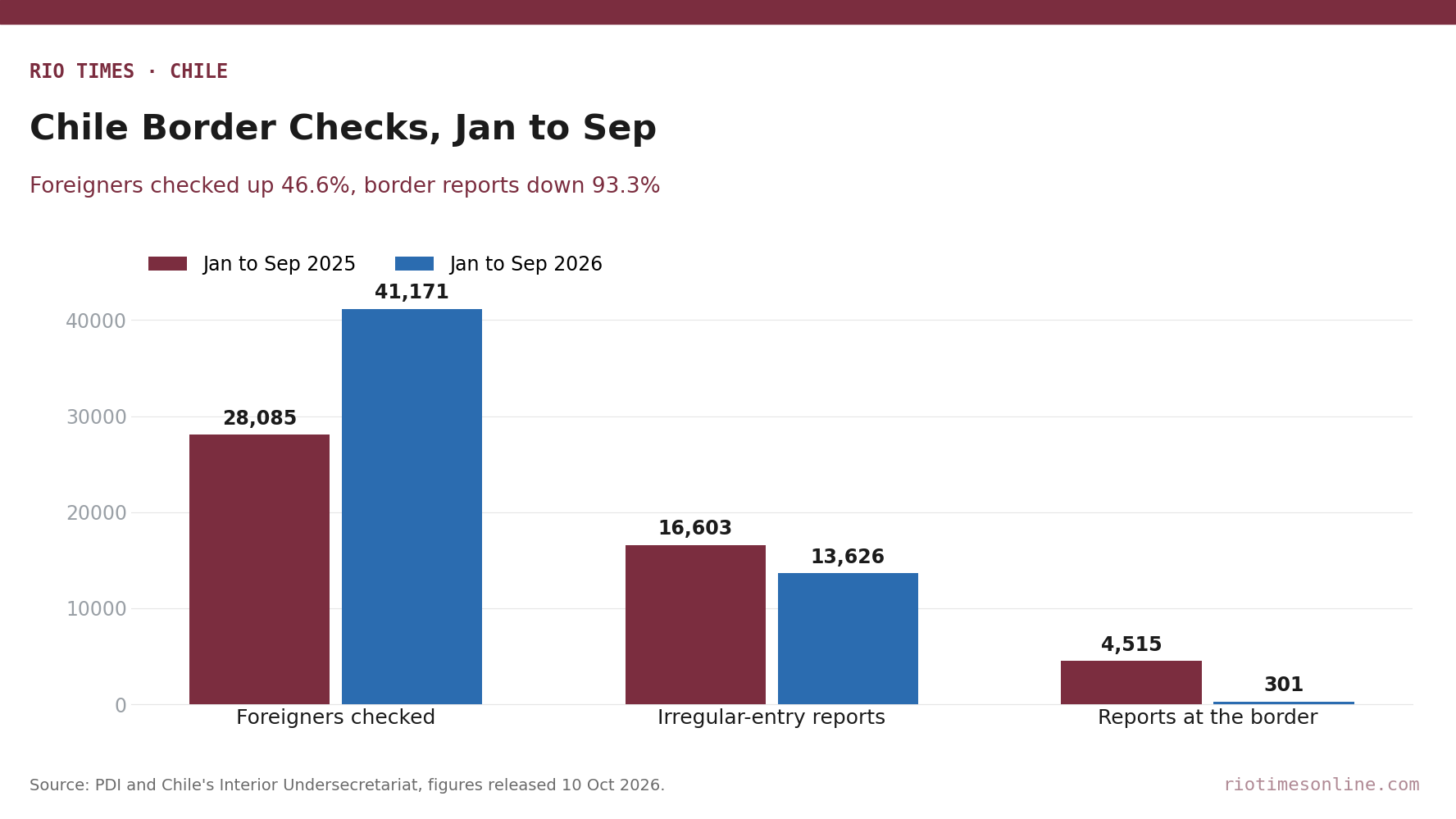
PDI data released with the flight point to fewer crossings and more enforcement inside the country. Reports filed directly at the border fell 93.3% between January and September, from 4,515 in 2025 to 301 this year.
That is a separate measure from reports of entry through unauthorised crossings, which dropped more modestly, from 16,603 to 13,626. Migration inspection operations rose 24.7%, from 1,407 to 1,755, and the number of foreigners checked climbed 46.6%, from 28,085 to 41,171.
Sauerbaum said the next phase will target employers. “We are going to continue with the inspections we are carrying out at companies that have hired irregular people, and also carry out the corresponding fine process,” he said.
What It Means for You
For tourists and legal residents, little changes in practice, but identity checks are more frequent. Carry your passport or Chilean ID card and keep proof of your legal status handy, especially in the north and in central Santiago.
For foreign companies and investors, the warning is about hiring. Firms that employ workers without valid status face Sermig inspections and fines, so it pays to audit contractors and subcontractors now.
For US policy watchers, Chile is another regional government aligning its migration stance with Washington’s. The stabiliser is that removals run through formal administrative and court procedures, with set grounds for each case.
What Is Not Known
The government did not say when the next flight will leave or which countries it will serve. It also gave no cost for Saturday’s operation.
The biggest gap is Venezuela. Venezuelans made up nearly 80% of voluntary departures, yet Cooperativa reported no progress on removals there, even though restored consular ties were announced in August.
A government bill to make irregular entry a criminal offence is still under debate in Congress, according to Cooperativa. Its timing and final wording are not known. The identities of the five people flagged by police were not released.
Frequently Asked Questions
How many people has Chile expelled in 2026?
The government says 1,874 foreigners have been expelled in 2026, including the 56 on the flight of Saturday 10 October. Another 10,345 left voluntarily between 3 January and 4 October.
Where did the latest Chile expulsion flight go?
The charter left Santiago at 1:25 a.m., stopped in Iquique and carried 21 Colombians, 20 Bolivians and 15 Ecuadorians back to their home countries.
Why were the 56 people expelled?
Most, 31 people, entered Chile through unauthorised border crossings. Others had records for robbery, drug offences and receiving stolen vehicles. Forty-five were administrative expulsions and 11 were ordered by courts.
Sources: Chile’s Interior Undersecretariat, National Migration Service and PDI press conference of 10 October 2026, as reported by La Tercera, Cooperativa, El Mostrador and BioBioChile.
This article was produced by The Rio Times’ automated newsroom system. How we use AI · Report an error · Editorial responsibility: Matthias Camenzind, Editor-in-Chief