Chile’s Kast Launches First Deportation Flight as 2,180 Venezuelans Self-Deport
— A Chilean Air Force Boeing 737 departed Thursday morning from Santiago with 40 irregular migrants aboard — 19 Colombians, 12 Bolivians, and 9 Ecuadorians — in the Kast government’s first deportation flight, five weeks after taking office
— Of the 40 expelled, 25 were removed on administrative orders and 15 on judicial orders, with 30 carrying criminal records including armed robbery, drug trafficking, and illegal weapons possession — each escorted by a dedicated PDI officer
— The deterrence effect is already measurable: irregular border entries have fallen 67% compared to four years ago, expulsions are up 33% in the first month, and 2,180 Venezuelans have left Chile voluntarily since Kast won the presidency
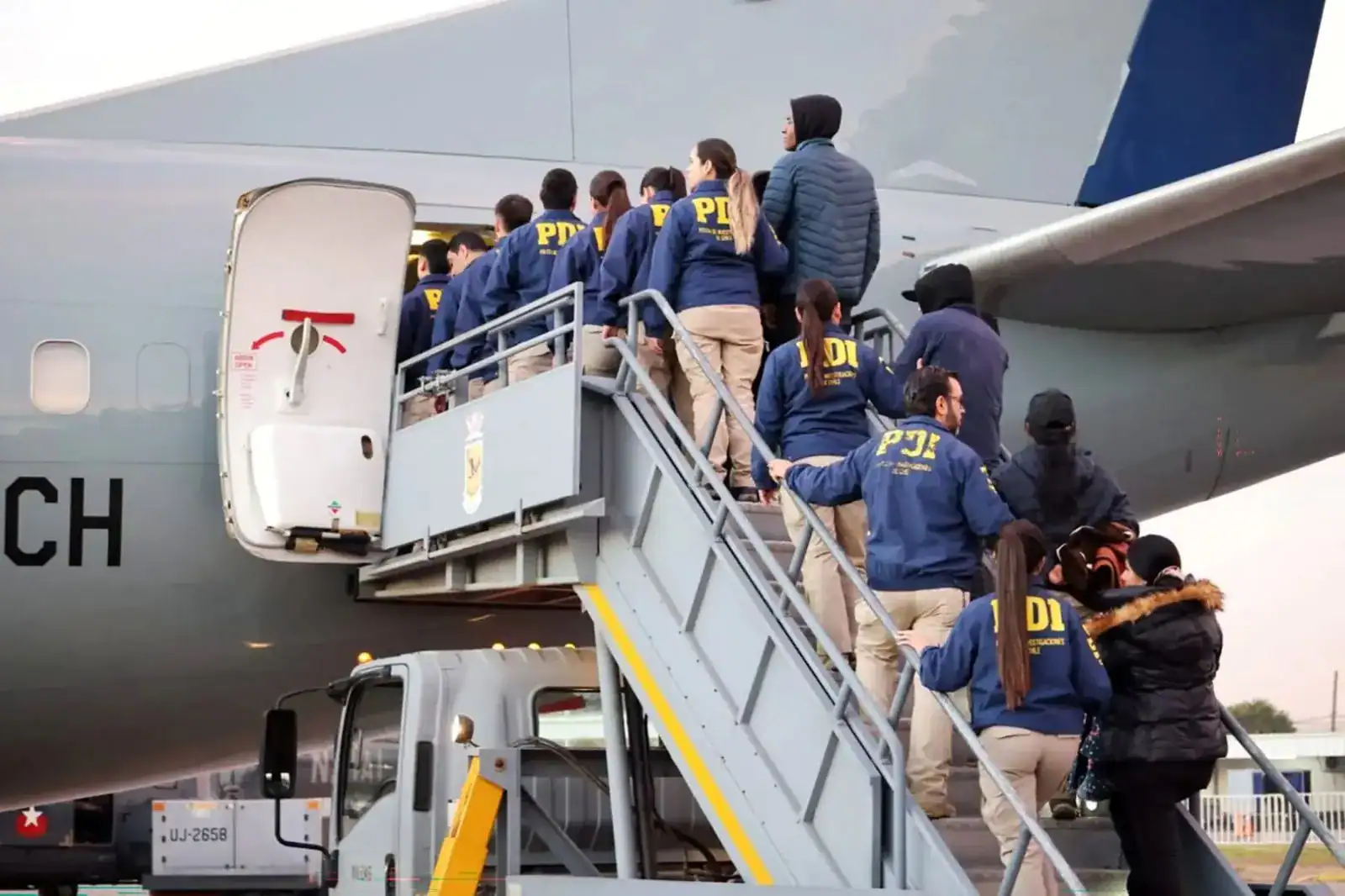
The Rio Times, the Latin American financial news outlet, reports that Chile Kast deportation operations moved from rhetoric to reality Thursday morning when a Chilean Air Force Boeing 737 lifted off from the Grupo 10 base at Pudahuel, carrying 40 irregular migrants to Bolivia, Ecuador, and Colombia. The flight — coordinated between the National Migration Service, the Policía de Investigaciones (PDI), and the Air Force — marks the first forced expulsion operation under President José Antonio Kast, who took office on March 11.
Interior Undersecretary Máximo Pávez was blunt at the Iquique stopover where additional deportees boarded: “Deportations are not announced — they are carried out. From now on, we will intensify these measures through systematic planning.”
The Chile Kast Deportation Operation: One Officer Per Deportee
The logistics reveal how seriously the government is treating the optics and security of the operation: each of the 40 deportees traveled with a dedicated PDI escort seated beside them in tactical gear, restrained with disposable plastic handcuffs throughout the flight, with no firearms carried aboard per protocol. The route flew Santiago to Santa Cruz de la Sierra (Bolivia), then Quito, then Bogotá, handing deportees to local authorities at each stop. The government will report results publicly every two weeks.
Of the 40 expelled, 25 were removed under administrative orders for irregular migration status and 15 under judicial expulsion orders. Thirty of the deportees had criminal records including armed robbery, drug trafficking, illegal weapons possession, and threats. The geographic origin of the deportees concentrated in Santiago (13 cases) and the northern mining city of Calama (8), with smaller numbers from Arica, La Serena, Punta Arenas, and Temuco.
The Deterrence Numbers: 67% Drop in Irregular Entries
Migration Service director Frank Sauerbaum presented first-month statistics that the government considers vindication of the hardline approach. Irregular border entries have fallen 67% compared to the same period four years ago under former President Boric, and expulsions have increased 33% in Kast’s first month. The most striking figure: 2,180 Venezuelans have left Chile voluntarily since Kast won the presidency — without a single Venezuelan being included on Thursday’s deportation flight.
The Venezuelan exclusion is diplomatic, not ideological. Chile’s relations with Venezuela remain frozen, making deportation flights logistically impossible. But the voluntary departure rate suggests that Kast’s campaign rhetoric — he promised to expel 337,000 undocumented migrants and predicted that for every forced deportation, four or five would self-deport — is producing a deterrence effect before enforcement has fully ramped up.
From Campaign Promise to Scheduled Operations
The government plans at least two deportation flights per month plus bus convoys to neighboring countries, with biweekly public updates on results. Pávez also announced a legislative agenda that includes criminalizing irregular entry, facilitating administrative expulsion procedures, and penalizing landlords and employers who house or hire undocumented migrants. A proposed 10-kilometer exclusion zone along the northern border would allow immediate detention and deportation of anyone without documentation.
This flight is the latest in a sequence of actions since Kast’s inauguration-night signing of three migration decrees, followed by the launch of border trench construction five days into his presidency, and the deployment of the Orbán-modeled Plan Escudo Fronterizo with 5-meter walls, drones, and thermal cameras across the northern frontier. Chile has approximately 330,000 irregular migrants in a country of 18 million, where the foreign-born population has risen from 0.8% in 1992 to 8.8% in 2024.
Opposition lawmaker Tatiana Urrutia of the Frente Amplio questioned the scale, noting that 40 deportees against 330,000 irregular residents is statistically negligible. The government’s counter-argument is that the flight is the visible tip of a systemic overhaul — and that the 2,180 voluntary Venezuelan departures prove the policy works before the planes even take off.
Read More from The Rio Times