Trump Tariffs Face US Court Test That Could Scrap a 12.5% Duty on Brazil
TRADE · BRAZIL
Key Facts
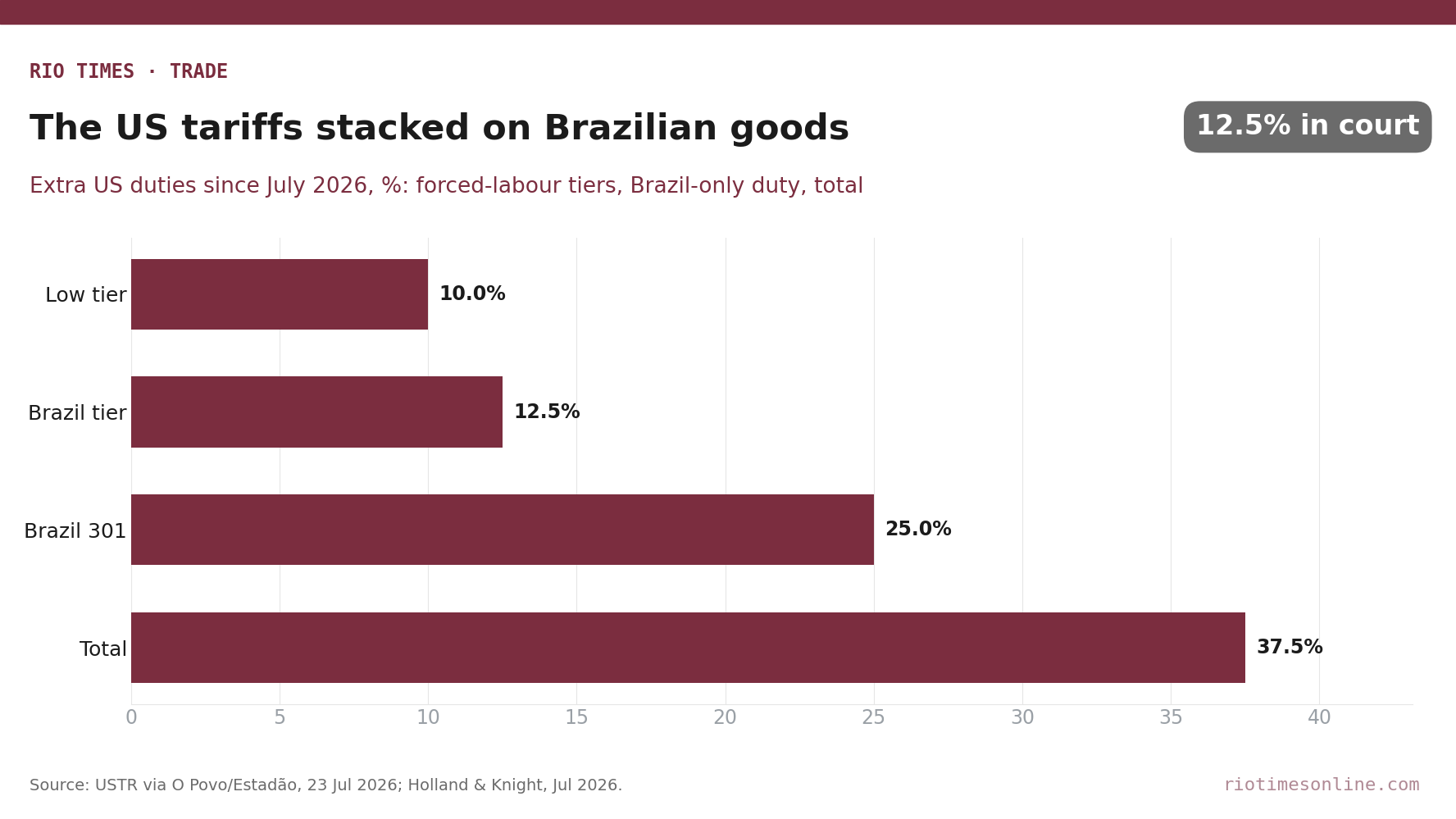
- —The country Brazil, whose goods face a 12.5 percent US “forced-labour” tariff plus a separate 25 percent duty, a 37.5 percent surcharge since late July (USTR, via Estadão, 23 July).
- —What happened On Wednesday 30 September a three-judge panel of the US Court of International Trade heard challenges to the forced-labour tariffs on 60 trading partners, Reuters reported.
- —Who is involved Four small businesses, two of them represented by the Liberty Justice Center, and 25 Democratic-led US states on one side; the Trump administration and its trade office on the other.
- —What it means for you A win for the challengers could remove the 12.5 percent layer on Brazilian goods. The 25 percent Brazil-only duty rests on a different investigation and would stay.
- —Still open The court will rule in writing, possibly weeks or months from now. Either side can appeal to the Federal Circuit and, later, the Supreme Court.
Trump tariffs imposed on Brazil and 59 other economies in the name of fighting forced labour went before a US court on Wednesday. A three-judge panel of the Court of International Trade in New York heard arguments over whether the duties are lawful.
The duties of 10 or 12.5 percent cover more than 99 percent of US imports, Reuters reported. Brazil sits in the higher band, and its exporters pay a further 25 percent under a separate order.

Who is suing, and on what grounds
The case pits four small businesses and 25 Democratic-led states against the administration, according to Reuters. The Liberty Justice Center represents two of them, the spice importer Burlap & Barrel and the watch importer Collective Horology, CT Mirror reported. The public-interest law firm was among the winners of the earlier tariff case at the Supreme Court.
The other two, the educational-toy makers Learning Resources and hand2mind, filed on 24 July, the day the duties took effect. The states, including California and New York, sued on 3 August, the BBC reported.
The duties rest on Section 301 of the Trade Act of 1974. It lets the president answer foreign practices that burden US commerce. The trade office did not accuse partners of using forced labour. It penalised them for not banning imports made with it: 10 percent where such a ban exists, 12.5 percent where it does not.
The challengers argue such tariffs require country-specific findings of unfair practices. The small businesses call the import-ban test one that no country could realistically pass, CT Mirror reported.
In their view, forced labour is a pretext to revive the blanket tariff power the Supreme Court struck down on 20 February. The administration says its trade office genuinely investigated each of the 60 partners before acting.
What is at stake for Brazil
The Office of the US Trade Representative (USTR) confirmed the Brazilian rate on 23 July. It said Brazil lacked sufficient means to block imports made with forced labour, Estadão reported.
That 12.5 percent sits on top of a 25 percent duty in force since 22 July, the result of a separate Section 301 investigation into Brazil. Together they form a 37.5 percent surcharge on goods not exempted.
Wednesday’s case concerns only the forced-labour layer. A ruling against it would lower, not remove, the extra cost for Brazilian footwear, textiles and other exposed products.
Much of Brazil’s US trade is already sheltered from the 25 percent duty. Coffee, beef, iron ore and aircraft parts are exempt, as detailed in Coffee and Iron Ore Escape the New 25% US Tariff on Brazil.
Brasília’s response and the court’s record
The Brazilian government called the forced-labour tariffs “arbitrary” and “unjustified” on 23 July. It said it would prepare measures under its Reciprocity Law and take the matter to the World Trade Organization.
Not all of industry agrees. The machinery association Abimaq said it opposes retaliation, arguing it would be ineffective and could harm dialogue with Washington.
The trade court has ruled against the White House before. In May it struck down the temporary 10 percent global tariff, as reported in U.S. Trade Court Strikes Down Trump’s 10% Global Tariff.
After the Supreme Court voided the earlier emergency Trump tariffs, importers received refunds worth tens of billions of dollars, the BBC reported. A similar outcome here is possible but far from certain.
What Is Not Yet Known
The panel did not rule from the bench, and CNN Brasil reported a decision could take weeks or months. Any appeal could keep the duties in force while the case continues.
It is also unclear whether new Trump tariffs would replace these if they fall. Several other Section 301 investigations are pending, and Washington is examining 16 countries over industrial overcapacity, the BBC reported.
Sources: Reuters (Dietrich Knauth), 30 September 2026; CT Mirror, 29 September 2026; CNN Brasil, 30 September 2026; BBC News Brasil via O Povo, 4 August 2026; O Povo/Estadão, 23 July 2026; Holland & Knight, July 2026; hand2mind statement, 21 August 2026.
Read More from The Rio Times