Brazilian Soybean Farmers in Bolivia Part of Political Uprising Overthrowing Morales
RIO DE JANEIRO, BRAZIL – The participation of the armed forces in the movement that imposed the resignation of Evo Morales was incisive, to the extent of obscuring the historic support of landowners to the former Bolivian leader’s opponents.
Among these landowners are some Brazilians, who began growing soybeans in the early 1990s in the east of the country – a region near the municipality of Santa Cruz de La Sierra, the political cradle of populist demagogue Luis Fernando Camacho. They account for 35 percent of Bolivia’s annual oilseed production of 2.4 million tons.

The soybean farmers are actively engaged in the strategies of organizations advocating the interests of ruralists in Bolivia, in opposition to the policies of Evo Morales and his party, the Socialist Movement (Movimiento al Socialismo – MAS).
“The east has historically been a focus of resistance to Evo’s policies,” says Tomaz Paoliello, professor of international relations at the Pontifical Catholic University in São Paulo (PUC-SP). “The rural representatives who support him are the small producers of the western region, gathered in the city of Cochabamba and its surroundings”.
One of the main areas defended by Evo Morales – now in exile in Mexico – was the policy of access to land for peasants and the control of food exports, which has always been perceived by landowners as a threat.
As a result, the downfall of the government did not surprise Jose Guilherme Gomes dos Reis, a naturalized Bolivian citizen who for nearly three decades has managed 6,500 hectares of soy plantations in the Santa Cruz de La Sierra region, the richest in the country. In an interview with the newspaper Zero Hora, Reis said that Morales was “becoming a dictator”. “If there was a coup, it was Evo’s electoral fraud,” he said.
BRAZILIANS FINANCED SANTA CRUZ COMMITTEE
Gomes dos Reis actively participates in the country’s agricultural policy, as one of the 13 directors of the National Association of Oilseed and Wheat Producers (ANAPO), one of the main organizations defending the interests of rural producers in Bolivia.
For at least twenty years, the Soybean Farmers’ Association has supported the pro-Santa Cruz Civic Committee, now led by Camacho, the most eloquent figure in the uprising. On November 8th, before the fall of Evo Morales, representatives of the two organizations and the Farming Chamber of the East took part in a protest against what they considered “the threat of confiscation of private properties”.
This support from ANAPO can be translated into figures, such as the donation of US$50,000 that the organization granted to the Committee in 2005. Most of this money came from Brazilian soy producers. This relationship was strengthened in 2007, in the second year of Morales’ administration, when the government coordinated the implementation of a new Constitution to guarantee the rights of indigenous peoples, among other items.
Landowners, particularly foreigners, felt the threat of losing their lands with the implementation of an agrarian reform that was being discussed in the Constituent Assembly. They then began to support the Civic Committee’s campaign for Santa Cruz to be managed with its own rules, by means of departmental rules.
This concept did not progress and soybean farmers kept their properties, despite the promulgation of the Bolivian Magna Carta. Even so, the closeness established between the groups was preserved. In 2015, the president of the Committee for Santa Cruz, Roger Montenegro Leite, Camacho’s predecessor, took part in the inauguration of ANAPO’s new board of directors.
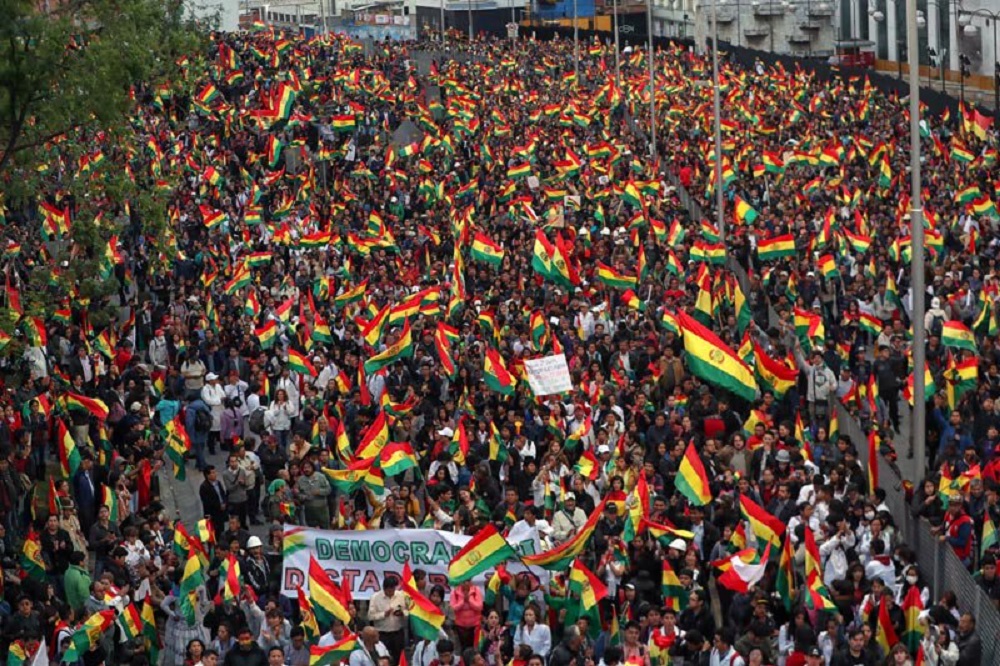
“They have always defended neoliberalism and their main objective is to establish free trade agreements,” says Hector Mondragón, an adviser to indigenous and peasant organizations in Colombia. With the fall of Morales, the loosening of the rules for exporting soybeans, one of the main priorities advocated by rural producers, is closer to being achieved.
As the indigenous leader’s policy regarded agricultural production as a source of food, not commodities, the government limited the export of grains to keep its domestic price stable. Nevertheless, in May Morales yielded to the market, and released 60 percent of soybean production for export. But the rural producers continued to advocate for the flow of the entire production.
“It is a movement encouraged by Brazilian producers, who want to export from there using the same routes from Mato Grosso to China,” says Paoliello. “This is a replica of the strategy also implemented in Paraguay. Along with the removal of Evo Morales, barriers have fallen so that this plan can be put into practice.”
INDIGENOUS LEADER DENOUNCES RACIST VIOLENCE
The reaction to the coup in Bolivia was led on Monday by peasants and indigenous people in El Alto, in the region of La Paz. “Now it’s civil war,” they shouted. There was repression. From Mexico, Evo Morales protested on Twitter against the police action:
“After the first day of the civic-political-police coup, the riot police repress with bullets to cause deaths and injuries in El Alto. My solidarity goes to these innocent victims, among them a little girl, and to the heroic people of El Alto, advocates of democracy.”
The demonstrators carried the Whipala, the flag of the original peoples recognized by the 2008 Constitution. “There will be blood and mourning, we will not allow the neoliberals to return to power,” said Rodolfo Machaca Yupanqui, leader of the Sole Trade Union Confederation of the Peasant Workers of Bolivia.
Adriana Guzmán Arroyo, a member of the organization Feminismo Comunitário Antipatriarcal (Anti-patriarchal Community Feminism), of the Aymará ethnic group, told the Argentinian newspaper La Voz a first-person account of the repression against peasant and feminist movements:
“We are under threat. People are being identified, lists of names are being distributed. These are racist attacks. For instance, among fifty people, they identify the one that can be symbolic: an indigenous woman, in a skirt, or an indigenous man; and if they are from the Socialist Movement, all the better. These are planned and programmed attacks, not attacks by everyone against everyone.”
“They are selective. Besides, it is not only violence but also humiliation: they make us kneel down and ask for forgiveness. The mayor of Warnes, Mario Cronenbold, was forced to resign and beg the country for forgiveness for having joined the MAS. On Monday morning, they were at the home of rural workers’ leaders, pressuring them and destroying and burning their homes, demanding that they kneel down, drop the flag and ask for forgiveness. In the streets, we hear: ‘These bloody Indians are finally gone’. Everything has a colonial logic.”
She said that “the civics” threatened journalists with death, they took over community radio stations and the headquarters of the Rural Confederation.
“In the midst of the terror created in the streets emerged Luis Fernando Camacho, president of the pro-Santa Cruz Civic Committee, which is the representation of the oligarchical union of the country’s landowners and businessmen,” she said. “He has economic power.”
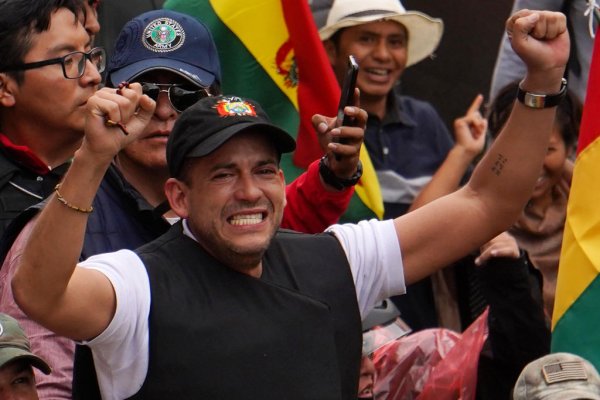
The reporter from La Voz reported that videos on social media recorded the burning of Whipalas. And that police officers removed the indigenous, plurinational symbol from their uniforms. Adriana described these facts as evidence of the racism of the coup.
Source: De Olhos nos Ruralistas
More: Brazil news in English, every day from The Rio Times.
This article was produced by The Rio Times’ automated newsroom system. How we use AI · Report an error · Editorial responsibility: Matthias Camenzind, Editor-in-Chief