New Gold Rush in Protected Yanomami Indigenous Area in Brazil
RIO DE JANEIRO, BRAZIL – More than 10,000 illegal gold prospectors are currently reported to be within the territory of the Yanomami Indians in northern Brazil. The figures are an estimate by Yanomami’s most significant association, Hutukara.
A Yanomami and Ye’kwana delegation had already reported the situation to government authorities in Brasília in May this year, including the Ministries of Justice and Defense and the Funai Indigenous Protection Agency.

Non-governmental organizations are also sounding the alarm. “Bolsonaro’s policy has tragic consequences, and the gold rush in northern Brazil is just one example,” Survival International director Stephen Corry said in a press release. Only public domestic and international outcry could stop it, Corry continued.
Since president Jair Bolsonaro took office, mining in Brazil’s indigenous protectorates has increased sharply, encouraged by the discourse of a president who wants to make these protectorates officially available for mining. The constitution provides for mining on indigenous land, but regulation is required for it to be legal, and Congress has not passed a bill to this effect for over 20 years.
This could now change. “In Roraima, there are billions of Reais underground. And the Indians have the right to use them, reasonably, of course. The Indians cannot continue to be poor on rich land,” Bolsonaro declared in April.
So far, army bases have restricted the illegal entry of gold seekers into Yanomami territory. In December, the units on the Uraricoera and Mucaja rivers, the central entry points for boats into Yanomami territory, left their positions.
The current gold rush represents the most massive invasion of the Yanomami land since the official land demarcation in 1992.
Between 1986 and 1990, more than twenty percent of the Yanomami population died as a result of a massive invasion of more than 40,000 gold prospectors and the associated spread of disease. In July 1993, gold miners murdered 16 Yanomami. The Haximu massacre was officially recognized as genocide by the judiciary in 2006.
More than 25 years later, the Yanomami again sounded the alarm. Davi Kopenawa, a Yanomami spokesman, spoke of up to 20,000 gold prospectors in the region. “They bring nothing good; they only bring problems. Malaria has spread to the Amazon region of Marari and has already killed four children.
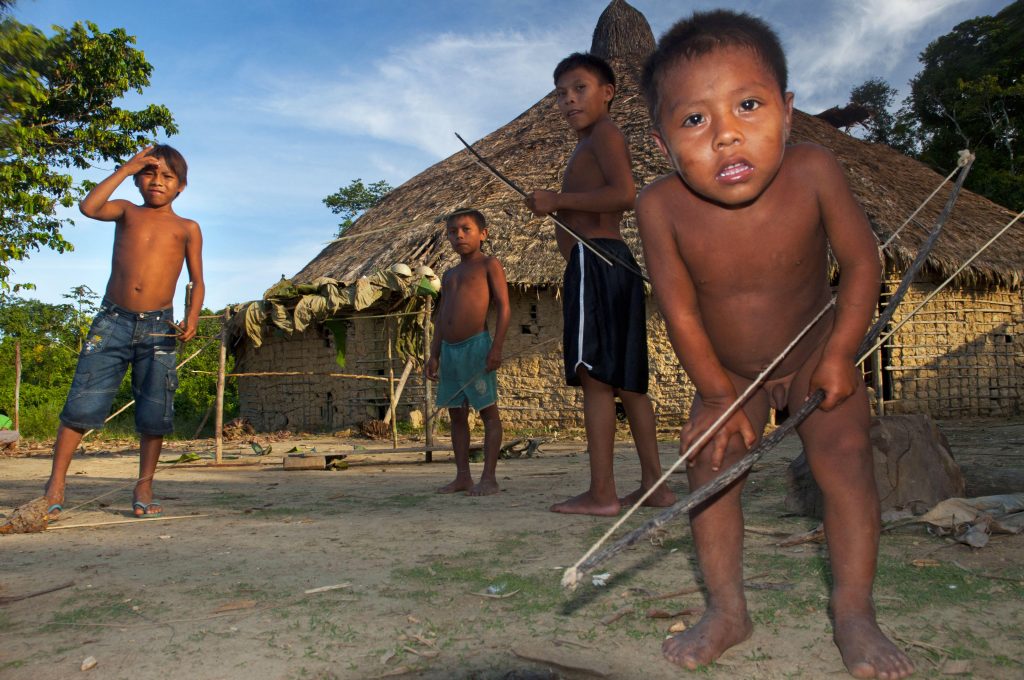
There may be at least one group of Yanomami in this area who do not want any contact with outsiders. The miners’ diseases particularly threaten uncontacted tribes. Besides, the more than 35,000 Yanomami in Brazil are already fighting today against contaminated rivers and fish stocks, principally by mercury, which is used in gold mining.
In 2016, a study conducted by the Oswaldo Cruz Foundation (Fiocruz) in collaboration with ISA showed that in some Yanomami villages, up to 92 percent of Yanomami residents are contaminated with the metal, especially when they are close to gold mining sites.
The gold business is concentrated in the state of Roraima. According to statistics from Comex Stat, the foreign trade portal of the Ministry of Economy, 194 kilograms of gold have been exported from Roraima to India since September 2018.
In 2019, gold is the second most important export in Roraima, although not a single gold mine has been legally registered in this state.
According to research by BBC Brasil, there is a suspicion that gold mining has now outgrown the possibilities of the black market to such an extent that gold prospectors have bought invoices from an officially registered mining company to cover up the origin of the illegally extracted gold and resell it at higher market prices.
More: Brazil news in English, every day from The Rio Times.
Editorial responsibility: Matthias Camenzind, Editor-in-Chief · Editorial standards · Report an error