Brazil Markets: Ibovespa & the Real — August 26, 2026
Key Facts
- Ibovespa closes up 1.55% at 174,577 points, its fifth straight gain, trimming August’s loss to under 2%
- Rate-sensitive stocks led the charge with Banco do Brasil up 5.2% and Magazine Luiza jumping 9.1% as local rate-cut bets deepened
- The real firmed slightly to 5.1490 per US dollar on the central bank’s PTAX closing rate, a 0.04% move
- Petrobras fell 1.8% as oil slid almost 4%, while Braskem plunged 13.1% after its debt restructuring filing and was dropped from the index
- The index remains about 12% below its 52-week high of 198,657 points, leaving room for the recovery to extend
Today’s Focus
Brazil’s Ibovespa — the main stock index on the B3 exchange in São Paulo — closed Tuesday up 1.55% at 174,577 points, its fifth consecutive daily rise. The session was a clear vote for domestic rate-sensitive names: Banco do Brasil soared 5.2%, Magazine Luiza jumped 9.1%, and builders Cury and Tenda each rose about 7.5%.
The US dollar slipped to 5.1490 reais on the Banco Central’s PTAX closing rate, down 0.04%. The commercial dollar ended at 5.140 reais, its low of the day and 0.25% weaker — small moves, but they keep the real in the stronger half of its one-year range.
The outliers were tied to oil and debt. Petrobras fell 1.8% as crude slid almost 4% on easing Middle East tension, while Braskem, the petrochemicals group, plunged 13.1% a day after filing for out-of-court debt restructuring, and was removed from the Ibovespa at Tuesday’s close.
What matters today. The market is betting that lower local interest rates are coming, and it is rewarding the stocks most exposed to that theme.
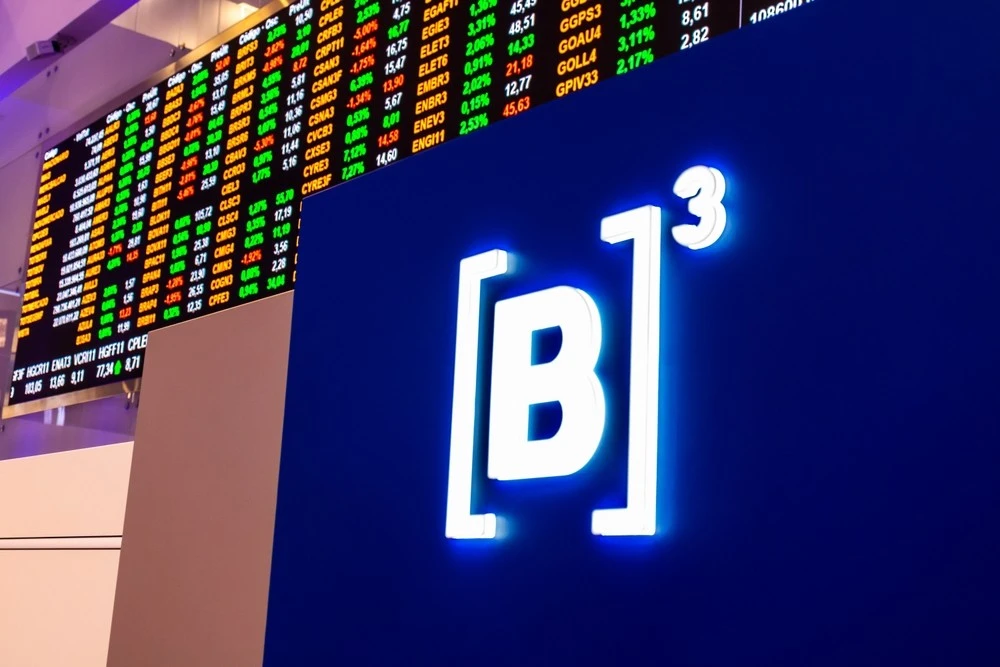
01 The session in one read
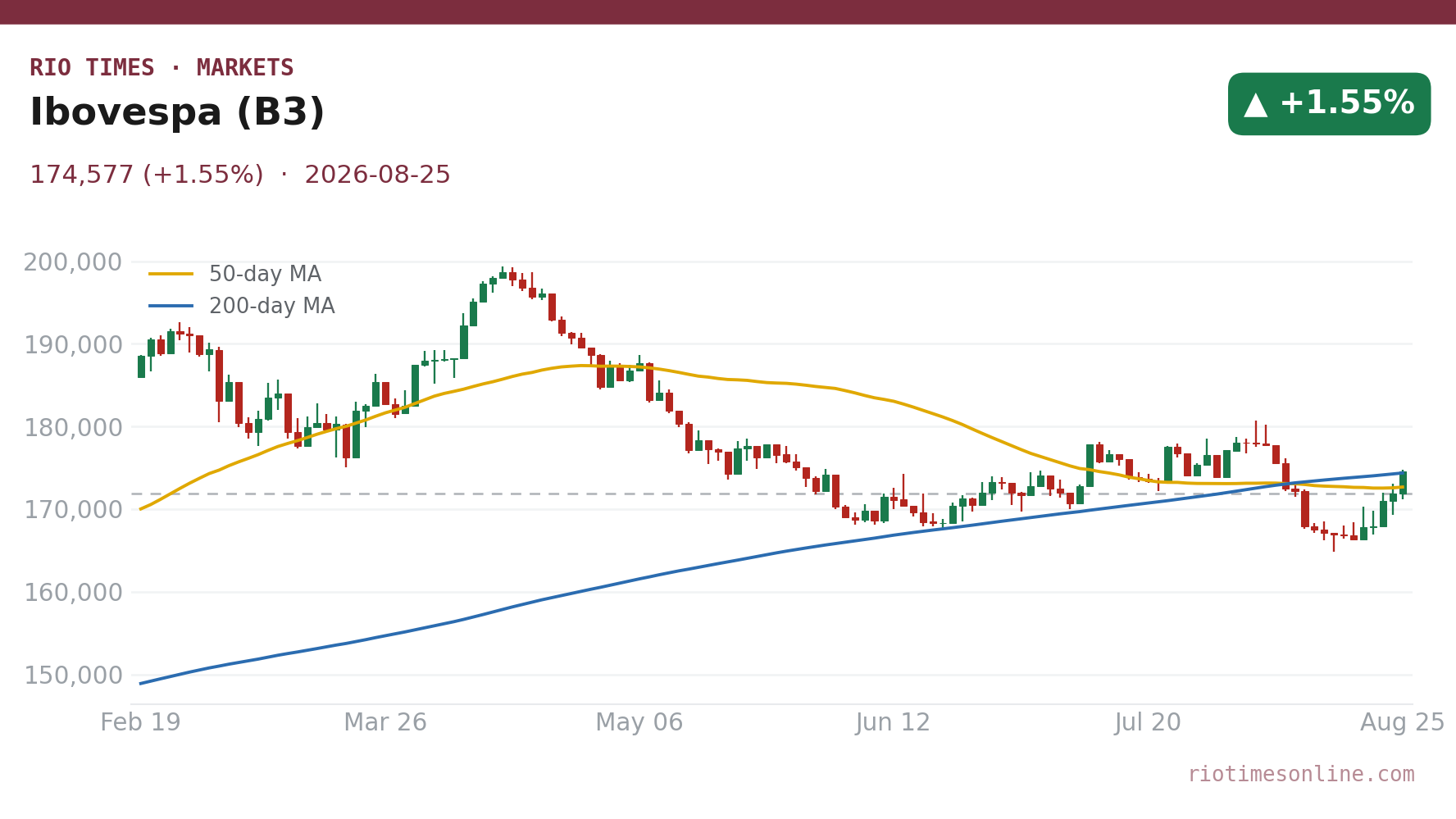
The Ibovespa climbed 1.55% on Tuesday to 174,577 points, a fifth straight advance that underlines how quickly the tone has shifted in São Paulo. The B3 exchange — Brazil’s main stock market — saw buyers concentrate on companies that win when borrowing costs fall, from homebuilders to discount retailers.
The real, Brazil’s currency, ended barely changed at 5.1490 per US dollar on the central bank’s PTAX closing rate, down 0.04%. That steadiness matters: it tells foreign investors that the rally in Brazilian shares is not being undermined by currency wobbles.
One clear signal came from Banco do Brasil, the state-controlled lender, which rose 5.2% with turnover of about US$131 million. Another came from Magazine Luiza, the electronics and home-goods retailer known to locals as Magalu, up 9.1% — the biggest gain inside the index.
Yet the session was not universal. Petrobras, the oil major that carries heavy weight in the index, fell 1.8% as crude prices slid. Braskem plunged 13.1% after filing for out-of-court debt restructuring, a reminder that single-stock shocks can still disrupt the broader mood.
Five straight gains and a 1.55% jump suggest the Ibovespa has re-established its upward path after the slide from April’s high near 199,000 points. The leadership — builders, retailers, and Banco do Brasil — points squarely at domestic rate expectations rather than a global commodity bid, which is a healthier foundation for a sustained move.
The variable to watch is whether Petrobras and the oil block stabilise, because a rotation that punishes the index’s heaviest weights for too long will cap further gains.
Live Company IntelligenceBanco do Brasil S.A. — the full investor dossier
Valuation & profitability
Price & risk
$17.6752-wk high
$27.36
Revenue trend · 6y
Ownership
Dividend
03 Why it moved — rate-cut bets broaden
The clearest driver was the widening expectation that the Selic, Brazil’s benchmark interest rate, has room to fall further. Local interest-rate futures dropped by as much as thirteen hundredths of a point across the curve, extending the easing that began when the central bank cut the Selic to 14.00% earlier in August.
When borrowing costs drop, two groups of stocks typically lead: banks, which can reprice their loan books favourably, and companies tied to consumer credit and housing. Banco do Brasil’s 5.2% gain and Bradesco’s 3.1% rise fit that logic — Bradesco traded about US$150 million, among the heaviest of the day.
On the consumer side, Magazine Luiza’s 9.1% jump was echoed by Sendas Distribuidora, the cash-and-carry chain known as Assaí, up 7.8%. Homebuilders Cury and Tenda each rose about 7.5%, a direct wager on cheaper mortgages.
The global backdrop helped, with US indices modestly higher — the S&P 500 gained 0.32% to 7,677 — and the VIX volatility gauge falling 2.52% to 15.45. That gave local investors room to focus on Brazil’s domestic story.
04 The day’s movers
| Driver | Level / Move | Change | Note |
|---|---|---|---|
| Petrobras PN (PETR4) | US$690m traded | −1.8% | Heaviest turnover of the day as oil slid |
| Vale ON (VALE3) | US$270m traded | +2.0% | Biggest single lift to the index on Carajás expansion talk |
| Bradesco PN (BBDC4) | US$150m traded | +3.1% | Rate-cut beneficiary among big banks |
| Banco do Brasil ON (BBAS3) | US$131m traded | +5.2% | State lender surges on rate bets |
| Magazine Luiza ON (MGLU3) | — | +9.1% | Biggest gain inside the index |
| Braskem PN (BRKM5) | — | −13.1% | Debt restructuring filing; left the Ibovespa at the close |
| Oncoclínicas (ONCO3) | — | +15.1% | Second straight surge in the small-cap space |
The turnover leaderboard tells the story of a two-speed session. Petrobras attracted the most money by far — about US$690 million, or R$ 3.55 billion — but fell 1.8%, meaning traders were actively cutting exposure even as the index advanced.
The arithmetic was striking: oil and gas names drained roughly 524 points from the index, yet Vale alone added about 400 and the four big banks around 600. The BOVA11 exchange-traded fund, which tracks the whole Ibovespa, rose 1.6% — broad buying, not a narrow, single-stock event.
Oncoclínicas, a cancer-treatment network, jumped 15.1% for a second straight day of sharp gains, with no company announcement to explain the move. It shows speculative appetite is returning to smaller names.
05 The regional scoreboard
| Index | Country | Change |
|---|---|---|
| Ibovespa | Brazil | +1.55% |
| IPC | Mexico | −0.38% |
| Merval | Argentina | +0.46% |
| IPSA | Chile | −0.76% |
Brazil led the region’s large markets by a wide margin with its 1.55% gain. Mexico’s IPC rose 0.79% and Argentina’s Merval added about 0.8%, while Chile’s IPSA fell 0.8%, dragged down by its lithium giant SQM.
The live market board above carries the exact closes for all regional indices.
06 The technical picture
At 174,577 points, the Ibovespa has recovered a meaningful share of the ground lost since the April slide from near 174,577 The move through 174,500 matters because it clears a shelf of recent selling pressure and puts the index back in a cleaner uptrend.
The 52-week low of 137,771 now sits about 21% below the current level, while the high of 198,657 is roughly 12% above. That asymmetry — more room to rise than to fall before testing extremes — is one reason dip-buyers have grown bolder.
The next real test is the 178,000–180,000 zone, where the index stalled earlier in the year. If rate-cut bets hold, that band could come into view quickly; if Petrobras and other heavyweights keep sliding, the index will struggle to reach it.
07 What to watch
- Local inflation: The mid-month IPCA-15 inflation print lands today and will shape the urgency of Selic rate-cut expectations
- Petrobras stabilisation: Whether the oil major finds support after Tuesday’s crude-driven drop will help determine if the index can hold 174,500
- Banco do Brasil momentum: A second day of strong bank buying would confirm the rotation into rate-sensitive financials
- The real’s next step: A push below 5.10 per dollar would signal stronger foreign inflows and add fuel to the share rally
Background: Ibovespa Slides for a 9th Straight Session as Citi Drops Brazil’s Real on a Likely Lula Win.
More: Brazil news in English, every day from The Rio Times.
Frequently Asked Questions
What is the Ibovespa?
It is Brazil’s main stock index, tracking the most-traded companies on the B3 exchange in São Paulo — essentially the health gauge of corporate Brazil.
Why did Banco do Brasil jump 5.2%?
Investors expect Brazil’s central bank to keep cutting the Selic interest rate, which tends to boost bank profitability and consumer credit demand.
Why did Petrobras fall when the market rose?
Oil prices fell almost 4% as Middle East tension eased, hitting producers across the region. Petrobras was the day’s most-traded stock, with about US$690 million changing hands.
What does USD/BRL 5.1490 mean?
It is the central bank’s PTAX closing rate for Tuesday: one US dollar bought 5.1490 reais. A fall in the number means the real is getting stronger against the dollar.
Market data: RT; exchange figures from B3; session reports: InfoMoney; FX: Banco Central do Brasil (PTAX, 25 Aug). Dollar conversions at PTAX 5.1490.
This article was produced by The Rio Times’ automated newsroom system. How we use AI · Report an error · Editorial responsibility: Matthias Camenzind, Editor-in-Chief
LatAm Markets: Live Signals → — real-time movers, turnover leaders and FX across Latin America.