Analysis: Police Violence Extends Across Brazil, Shielded by Impunity
RIO DE JANEIRO, BRAZIL – June 2020 marked the explosion of worldwide antiracist protests after the death of African-American George Floyd, murdered by a police officer in Minneapolis. At the same time that demonstrations by the Black Lives Matter movement were replicating in the country, the violence of the Brazilian police against black people was also escalating in the peripheries.
In São Paulo alone there were at least four cases of torture or abuse of authority by state police in June. A study by the Brazilian Public Safety Forum points out that police lethality in São Paulo grew by 31 percent between January and April, a month that beat the record of deaths caused by police (119, compared to 78 in 2019) during quarantine.
In the most striking case, 15-year-old black teenager Guilherme Silva Guedes disappeared in the southern part of the state capital and was found dead in Diadema with two gunshot wounds and beating marks on his body. The State Police’s (PM) Internal Affairs is investigating a sergeant and a soldier who are suspected of the murder.
In another case, in the outskirts of Carapicuíba, São Paulo, a 19 year-old black youth, Gabriel Nunes de Sousa, was immobilized by strangulation after failing to stop the motorcycle he was driving and colliding with a car. He was immobilized through a sleeper choke hold by one of the police officers and later, lying on the tarmac, passed out when asphyxiated by another officer who pressed his knee over his neck for almost a minute, in a setting that recalls the action that killed George Floyd in the United States.

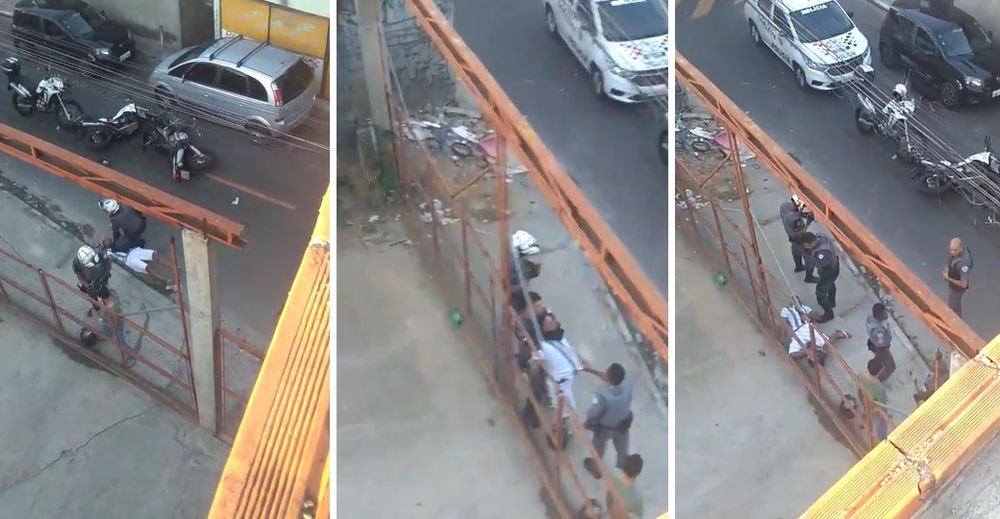
“I thought they were going to kill me. There were a lot of blows to my head,” says 27-year-old W.F.G., who was beaten and tortured by police officers in the early hours of June 14th in Jaçanã, in northern São Paulo. Although he told the police that he was not a criminal – “I’m a worker, I’m a worker,” he shouted during the torture session filmed by community residents – the pizzaiolo was unable to escape the beating with punches, kicks and clubbing. After the footage repercussions, eight police officers involved in the operation were arrested.
At the police station, threatened by police officers, the victim did not report the beatings, which only came to light after the footage was released. “They [police officers] made several threats. I work respectfully, I never had to steal from anyone, but now I’m afraid to leave home,” the pizzaiolo says.
Cases like the recent abuses in São Paulo have become routine across Brazil. Fifty-eight occasions of violence or torture by police officers have been identified since the start of the year, with at least one recorded per state, based on formal charges that became public.
There are violations of several kinds: from security agents who commit crimes out of uniform, off-duty, to beatings during policing rounds and special operations. The majority of victims (68 percent) are black and live in peripheral neighbourhoods, where they were approached.
In Rio de Janeiro, May was marked by deaths of black youths by police in favelas. Residents of the Acari favela reported police officers for alleged torture and murder of Iago César dos Reis Gonzaga, 21.
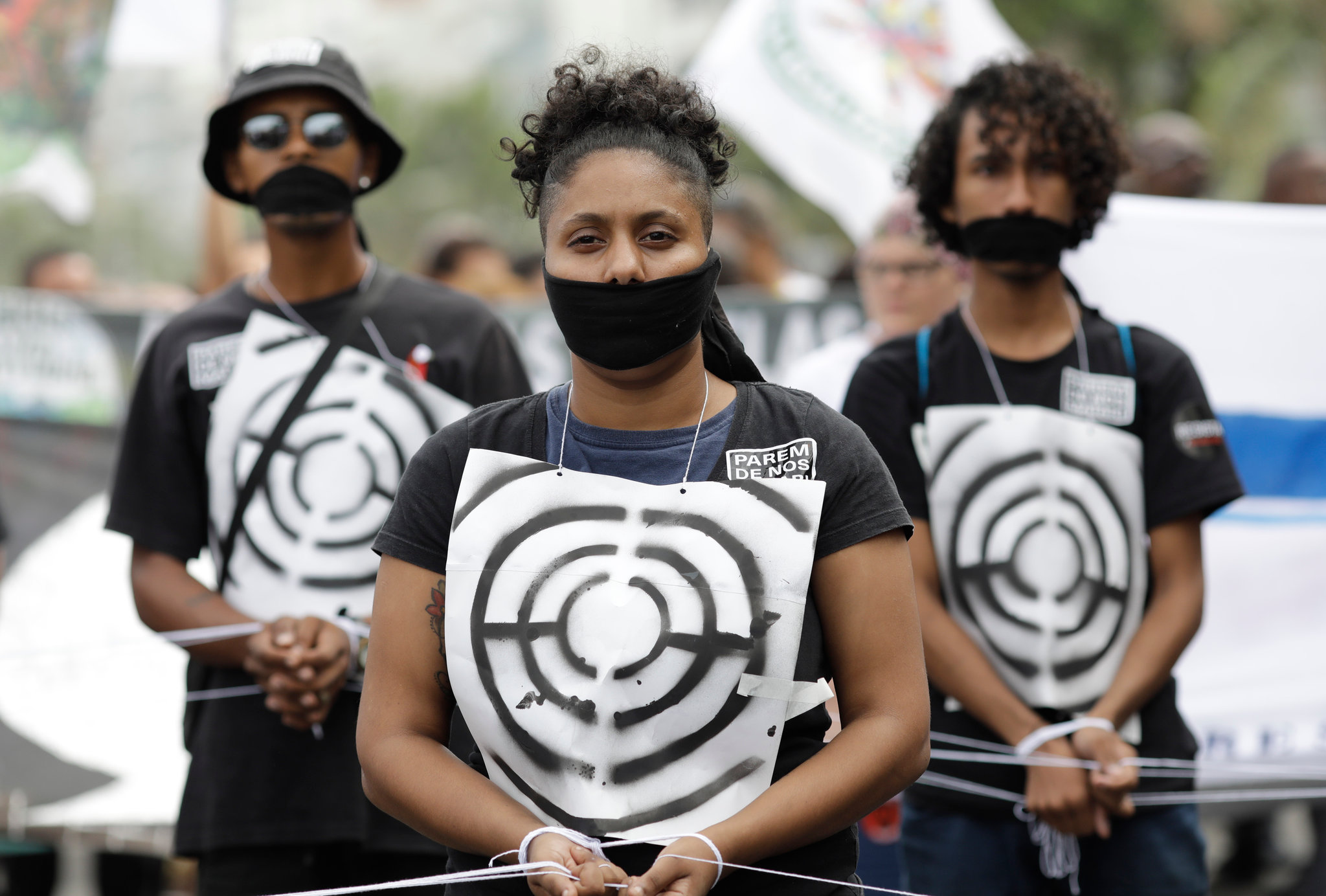
João Vítor da Rocha, 18, died after being shot in Cidade de Deus – according to the police, there was a gunfight. Two days later, during another operation at the Salgueiro favela complex in São Gonçalo, 14-year-old João Pedro was shot in the back. His death triggered protests, in the wake of Black Lives Matter, which called attention to racism and black genocide.
Racial discrimination is flagrant in police approaches. In February, a state police soldier in Bahia attacked a 16-year-old black teenager by kicking him in the stomach and punching him in the ribs while searching him in the neighborhood of Paripe, a railroad suburb of Salvador. In the deed, filmed by a witness, the PM also delivers homophobic and racist insults to the victim, who had a black power hairstyle.
“You’re a crook to me, a bum. Go get that disgraceful thing out of your hair,” shouted the assailant during the violent approach. The witness who filmed the scene was forced to be included in the National Secretariat of Citizenship’s protection program of the Ministry of Human Rights after police officers returned to the neighborhood in search of the person responsible for the filming.
Prosecuted by the Internal Affairs Department, the soldier was removed from street policing and transferred to administrative functions. “I don’t accept police violence,” said Rui Costa, the governor of Bahia at the time. “It is unacceptable, intolerable and does not reflect the institution’s ideals.”
However, the following month, Salvador police officers were caught torturing youths who were approached in a raid in the neighborhood of Liberdade, using a wooden club. The four PMs who were filmed during the torture session were eventually arrested and prosecuted by Internal Affairs.
In Planaltina, a community in the Federal District, 30-year-old street vendor Weliton Luiz was approached by two police officers as he walked out of a supermarket and beaten with batons on his back and head. The Federal District State Police opened an investigation, acknowledging the disproportionate attack, but rejecting a discriminatory act of racism because Weliton is black. “There is no need to talk about racial behavior, but rather about abuse in police action,” the PMDF said in a statement. A young man, also black, filmed the attacks and denounced the case through social media.
In early June, the Locomotiva research institute conducted a survey for the Single Favela Center (CUFA) in which 94 percent of 1,652 respondents agreed that in Brazil blacks are more likely to be violently approached or killed by the police than whites.
According to the Violence Yearbook prepared by the Brazilian Public Safety Forum, 75 percent of victims of police lethality are black, in a country where 56 percent of the population declares themselves black.
The practice of torture is still established as a chronic and racial issue in the prison system. A survey by the Rio de Janeiro State Public Defender’s Office shows that the institution has received more than 1,000 denunciations of inhumane treatment committed against prisoners -72 percent of them black – in the state.
On average, three prisoners are tortured every day. “The numbers reflect the logic of continued human rights violations, particularly at the time of arrest,” explains public defender Fábio Amado. “Unfortunately, there is a regularity of this very serious practice, which is torture.”
Uncontrolled police violence during the pandemic
In the survey there are also cases of police abuse related to restrictive measures decreed because of the Covid-19 pandemic. In Luzilândia, interior of Piauí state, 43-year-old Raimundo Nonato da Costa died after being arrested for breaking a health barrier to prevent the coronavirus. Police officers involved in the arrest were removed under suspicion of torture by the PM, which is still investigating the cause of death.
In Plácido de Castro, state of Acre, a 17-year-old black teenager with psychiatric and neurological disorders denounced assaults by police officers from the Special Border Group (GEFRON), who approached him demanding that he wear a mask. The Prosecutor’s Office for Childhood and Youth has opened proceedings to investigate the case.
By preliminary order of Federal Supreme Court (STF) Justice Edson Fachin, police operations in Rio de Janeiro’s favelas were banned, except in “absolutely exceptional cases,” where a written justification must be submitted to the Prosecutor’s Office.
The measure in effect since June 5th has not prevented, however, an operation using armored vehicles by the Special Operations Command in the Complexo do Salgueiro, in order to stop a trafficker’s birthday party. On the same day of the operation, as part of the State Police’s exceptionality, the camera in a bar filmed a police officer punching a female resident.
In his decision, Fachin stressed that in extraordinary operations, the police must take special care and not endanger the population or hinder the provision of public health services or humanitarian aid activities in the communities.
The justice also mentioned the case of João Pedro, whose residence in Salgueiro was struck by over 70 shots, to sustain the measure. “Nothing justifies a 14-year-old child being shot over 70 times. The fact is indicative, in itself, that, maintaining the current normative framework, nothing will be done to reduce police lethality, a state of affairs that in no way respects the Constitution.”
For activist Zulu Araújo, president of the Pedro Calmon Foundation, linked to the Secretariat of Culture of Bahia, the pandemic has increased the vulnerability of the black population, exposed to the risks of the coronavirus and, simultaneously, of aggressive approaches for compliance with social isolation measures.
“In Brazil we are experiencing an endemic picture of police violence, which afflicts the poor and the black,” says Zulu. “In an exceptional situation, because of the pandemic, it becomes even clearer how the Brazilian state has established the legalization of genocide of young blacks, and how their bodies are dehumanized to the point where the security forces feel entitled to attack and exterminate them. These are deaths that neither raise awareness nor generate a collective feeling of guilt. If a white boy had been shot by a rifle in an apartment in Leblon, the whole of Rio de Janeiro’s society would be on the streets in protest.”
Repetitive events under the guise of impunity
Most cases of abuse of authority involving police officers still proceed in special courts, although a 2018 opinion by the Federal Prosecutor’s Office (MPF) argues that prosecuting officers for intentional crimes against life is the task of the usual criminal court system, where the proceedings tend to be swifter than in the Military court system.
Last year, five state police officers were acquitted in Rio de Janeiro’s 2nd Criminal Court of the murder of a 17-year-old teenager in Morro da Providência. Cell phone footage showed one of the police officers placing a gun in the young man’s hand and firing two shots to forge a resisting arrest report (when the victim is shot in a gunfight). The court considered that despite evidence of “potentially reprehensible and illegal conduct,” the action of the police in the favela was legitimate.
Recording approaches has become a way of exposing police violence. In February, 23-year-old Isabela de Souza, six months pregnant, was attacked by a state police officer in São José do Rio Preto, interior of São Paulo, after challenging an approach to a teenager for carrying marijuana. She filmed the action and, trying to stop it, the police officer immobilized her and slapped her in the face and knocked her on the belly. The attacks continued despite the appeal of neighbors who warned about the woman’s pregnancy. The police officer was removed and prosecuted by Internal Affairs.
Since 2019, a bill that criminalizes by a penalty, ranging from three months to a year’s imprisonment, the action of preventing someone from photographing, filming or recording police operations, has been under way in Congress. The proposal is being analyzed by the Chamber of Deputies’ Commission of Constitution and Justice and Citizenship.
“Brazilian law does not prohibit citizens from taking photos and filming police actions, but even so, this type of restriction by police officers is very common,” says Deputy Charles Fernandes, the bill’s sponsor, which provides for an increased sentence for politicians, the military or public servants. “Good police officers have no reason to fear their conduct being recorded.”
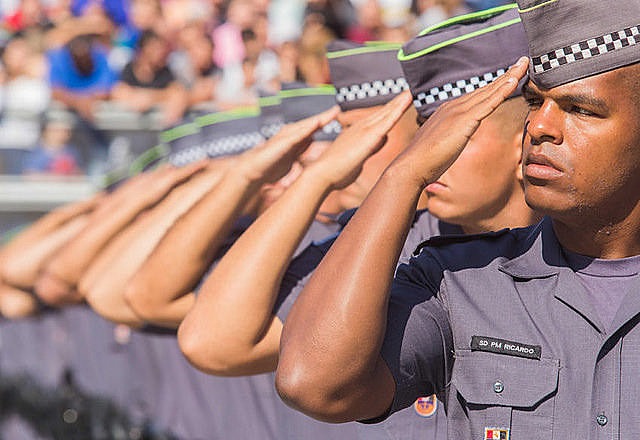
Pressed by the string of police abuses recorded this year in São Paulo, Governor João Doria announced on June 17th a program called “Retreinar” (Retrain), which provides new training for the state command in order to curb disproportionate violence in approaches.
Doria argues that violent conduct is an exception in the police force, pledging rigor in the investigation and punishment of misconduct. “We will retrain the entire command of our troops to prevent this one percent of bad cops, who persist in using unnecessary violence against the population, realizing that this is not acceptable in the São Paulo State Police,” said the governor when launching the program. In 2020, Doria issued five statements condemning violent police practices that became public – and which continue to be repeated.
On the other hand, the Bolsonaro government has been trying to give carte blanche to police operations. Late last year, the President, a retired Army captain, approved a law passed by the Senate that abolishes disciplinary custody for accused police officers and firefighters.
The government also excluded data on police violence from the annual balance of Dial 100, a denunciation hotline service run by the Ministry of Women, Family and Human Rights. A federal Prosecutor’s Office lawsuit forced the disclosure of the data in June, which showed 1,486 reports of police violence in 2019.
In criticizing antiracist protests, Deputy Eduardo Bolsonaro downplayed the death of blacks killed by the police by comparing the American and Brazilian realities. “They are trying to import the badge of the protests taking place in the United States into Brazil, although there are no cases like [George] Floyd’s here,” the President’s son said at a conference promoted by ultraconservatives.
On the same day of the Deputy’s remarks, Guilherme Silva Guedes’ relatives and neighbors were attacked by police officers while protesting the teenager’s murder in southern São Paulo. The repression of protests and the continued violent approaches in the periphery contrast with the tolerance of contempt in noble areas.
In late May, entrepreneur Ivan Storel, 49, a resident of the luxurious Alphaville condo in São Paulo, was caught insulting police officers who answered a domestic violence call from his wife. “You may be macho in the periphery, but here you suck. This is Alphaville”, shouted the entrepreneur. After calming down, he was taken to the police station and released that same day. He apologized to the police, who reported him for contempt.
The PM reported that its officers are trained to deal with this kind of situation. But in the favelas and poor neighborhoods this is definitely not the case.
Source: El Pais
More: Brazil news in English, every day from The Rio Times.
This article was produced by The Rio Times’ automated newsroom system. How we use AI · Report an error · Editorial responsibility: Matthias Camenzind, Editor-in-Chief