Argentina Analysts See September Inflation Near 2%

ECONOMY · ARGENTINA
Key Facts
- —The country Argentina is South America’s second-largest economy, with about 46 million people. President Javier Milei has made ending chronic inflation the core promise of his government since December 2023.
- —Why it matters Monthly inflation fell to 1.7% in August, the lowest in 14 months, INDEC reported on 10 September. A rebound would test the government’s claim that price rises are settling below 2%.
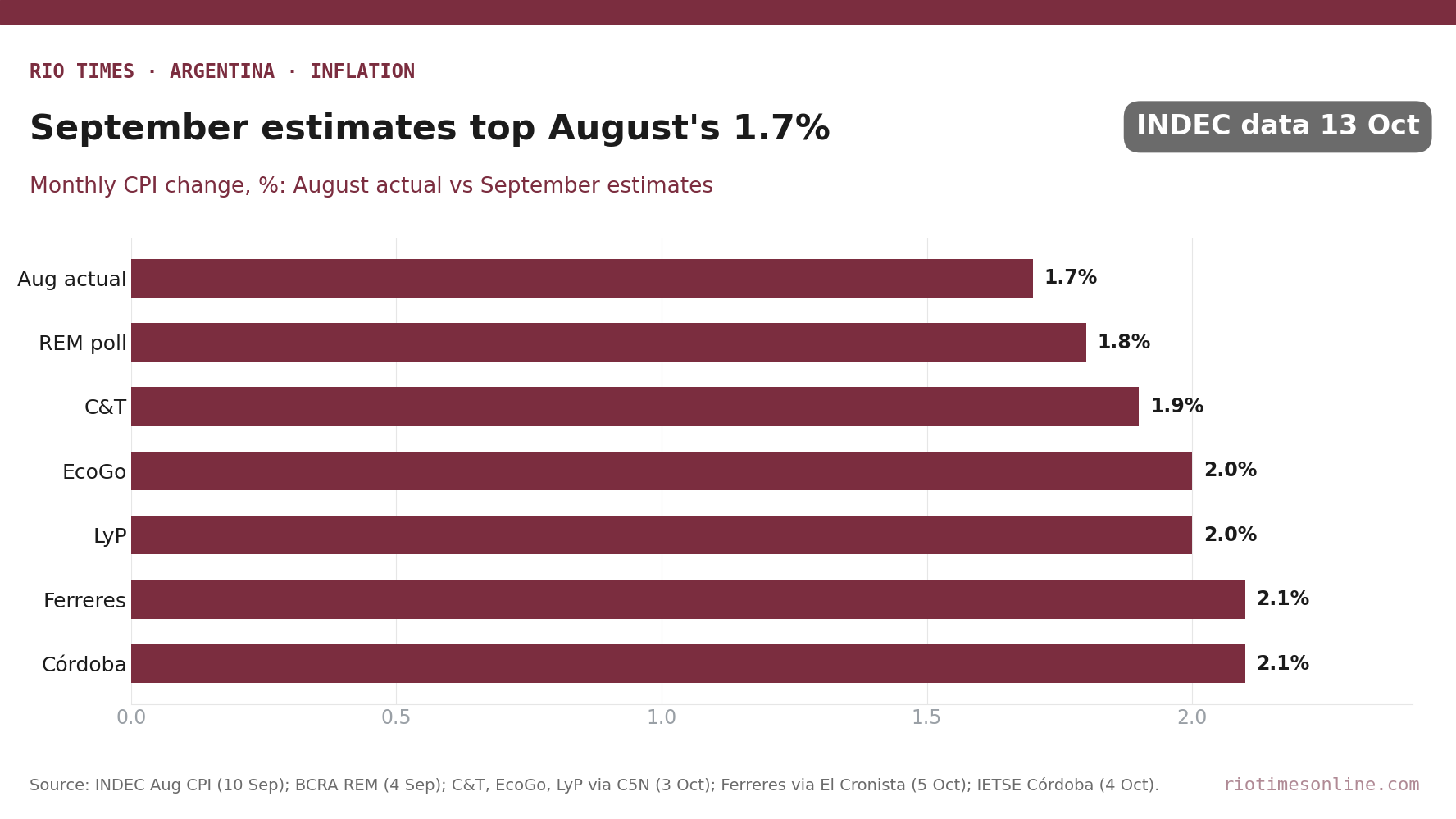
- —Why now On 5 October the consultancy Orlando Ferreres & Asociados put September inflation in Greater Buenos Aires at 2.1%, El Cronista reported. A Córdoba shopkeepers’ institute reported the same figure on 4 October.
- —What happened Private September estimates range from 1.8% to 2.2%, most near 2%, according to C5N and Pilar a Diario (3 October).
- —The numbers Annual inflation was 33.5% in August (INDEC). The central bank’s analyst survey, published 4 September, expected 1.8% for September and 30% for all of 2026.
- —What it means for you US holders of Argentine bonds watch inflation as the main test of Milei’s plan. For visitors, peso prices are still rising about 2% a month.
- —Still open INDEC publishes the official September figure on 13 October. Analysts say late-September fuel price rises will show up only in October.
- —Prediction markets Polymarket gives September inflation of 1.9% to 2.1% a 55.5% chance and 1.6% to 1.8% a 24.5% chance (5 October, 12:38 p.m. ET).
Argentina inflation probably picked up again in September, to about 2% a month, private estimates published since 2 October show. For US investors in Argentine bonds, the monthly figure is the clearest scorecard of President Javier Milei’s plan to end chronic inflation. A rebound would end a short run of good news after August’s 1.7%, the lowest in 14 months.
The official number from the statistics agency INDEC is due on Tuesday 13 October. Until then, investors rely on consultancies and a central bank survey of analysts.
What the September Estimates Show
The latest estimate came on Monday 5 October from Orlando Ferreres & Asociados, a Buenos Aires consultancy. It put September inflation at 2.1% for Greater Buenos Aires, as reported by El Cronista.
That figure compares with 1.7% for August from INDEC, which measures the whole country. Ferreres put the annual rate for the capital region at 30.8% and the January to September rise at 22.6%.
A day earlier, the Córdoba shopkeepers’ institute IETSE reported 2.1% for September in that province, up from 1.8% in August. It also said food and drink sales volumes in neighbourhood shops fell 8.3% from a year earlier.
Other estimates came on 2 and 3 October, the TV news channel C5N reported. The consultancy EcoGo and the Libertad y Progreso foundation, a Buenos Aires think tank, both estimated 2.0%.
The consultancy C&T Asesores Económicos measured 1.9% for Greater Buenos Aires. IETSE put the poverty-line basket for a reference family in Córdoba at 2,076,505 pesos (about US$1,363) a month.
Why Prices Picked Up
Most estimates point to food, seasonal goods and regulated prices. Ferreres said food and drink rose 2.3% and explained 0.8 points of its 2.1% figure.
The consultancy LCG, which tracks about 8,000 supermarket prices each week, found food prices accelerating late in the month. Its four-week average reached 4.2% in the week to 30 September.
Seasonal items also weighed. C&T said clothing rose 3.8% with the change of season, while vegetables climbed 11% in its survey.
Libertad y Progreso linked part of the rise to the weaker peso feeding into prices of traded goods, especially food. It said transport did not yet reflect fuel price rises at the end of the month.
The Case for Calm
The underlying trend looks steadier than the headline. C&T put its core measure, which strips out volatile items, at 1.6% and falling.
Ferreres estimated core inflation at 1.3%, up from 0.7% in August but still well below its headline figure. Much of the September jump comes from items that tend to swing back.
The three-month average of official inflation was 1.9% in August, Economy Minister Luis Caputo said on 10 September. That was its fifth straight monthly decline.
Even at 2.1%, September would match July rather than signal a return to the far higher rates of earlier years. Annual inflation stood at 33.5% in August, INDEC said.
What It Means for You
For US funds holding Argentina’s dollar bonds, inflation is the main test of Milei’s plan. A reading near 2% would not derail it, but a run of higher prints would raise doubts about the peso.
For visitors, prices in pesos are still rising by about 2% a month. What hotel and restaurant bills cost in dollars also depends on how the peso moves against the US currency.
The August reading was covered in our report Argentina Inflation Falls to 1.7 Percent, Lowest in 14 Months. Weak activity has already put the government on the defensive, as seen in Argentina’s Caputo Denies Recession After July Drop.
What Is Not Known
The national figure is the one that counts, and only INDEC can provide it on 13 October. Private surveys cover narrower areas and baskets, so the official number may differ.
It is also unclear how much of the late-September fuel increase will reach October prices. The central bank’s next survey of forecasters, due this month, will show whether expectations have shifted.
What Prediction Markets Say
On Polymarket’s “Argentina Monthly Inflation – September” market, bets gave the 1.9% to 2.1% band a 55.5% chance on 5 October at 12:38 p.m. ET. That was down about 10 points over the previous day.
The 1.6% to 1.8% band stood at 24.5% and 2.2% to 2.4% at about 10%. About US$24,000 has been traded on the market, which settles on the INDEC figure.
Why we show this: prediction markets turn real-money bets into a live probability that moves within minutes of the news, which is why investors, campaigns and newsrooms in the United States now follow them closely. We show them next to polls and official results, never instead of them.
What is Argentina inflation expected to be for September 2026?
Private estimates range from 1.8% to 2.2% a month, with most near 2%. Orlando Ferreres put it at 2.1% for Greater Buenos Aires on 5 October.
When does INDEC publish September inflation?
Argentina’s statistics agency INDEC is scheduled to publish the September consumer price index on 13 October 2026. August inflation was 1.7%, the lowest in 14 months.
Why did prices rise faster in September?
Consultancies cite food, seasonal items such as clothing and vegetables, and regulated prices. Core measures that strip out volatile items rose more slowly, between 1.3% and 1.6%.
Sources: El Cronista (Ferreres estimate, 5 Oct); El Cronista (LCG food prices, 3 Oct); C5N (consultancy estimates, 3 Oct); Pilar a Diario (3 Oct); Perfil Córdoba (IETSE, 4 Oct); Puntal (IETSE, 4 Oct); INDEC, August CPI; BCRA, REM; La Nación (10 Sep).
This article was produced by The Rio Times’ automated newsroom system. How we use AI · Report an error · Editorial responsibility: Matthias Camenzind, Editor-in-Chief
In depth
LatAm Markets: Live Signals → — real-time movers, turnover leaders and FX across Latin America.