Rockhopper Sinks 15% as Falklands Oil Loses Contractors

ENERGY · ARGENTINA
Key Facts
- —The country Argentina claims the British-run Falkland Islands, which it calls the Malvinas, and fought Britain over them in 1982. It calls oil work in their waters illegal.
- —Why it matters Sea Lion is the islands’ first commercial oil development. Israel’s Navitas Petroleum holds 65% and operates it; London-listed Rockhopper Exploration holds 35%.
- —Why now On 2 October Houston-based Halliburton confirmed it will do no Sea Lion work, after contact with Argentine federal authorities about possible criminal and civil action.
- —What happened On 5 October Navitas said it is replacing two contractors that stopped work. Rockhopper closed down 15.2% at 51.5 pence in London.
- —The numbers The shares touched 48 pence on Monday, against Friday’s 60.7 pence close, London Stock Exchange data show. First oil is still targeted for early 2028.
- —What it means for you US oilfield service firms must choose between island contracts and Argentina’s much larger shale market. Nothing changes for travel or trade today.
- —Still open Which two contractors left, who replaces them, and what Argentina does when its two-week deadline to Britain, set on 28 September, runs out.
Falklands oil shares fell hard in London on Monday after Argentina’s sanctions campaign cost the Sea Lion project two contractors. The news came days after Houston-based Halliburton said it would stay away from the field. It shows US service firms putting Argentina’s far larger oil market first.
Rockhopper Exploration, which owns 35% of Sea Lion, closed at 51.5 pence, down 15.2% on the day, London Stock Exchange data show. Its partner and operator, Israel’s Navitas Petroleum, still expects no material harm to the project.
What Navitas Told Investors
Rockhopper published the Navitas statement to the London market at 9:45 a.m. local time on 5 October. Navitas said it is “taking action to replace two breaching contractors” and will adjust the project as required.
It did not name the two firms. It cited only a contractor’s public pledge to stay out of Sea Lion and the islands’ oil sector.
Navitas said it keeps “the full support” of the Falkland Islands and British governments. At this stage, it said, “no material adverse effect on the Project is expected.”
The company also listed what could change that view. Those risks are delayed or failed replacements, more contractor exits, and “further escalation” by the Argentine government.
How the Market Reacted
Rockhopper opened at 62 pence and fell as low as 48 pence, about 21% below Friday’s close. Some 21 million shares changed hands, exchange data show.
Alliance News reported a 10% fall to 54.50 pence earlier in the session, while Clarín reported a drop of more than 16%. Clarín said the shares had already lost 8.13% over Thursday and Friday.
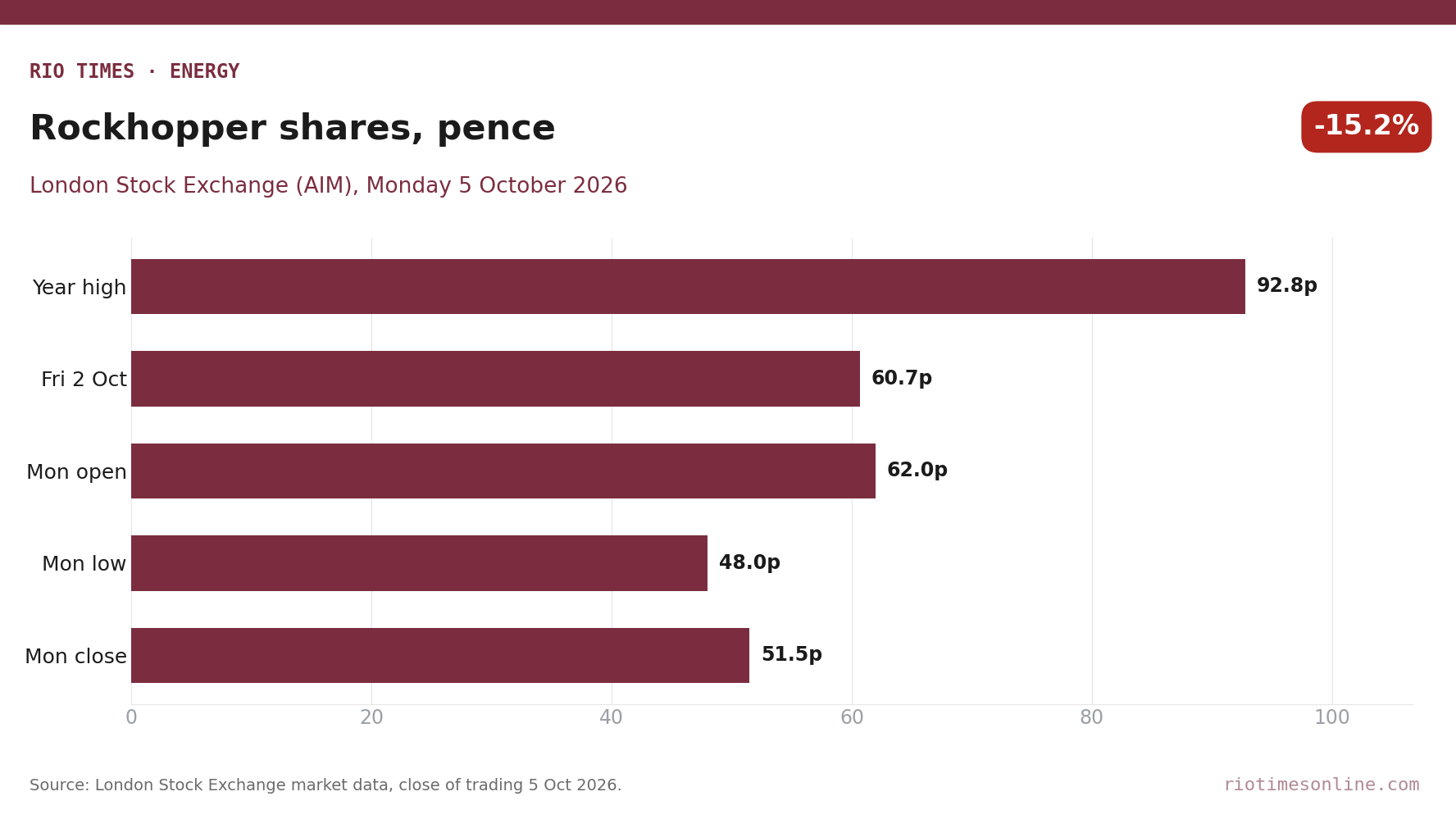
The close came well off the day’s low, and the company has not changed its timetable. In results on 30 September, Rockhopper said first oil “remains targeted for Q1 2028.” That timetable is set out in Falklands Oil Firm Rockhopper Keeps Its 2028 Start Date Despite Argentina’s Sanctions.
That plan rests on 11 first-phase wells feeding the Aoka Mizu, a floating vessel able to handle about 55,000 barrels a day. Drilling is due to begin early in 2027, the company has said.
Argentina’s Pressure Campaign
President Javier Milei’s libertarian government announced sanctions in early September on firms and people working on island oil without Argentine approval. Big service groups began stepping back, as covered in Falklands Sea Lion Loses Halliburton, SLB, Baker Hughes.
On 16 September a federal judge in Río Grande, Mariel Borruto, ordered both companies to halt the project, BAE Negocios reported. That order has no force in the islands themselves.
On 28 September Milei ordered arbitration under the UN Convention on the Law of the Sea and gave Britain two weeks. The details are in Falklands Oil: Argentina Gives the UK Two Weeks, Then Plans a Law of the Sea Case.
London rejected the arbitration request on 30 September, Infobae and BAE Negocios reported. On 2 October Halliburton confirmed that neither it nor its subsidiaries would work on Sea Lion, Offshore Engineer reported.
Why Washington Has a Stake
The dispute lands on American companies first. Halliburton and Baker Hughes, two of the largest oilfield service groups, are based in Houston. For such firms, Argentina’s Vaca Muerta shale field is a far bigger and longer-lasting market than one offshore field.
Argentina is also a close partner of Washington under Milei. That gives Buenos Aires extra weight with US companies weighing a contract in the islands.
Britain, for its part, calls the Argentine measures illegitimate and continues to back the project. Islands officials have extended offshore production licences by five years, which keeps the long-term door open.
What It Means for You
For US investors, direct exposure is narrow. Rockhopper trades on London’s AIM market, and its value rests mostly on its 35% Sea Lion stake.
For Houston service groups, the choice is Argentina. Staying out of the islands protects their work in Vaca Muerta, as Halliburton’s exit shows.
For travellers and shippers, nothing has changed. No travel or trade measure has been announced as part of the contractor dispute.
What Is Not Known
Navitas has not named the two departing contractors or said who will replace them. It has also not said whether the early 2027 drilling start is affected.
It is unclear whether Argentina will ask the UN sea tribunal in Hamburg for emergency measures once its deadline passes. Whether more suppliers will leave the Falklands oil project is also open.
More: Argentina news in English, every day from The Rio Times.
What is the Sea Lion project?
Sea Lion is an oil field north of the Falkland Islands, discovered by Rockhopper in 2010. Navitas Petroleum operates it with 65%, Rockhopper holds 35%, and first oil is targeted for early 2028.
Why did Rockhopper shares fall on 5 October?
Navitas said it is replacing two contractors that stopped work under Argentine sanctions pressure. Rockhopper closed down 15.2% at 51.5 pence in London, after touching 48 pence.
Does Argentina’s court order stop Falklands oil drilling?
No. The Río Grande court order has no force in the islands, which Britain governs. Argentina’s pressure works mainly through sanctions threats against contractors that also do business in Argentina.
Sources: Rockhopper Exploration, Sea Lion Operator Update, 5 October 2026; London Stock Exchange, RKH market data, 5 October 2026; Alliance News via MarketScreener; Clarín; BAE Negocios; Offshore Engineer.
This article was produced by The Rio Times’ automated newsroom system. How we use AI · Report an error · Editorial responsibility: Matthias Camenzind, Editor-in-Chief
LatAm Markets: Live Signals → — real-time movers, turnover leaders and FX across Latin America.