
Published Monday, 19 October, 6:40 p.m. ET · Source: ICE Futures US via Notícias Agrícolas, Reuters
Key Facts
—The number. Arabica coffee futures for December delivery settled at US$3.157 per pound (315.7 cents) in New York on Monday, 19 October, up 3.3% on the day and a one-month high.
—What changed. The contract was near 285 cents on the morning of 12 October, so it has gained about 11% in a week as stocks in ICE warehouses sit near a 27-year low.
—The real. The real firmed about 0.5% to roughly R$5.04 per US$1 on Monday, which cuts what Brazilian growers earn in local currency per dollar sold.
—Prediction markets. Polymarket’s market on peak severe drought in Minas Gerais, the top coffee state, puts 20% to 39.99% coverage at 39% and 40% to 59.99% at 31% (19 October 2026, 6:37 p.m. ET; resolves 30 April 2027).
—Still unknown. Whether Brazilian beans reach ICE warehouses before the December contract expires.
Runoff · Sunday, 25 October
Brazil Runoff 2026: Lula vs Flávio
Date, polls, debates, odds and how the runoff works, updated every day.
Brazil runoff polls · Polymarket and Kalshi odds · When results come
Prediction markets · who wins the runoff
Implied chance of winning Brazil’s presidency on 25 October, from traders’ prices.
Polymarket
Flávio Bolsonaro 76.8% · Lula 23.5% (US$188 million traded)
Kalshi (regulated in the US by the CFTC)
Flávio Bolsonaro 79% · Lula 22%
As of 19 October, 6:40 pm ET (23:40 Lisbon), updated every 20 minutes. Prices are bets, not polls, and can move fast.
Why we show this: prediction markets turn real-money bets into a live probability that moves within minutes of the news, which is why investors, campaigns and newsrooms in the United States now follow them closely. We show them next to polls and official results, never instead of them.
Arabica coffee futures for December delivery settled at US$3.157 per pound in New York on Monday, 19 October, up 3.3% and the highest level in a month, as stocks in ICE warehouses stayed near a 27-year low. A stronger Brazilian real, which firmed to about R$5.04 per US$1, also weighed on selling by farmers in the world’s largest coffee producer, according to Reuters.
Notícias Agrícolas, a Brazilian farm-news site, reported the settlement at 315.7 cents, up 10.1 cents. Coffee is one of the best-known products of the Brazil economy, and US buyers pay close attention to its price.
What Moved Arabica on Monday
The December contract rose 10.10 cents to 315.70 cents, while the March 2027 contract settled at 302.25 cents, according to Notícias Agrícolas. Reuters described the level as the highest in a month.
The December contract was near 285 cents on the morning of 12 October, according to Notícias Agrícolas. That is a rise of about 11% in a week.
Analyst Vicente Zotti of NRT told Notícias Agrícolas that the jump reflects traders covering short positions, meaning bets on falling prices that must be closed. He pointed to low exchange stocks and high price premiums for some origins as limits on switching to other supply.
Why the Real Matters for Coffee
Coffee trades in US dollars, but Brazilian farmers pay their costs in reais. When the real gains, each dollar buys fewer reais, so growers get less at home for the same sale and tend to hold back beans, as Reuters reported.
The real closed at R$5.0356 per US$1 on Monday, from R$5.0627 on Friday, a gain of about 0.5%, according to RT market data. Our dollar-to-real guide explains what drives the exchange rate.
Warehouse Stocks Near a 27-Year Low
ICE-certified arabica stocks are near a 27-year low, according to Notícias Agrícolas and Reuters. Traders worry that Brazilian supplies will not reach ICE warehouses before the December contract expires.
Notícias Agrícolas also lists El Niño, a weather pattern that can upset harvests, as a risk for future harvests. Robusta, the cheaper bean grown mostly in Vietnam and Brazil, settled at US$3,484 per metric ton for November delivery in London, up US$70.
What It Means for US Readers
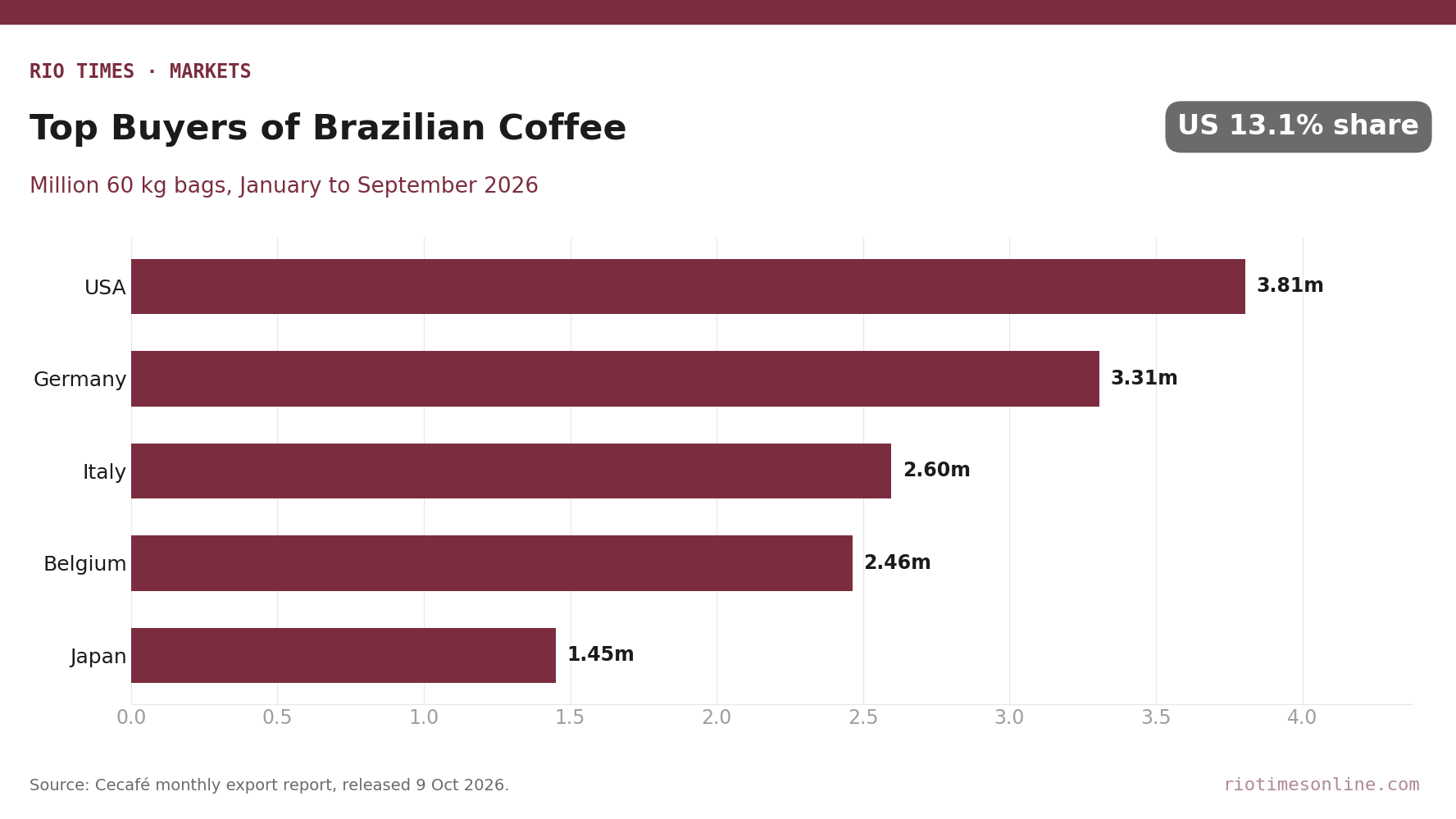
The United States was the largest buyer of Brazilian coffee in the first nine months of 2026, with about 3.8 million 60-kilogram bags, according to Cecafé, the Brazilian coffee exporters’ council. Higher New York futures usually reach US roasters first and shelf prices later, with a lag of months.
Investors who follow the Brazil stock market can watch the real and the dollar together. Cecafé data also showed US imports of Brazilian coffee rising 86% in September, as our earlier report explains.
What Is Not Known
It is not clear whether the rally will last once the December contract expires and short covering fades. Brazilian farmers’ stock-holding is also hard to measure, so the size of the supply squeeze is uncertain.
What Prediction Markets Say
- Polymarket, “Peak Severe Drought in Minas Gerais during the Coffee Growing Season?”: 20% to 39.99% at 39%, 40% to 59.99% at 31%, 5% to 19.99% at 29%, under 5% at 14%, 60% or more at 13% (US$15,190 traded). The market measures peak severe drought coverage in Minas Gerais, per the National Water Agency’s drought monitor, through 30 April 2027.
Prices as of 6:37 p.m. ET, 19 October 2026. Prices are bets, not polls.
Why we show this: prediction markets turn real-money bets into a live probability that moves within minutes of the news, which is why investors, campaigns and newsrooms in the United States now follow them closely. We show them next to polls and official results, never instead of them.
Frequently Asked Questions
What happened to arabica coffee prices on 19 October?
The December contract settled at US$3.157 per pound, up 3.3% and the highest in a month, according to Notícias Agrícolas and Reuters. It was near US$2.85 on the morning of 12 October.
Why does a stronger real push coffee prices up?
A stronger real means Brazilian growers earn less in local currency for each dollar of coffee sold. Many hold back beans, which tightens supply.
How low are coffee stocks in ICE warehouses?
ICE-certified arabica stocks are near a 27-year low. Traders fear Brazilian beans may arrive late for the December contract.
Will US coffee prices rise?
Higher futures usually feed into roasters’ costs first and shelf prices later. How much depends on how long prices stay high.
Sources: Notícias Agrícolas ICE settlement report (19 October 2026); Reuters via Investing.com Brasil (19 October 2026); Cecafé monthly export report (early October 2026); RT; Polymarket.
This article was produced by The Rio Times’ automated newsroom system. How we use AI · Report an error · Editorial responsibility: Matthias Camenzind, Editor-in-Chief
LatAm Markets: Live Signals → — real-time movers, turnover leaders and FX across Latin America.