Rio Times · Analysis
Key Facts
—The Growth Flip Africa’s economy is projected to grow faster than Asia’s in 2026 for the first time in recent history, led by East Africa’s near 6% expansion.
—The Financing Gap North Africa faces an annual structural transformation financing gap of US$104.9 billion, threatening the sustainability of its social gains.
—West African Boom West Africa is consolidating as a BRICS-adjacent consumer and energy frontier, with GDP growth projected at 4.2% in 2026.
—Latin America’s Angle The shift opens concrete competition and cooperation channels for Brazil, Mexico, and Colombia in agribusiness, energy, and manufacturing.
—BRICS Capital Shift Gulf and Chinese capital is flowing aggressively into African infrastructure, creating a new geometry of South-South investment that Latin America cannot ignore.
—The Mosaic Reality Africa is not a single story but a mosaic of East, North and West African trajectories demanding distinct market entry strategies.
Africa’s economy is projected to grow faster than Asia’s in 2026 for the first time in recent history, a shift that will open new trade and investment paths for Latin America and reshape how the two regions do business together.
A Historic Inflection Point: The Numbers Behind the Shift
For decades, the global economic imagination has been fixed on Asia’s rise, but a quiet shift is underway on a different continent. The United Nations Economic Commission for Africa now projects that Africa’s aggregate economy will expand faster than Asia’s in 2026 for the first time in recent memory.
This is not a blip. It is the result of years of structural change, a young and growing workforce, and global supply chains that are looking beyond their traditional hubs.
East Africa is the engine of this shift, with growth rates hovering close to 6%, well above the continental average of 4.1%.
Kenya, the region’s largest economy with a nominal GDP approaching US$147.26 billion, and Ethiopia, at roughly US$121.53 billion, together provide nearly half of East Africa’s economic output and are setting a rapid pace.
The Eastern Africa Association projects the regional economy reaching US$603 billion in 2025, expanding at 5.7% and attracting capital that is looking for faster-growing markets.
East Africa’s Engine Room: Kenya, Ethiopia and the 507-Million Consumer Market
East Africa’s population has reached 507 million, growing at 2.8% annually, which is creating one of the world’s most rapidly expanding consumer bases and labour pools.
Urbanisation is accelerating this transformation, with cities like Nairobi, Addis Ababa, and Dar es Salaam becoming genuine regional hubs for technology, logistics, and services, attracting venture capital and multinational regional headquarters.
Yet the region is not without its fault lines. The same UN ECA analysis that celebrates East Africa’s outperformance warns of economic divergence that clouds integration, with fragile states and conflict zones sitting uncomfortably close to booming metropolises.
Infrastructure connectivity remains a bottleneck. The gap between the region’s 1.7 trillion PPP economy and its much smaller nominal output reflects the persistent difficulty of converting potential into transactional reality.
For Latin American agribusiness and infrastructure firms, this is the signal: a market of half a billion people that is finally building the roads, ports, and cold chains necessary to become a genuine trading partner.
The US$104.9 Billion Question: North Africa’s Fragile Social Model
If East Africa represents raw growth, North Africa presents a cautionary tale that resonates profoundly in Latin America. The African Development Bank has pegged North Africa’s annual structural transformation financing gap at US$104.9 billion a year until 2030.
This is the difference between the US$134.8 billion the region needs annually and the resources it can actually mobilise, a chasm that threatens to unravel decades of remarkable social progress.
North Africa achieved what few developing regions have managed: it halved extreme poverty five years ahead of the 2015 Millennium Development Goal deadline, reducing the share living on less than US$1.25 a day from 5% in 1990 to under 1% by 2015.
Maternal health and primary education indicators soared, with antenatal care coverage reaching 89% by 2014 and youth literacy climbing dramatically.
But the Economic Research Forum warns bluntly that these gains were achieved through social policies, subsidies, and political regimes, not strong economic growth, making them fundamentally fragile.
Policy Without Growth: The North African Lesson for Brasília, Bogotá and Buenos Aires
The North African predicament will sound eerily familiar to any Latin American policymaker. It is the story of cash transfers, fuel subsidies, and expanded public employment that keep households afloat but do not generate the productivity growth that makes the model sustainable.
Egypt’s 118 million people squeeze into the Nile Valley and Delta, just 5% of the country’s land area, intensifying pressure on infrastructure, water, and arable land in ways that mirror the concentrated urbanisation of Lima, São Paulo, or Mexico City.
Water withdrawal rates exceeding 78% of renewable resources place the entire social compact in jeopardy as climate change bites harder.
Latin American economies that have relied on conditional cash transfers and commodity-fuelled social spending to reduce poverty now face the same arithmetic as Algiers or Cairo: how to maintain social peace when the fiscal space shrinks and the growth engine sputters.
The North African example suggests that without a deliberate pivot to higher-productivity sectors, the impressive social gains of the MDG era could prove a historical peak, not a permanent plateau.
West Africa’s Quiet Boom: Oil, BRICS and the Lekki Deep Sea Port
While the spotlight often lands on East Africa’s tech scene, West Africa is undergoing a transformation of its own. PwC projects West African GDP growth at 4.4% in 2025 and 4.2% in 2026, driven by new oil and gas production in Senegal and Niger and deep reforms in Nigeria, Ghana, and Côte d’Ivoire.
Nigeria’s accession to BRICS has symbolic and practical weight, aligning Africa’s most populous nation with a bloc that already includes Brazil and South Africa, creating new institutional channels for trade and investment diplomacy.
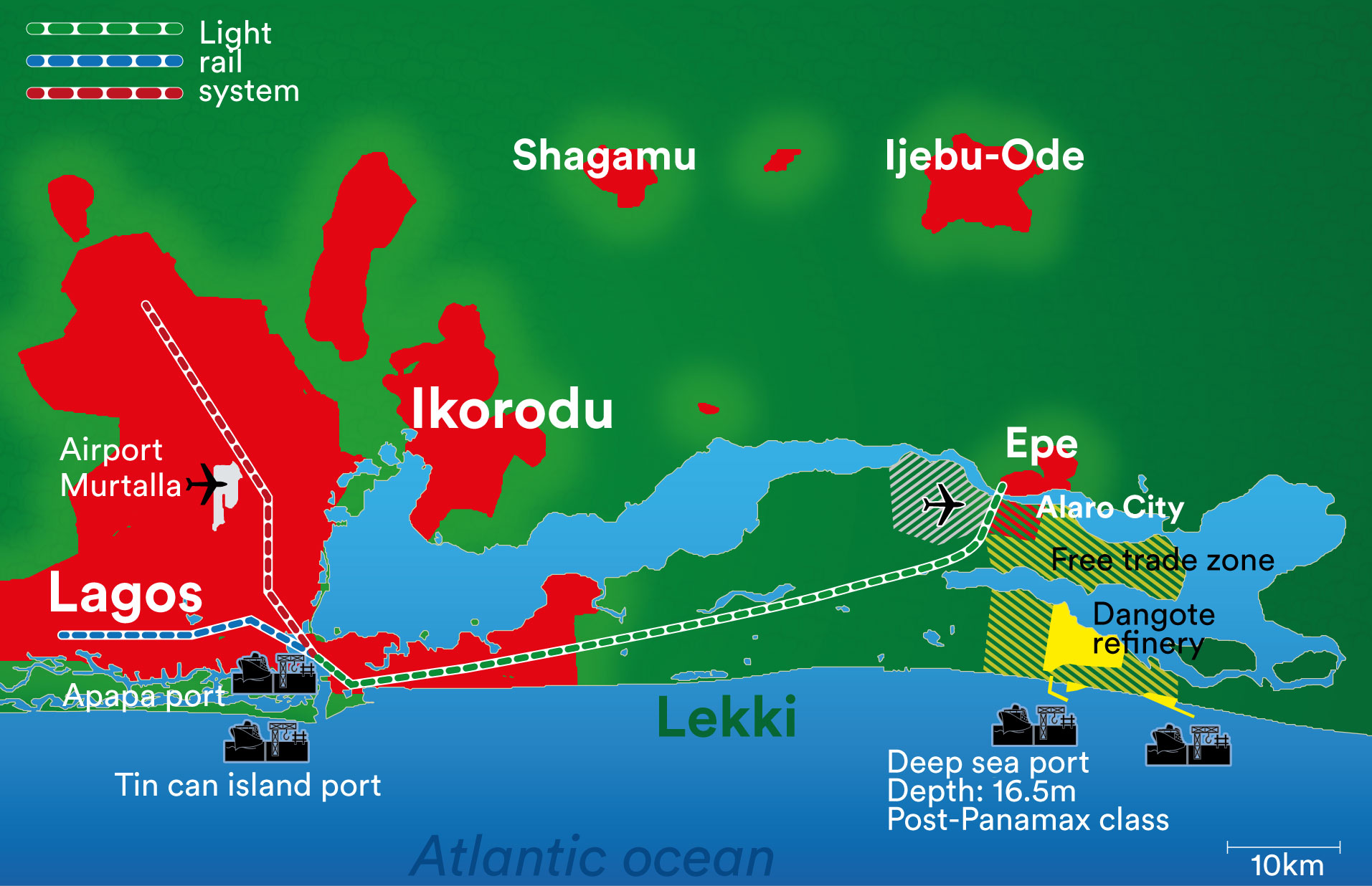
The Lekki Deep Sea Port in Nigeria symbolises the new logistics infrastructure that is reshaping the region’s commercial geography. Maersk values Nigeria’s fast-moving consumer goods sector alone at US$28–32 billion, with potential reaching US$50 billion.
Ghana’s 5.5% growth in late 2025, powered by agriculture and services, shows that the diversification narrative has substance beyond the extractive industries that have long defined the region’s external image.
For Latin American food producers, feed suppliers, and consumer goods manufacturers, West Africa is no longer a theoretical market but one where South American meat, grains, and packaged foods are already carving out share against European and Asian competitors.
The New Geometry of Capital: China, the Gulf, and Where Latin America Fits
The financing of Africa’s infrastructure and industrial expansion is reshaping global capital flows. Chinese lending and investment, Gulf sovereign wealth funds, and Western development finance institutions are competing intensely for influence and returns.
Russia’s deepening security footprint, offering counter-terrorism assistance to Mozambique while US funding retreats from Somalia, adds a geopolitical layer that complicates the investment climate but does not appear to be slowing the money flows.
Latin America is largely absent from this scramble, with Brazilian construction firms still nursing the wounds of the Lava Jato scandal and Mexican and Colombian capital focused overwhelmingly on their own hemispheres.
This absence is a strategic mistake. East and West Africa’s demand for agribusiness technology, renewable energy components, and pharmaceutical production capacity maps directly onto capabilities where Latin American firms are globally competitive.
The African Continental Free Trade Area, if it continues to reduce intra-African tariffs, will create a unified market of 1.4 billion consumers that will reward early movers, not latecomers, with durable supply chain positions.
A Mosaic, Not a Monolith: Why Tailored Strategies Matter
The single biggest mistake outsiders make is treating Africa as one market. Scholarly analysis from the Academy of International Business identifies five distinct business regions with radically different formalisation levels, infrastructure quality, and risk profiles.
Southern Africa enjoys the most developed transport and logistics networks and higher economic formalisation around 80%, while West Africa’s economy remains roughly 65% informal, demanding entirely different distribution and financing models.
Central Africa’s infrastructure deficits remain severe, but its critical mineral wealth in cobalt and copper is indispensable to the global energy transition, creating a very different value proposition for mining-adjacent Latin American economies like Chile and Peru.
The competition angle is also real: African cocoa producers are moving up the value chain into processing and chocolate manufacturing, potentially challenging Latin American producers in global markets.
This mosaic demands that Latin American trade promotion agencies stop treating Africa as a side note and start building the country-by-country expertise that Asian and Gulf competitors have been accumulating for a decade and a half.
Scenarios for 2030: Cooperation, Competition, or Irrelevance
The most likely scenario is a hybrid one: growing South-South trade in specific sectors like agribusiness and pharmaceuticals, coupled with intense competition in commodities and light manufacturing where both continents are trying to climb the same value chains.
A more ambitious path would see Brazil leverage the BRICS platform and its own developmental experience to position itself as a genuine partner in African industrialisation, exporting not just goods but systems and technical expertise.
The risk for Latin America is not conflict with Africa but irrelevance: a failure to show up at all while other global players cement relationships that will last a generation.
The evidence is clear that Africa’s growth acceleration is structural, not cyclical, rooted in demographics, urbanisation, and belated but real improvements in governance and macroeconomic management.
For The Rio Times’ readers, the message is simple: the next decade’s emerging market story is not just about Shanghai and Mumbai, but about the corridors connecting Nairobi to Lagos, Casablanca to Cape Town, and increasingly, São Paulo to Accra.
Frequently Asked Questions
Why is Africa’s growth projected to outpace Asia in 2026?
A combination of demographic momentum, urbanisation, regional trade integration under the African Continental Free Trade Area, and a shift in global supply chains away from overconcentration in Asia is driving the projected growth crossover.
What does Africa’s growth shift mean for Latin American economies?
It opens concrete opportunities in agribusiness, pharmaceuticals, infrastructure, and consumer goods exports, but also creates new competition in commodities and light manufacturing. The net effect depends on how quickly Latin American firms and governments engage.
Why is North Africa facing such a large financing gap despite low poverty?
North Africa reduced poverty through social policies, subsidies, and public employment rather than strong productivity growth. With demographic pressure and climate stress rising, the fiscal cost of maintaining these programmes now far exceeds available resources, leaving a US$104.9 billion annual gap.
Sources: wits.worldbank.org, un.org, insights.aib.world
Connected Coverage
- Morocco Foils ISIS Sahel Plots, Arrests 10 in Seven Cities
- Senegal Insurance Revenue Hits 311 Billion CFA, Second in CIMA Region
- Sudan Health System Collapse Leaves 30M Without Care
- Global Economy Briefing — July 27, 2026
- Kenya’s Maisha Namba Digital ID Reaches 1.7 Million Cards
- Zuma’s MK Party Shatters ANC Grip, Stirs Racial Tensions
- Ethiopia’s Babile Elephant Sanctuary Down to Last 200 Elephants
- UN Chief Warns Libya Over Arms Embargo and Parallel Oil Networks
Explore the cluster: World · Africa
This article was produced by The Rio Times’ automated newsroom system. How we use AI · Report an error
LatAm Markets: Live Signals → — real-time movers, turnover leaders and FX across Latin America.
Read More from The Rio Times