The reign of the strongest currency in Latin America in 2022 could be coming to an end
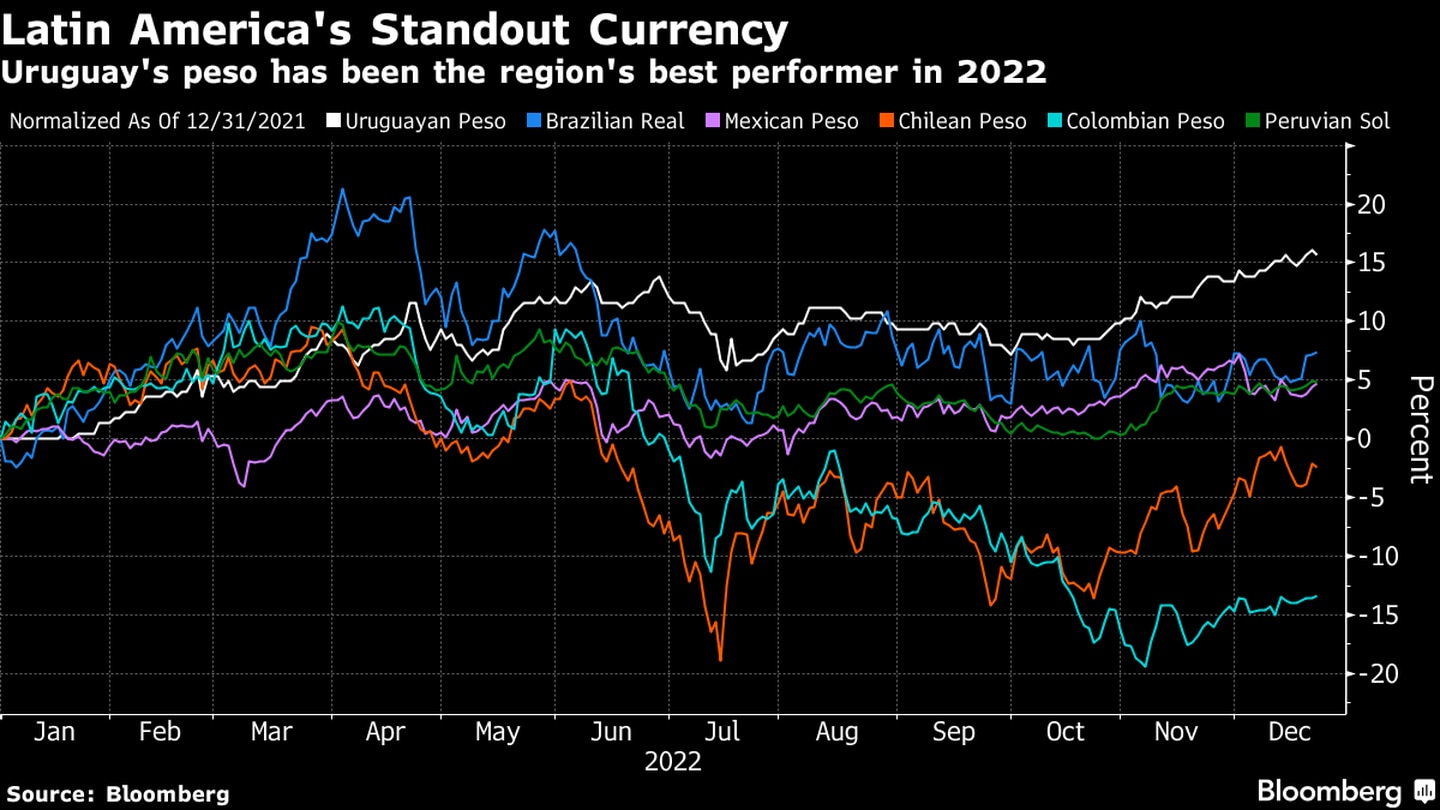
The impressive appreciation of the Uruguayan peso throughout 2022, which positioned it among the strongest currencies in the world, could be coming to an end.
The Uruguayan economy is one of many expected to move away from sharp rate hikes in 2023 as inflation eases, in a move traders say would lead to a weaker peso. Even the head of the central bank foresees the end of a rally.
The president of the Central Bank of Uruguay, Diego Labat, said this month in a radio interview that the models and the reading of the market indicate that a change of course would be expected relatively soon.

Such a reversal would mark the end of the peso’s epic rally, which made it one of the few global currencies to advance against the dollar in 2022.
A series of interest rate hikes, a boom in exports and foreign investment have helped send the currency soaring more than 14% so far this year, making it Latin America’s best-performing currency. Its gains surpassed even those of the real, which benefited from the Brazilian central bank’s early fight against inflation.
Uruguay’s currency was also the fourth best in the world after the Armenian dram, Afghan afghani and Georgian lari, according to data compiled by Bloomberg.
LOWERS THE PRESSURE
As the end of the year approaches, expectations are rising that the Uruguayan central bank will adopt a less restrictive stance in 2023 after an expected increase of half a point next week to 11.75%. Inflation has slowed for two straight months, falling to 8.5% in November, just below its 20-year average.
If the central bank begins to lower its policy rate, “financial flows supporting the Uruguayan peso will likely weaken during 2023,” TPCG Valores chief economist Juan Manuel Pazos and strategist Santiago Resico wrote in a note.
The peso is likely to weaken, but less than any possible inflation relief next year would suggest, and the economy is doing relatively well at an exchange rate between 40 and 42 to the dollar, said Jerónimo Nin, who manages nearby of US$1.2 billion in the local brokerage Nobilis.
Walter Stoeppelwerth, a senior strategist at Montevideo-based brokerage Gletir, said the peso could hit 41-42 to the dollar in the first quarter as dollar inflows from summer tourism fade. Rising imports and falling exports suggest the currency is overvalued, he said.
“The very high real effective exchange rate implies that there could be a correction after the summer tourist season,” Stoeppelwerth said.
PRESSURE ON EXPORTS
Exporters have become increasingly critical of the exchange rate as an overvalued peso is costing them business. Government data shows significant drops in the value of exports in each of the last two months.
“A free market exchange rate is good, but sometimes you have to intervene to improve the performance of exporters,” the president of the Confederation of Uruguayan Business Chambers (CCE), Juan Martínez Escrich, told reporters in Montevideo.
Labat acknowledged at the beginning of December that the exchange rate is a “worry” for the central bank and indicated that intervention is something that is always on the table, but that it must be used with great caution.
With information from Bloomberg
More: Brazil news in English, every day from The Rio Times.
Editorial responsibility: Matthias Camenzind, Editor-in-Chief · Editorial standards · Report an error