The Fading Light: Christianity’s Struggle in its Middle Eastern Birthplace
Christianity’s ancient Middle Eastern roots now face unprecedented challenges as these long-established communities struggle to survive in their ancestral lands.
The region has witnessed a dramatic decline in its Christian population over the past century. Once comprising about 20% of the Middle East’s inhabitants, Christians now make up a mere 5%.
This shift stems from a complex web of factors. Political instability, economic hardship, and the rise of extremist ideologies have all played a role.
Many Christians have felt compelled to leave their ancestral homes in search of safety and opportunity elsewhere. Those who remain often face discrimination and outright persecution.
Gaza serves as a microcosm of this larger trend. The tiny Christian community there has shrunk by half since 2007. Hamas, the governing authority in Gaza, had imposed restrictions on Christian practices.
(A Pierre Rehov documentary)
[arve url=”https://www.riotimesonline.com/wp-content/uploads/1728/27/The-Sunday-People.mp4″ /]
Some Christians reported feeling pressure to convert to Islam or facing job discrimination. Similar stories echo across the region. In Iraq, the Christian population has plummeted from 1.5 million in 2003 to less than 250,000 today.
Syria’s long-running civil war has driven two-thirds of its Christians from the country. Even in Egypt, home to the Middle East’s largest Christian community, Coptic Christians face ongoing challenges.
Copts, The Original Inhabitants of Egypt, Face Systemic Discrimination
The Copts, descendants of ancient Egyptians and the original inhabitants of the land now known as Egypt, have seen their prominence gradually diminish due to waves of Islamic migration from the Arabian Peninsula.
The very name “Egypt” derives from the Greek “Aigyptos,” which itself stems from the ancient Egyptian term “Hwt-ka-Ptah,” ultimately referring to the native people – the Copts.
Today, these indigenous Christians comprise only 10-15% of Egypt’s population and face ongoing challenges, including church bombings and targeted attacks, as they strive to maintain their ancient heritage in a predominantly Muslim society.
The Copts face ongoing systemic discrimination in government employment and education. Despite the Egyptian government’s claims of addressing these issues, tangible progress remains elusive.
Official policies often fail to translate into meaningful change at the local level, where deep-rooted biases persist. Copts continue to be underrepresented in senior government positions and face barriers in accessing quality education.
While some symbolic gestures have been made, the community still awaits substantial reforms to ensure equal opportunities and fair treatment in these crucial areas of public life.
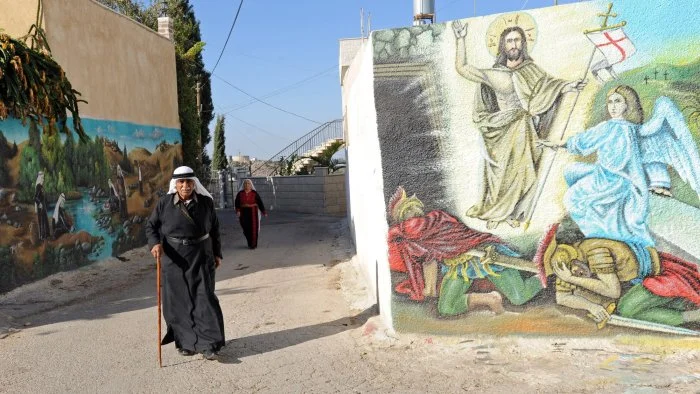
The situation for Christians varies across the Middle East. Some countries offer greater protections than others. However, the overall trend points towards declining numbers and increasing pressures.
This shift carries profound implications for the region’s cultural and religious diversity. International observers have taken note of this crisis. Some Western nations have opened their doors to Christian refugees from the Middle East.
The Fading Light: Christianity’s Struggle in its Middle Eastern Birthplace
Various organizations have called for greater protections for religious minorities in the region. Critics argue, however, that these efforts fall short of addressing the root causes.
The potential disappearance of Christianity from its birthplace would mark a significant historical shift. It would also represent a loss of diversity in a region already grappling with sectarian tensions.
The challenges facing Middle Eastern Christians reflect broader issues of religious freedom and minority rights. As the situation continues to evolve, the international community faces difficult questions. How can religious pluralism be preserved in the Middle East?
What role should outside nations play in protecting minority communities? The answers to these questions will shape the future of Christianity in its ancestral homeland.
The Fading Light: Christianity’s Persecution in its Middle Eastern Birthplace
More: Egypt news in English, every day from The Rio Times.
This article was produced by The Rio Times’ automated newsroom system. How we use AI · Report an error · Editorial responsibility: Matthias Camenzind, Editor-in-Chief