Tanzania GDP Rebasing Puts Economy at US$96 Billion

ECONOMY · TANZANIA
Key Facts
- —The country Tanzania, East Africa’s gold and tourism economy, is made up of Mainland Tanzania and semi-autonomous Zanzibar, each with its own statistics office.
- —Why it matters GDP is the yardstick for debt, deficit and tax ratios. A bigger, more current measure changes how investors and lenders read the country.
- —Why now The Bank of Tanzania set the rebased 2025 figures against the old series in its policy statement on Thursday 8 October.
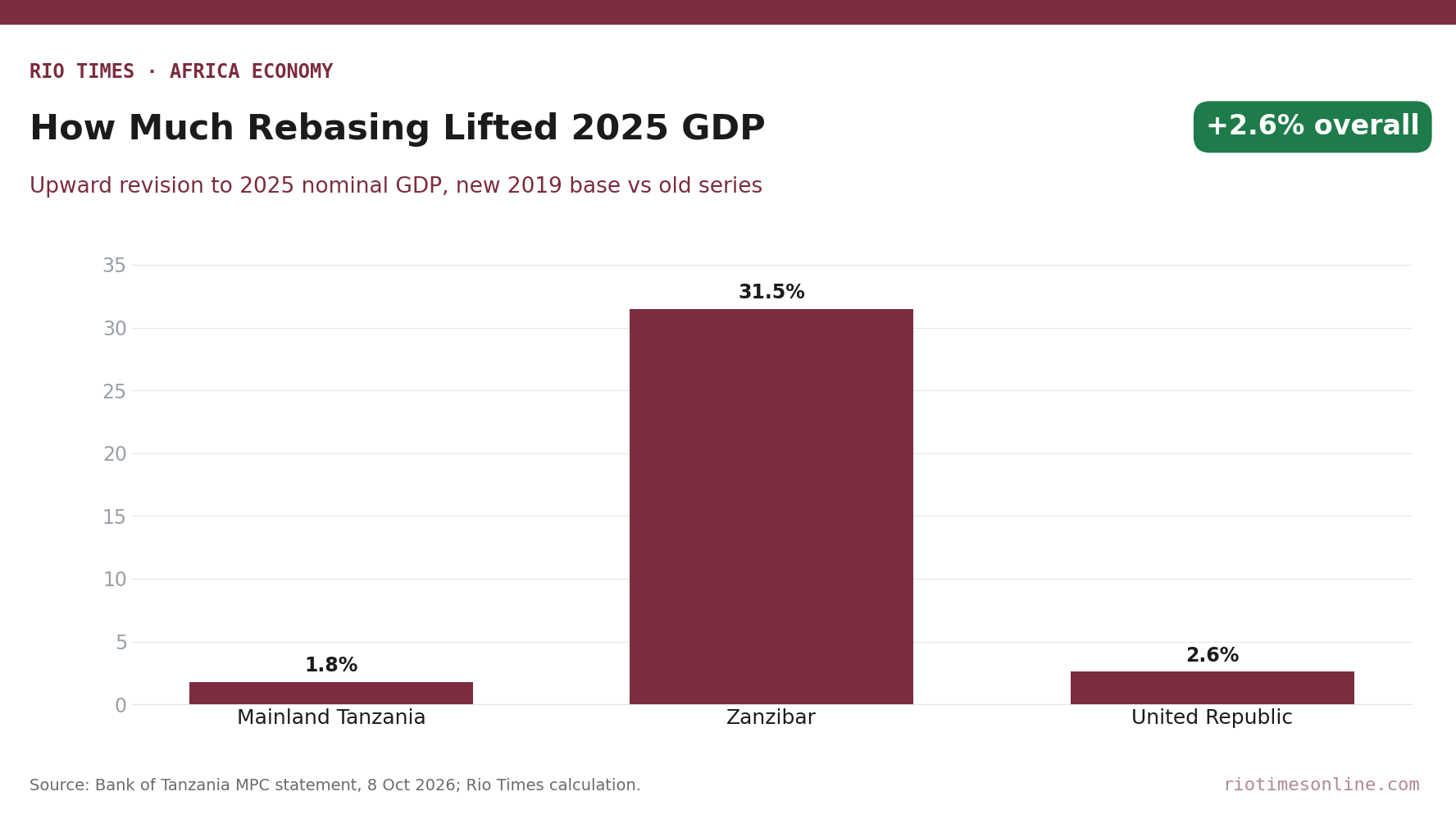
- —What happened Rebasing from 2015 to 2019 prices raised combined 2025 nominal GDP by 2.6% to about US$95.9 billion, using the bank’s own conversions.
- —The numbers Mainland output was revised up 1.8% to about US$92.3 billion. Zanzibar’s was revised up 31.5% to about US$3.6 billion.
- —What it means for you Ratios measured against GDP shrink slightly. Growth runs above 6%, and inflation sits at 4.3%, inside the 3% to 5% target.
- —Still open The central bank did not say which sectors drove the revision or why Zanzibar’s jump was so large, and no new debt-to-GDP ratio has been published.
Tanzania GDP rebasing has made the country’s economy measurably larger. Figures set out by the Bank of Tanzania on Thursday 8 October put combined 2025 output at TSh 243.3 trillion (about US$95.9 billion). For foreign investors, lenders and rating analysts, that is the new denominator for every ratio they track.
The figure comes from the central bank’s Monetary Policy Committee, which met on Wednesday 7 October. The committee also kept its policy rate, the Central Bank Rate, at 6.25% for the quarter to December.
The revision itself is modest for the Mainland and dramatic for Zanzibar. Together they add about TSh 6.2 trillion (about US$2.4 billion) to the size of the 2025 economy.
Dollar values in this article use the Bank of Tanzania’s own conversions for 2025 output. For reference, the bank’s official mean rate on Saturday 10 October 2026 was TSh 2,630.89 to the US dollar.
What the Rebasing Changed
Rebasing means updating the reference year whose prices and economic structure are used to measure output. Tanzania moved its base year from 2015 to 2019, so newer activities and sector weights now count properly.
Two agencies did the work. The National Bureau of Statistics, the Mainland’s official data agency, rebased Mainland accounts. The Office of the Chief Government Statistician did the same for Zanzibar, the semi-autonomous island region.
On the new base, Mainland nominal GDP for 2025 is TSh 234.1 trillion (about US$92.3 billion). Under the old series it was TSh 230.1 trillion (about US$90.7 billion). That is an upward revision of about 1.8%.
Zanzibar’s 2025 output rose to TSh 9.2 trillion (about US$3.6 billion), from TSh 7.0 trillion (about US$2.8 billion). That is a revision of about 31.5%, by far the larger change.
The two offices also harmonised their accounts. For the first time this allows a single GDP figure for the United Republic of Tanzania, the union of both parts.
The statistics bureau first published the harmonised tables on the 2019 base in late June 2026; they put 2025 output for the United Republic at TSh 243.3 trillion (about US$95.9 billion at the bank’s conversions). The October statement set those levels against the old series and in US dollars.
Some early local headlines paired the combined figure with a US$92 billion value. In the central bank’s statement, about US$92.3 billion is the Mainland alone.
Growth, Prices and the Rate Decision
Growth looks strong on the revised series. The statistics bureau reported 6.1% growth for the United Republic in the first quarter of 2026. A year earlier it was 4.3%.
The central bank said the Mainland grew 6% in the first quarter. It estimates growth above 6% in the second and third quarters. It credited financial services, industry, infrastructure investment and social services.
Zanzibar grew 6.7% in the first quarter, the bank said, with growth estimated above 7% in both later quarters. Tourism, construction and irrigation projects led the way.
Inflation is the stabiliser and the risk at once. Mainland inflation reached 4.3% in August, up from an average of 4.1% in the quarter to June. Higher fuel and transport costs drove most of the rise. It remains inside the 3% to 5% target. Our earlier report covered the next reading: Tanzania Inflation Holds at 4.3% in September.
The bank signed off its statement under Governor Emmanuel Tutuba. It said it stands ready to act if price pressures become persistent and broad-based.
What It Means for US Readers
For US funds and lenders, the first effect is arithmetic. Any ratio with GDP below the line, such as debt, the deficit or tax revenue, now looks slightly smaller.
The central bank said the fiscal deficit stayed below 3% of GDP and public debt remained sustainable. It did not publish a new debt-to-GDP ratio on the revised base.
The external picture matters for anyone exposed to the Tanzanian shilling. Foreign reserves stayed above US$6 billion, covering 4.3 months of imports in September. The current account deficit was 2.5% of GDP in the year to September.
Gold, tourism and manufactured goods drove export earnings, the bank said. Those are also the sectors most exposed to swings in global prices and travel demand.
The risks are external. The bank named conflict in the Middle East, high oil prices, supply-chain disruptions and possible El Niño weather shocks. For background on the country, see Tanzania Explained: The Country, Its Politics, Its Economy and What to Watch.
What Is Not Known
The central bank did not explain why Zanzibar’s output was revised so much more than the Mainland’s. A full sector breakdown of the annual 2025 revision was not in the statement.
It is also not yet clear how the Tanzania GDP rebasing will change debt-to-GDP and tax-to-GDP ratios in official budget documents. The next policy decision is due on Thursday 7 January 2027, after a meeting on 6 January.
Frequently Asked Questions
What is GDP rebasing?
It updates the reference year used to measure output, so newer activities and current sector weights are counted. Tanzania moved from a 2015 to a 2019 base.
How big is Tanzania’s economy after rebasing?
Combined 2025 nominal GDP is TSh 243.3 trillion (about US$95.9 billion), according to the Bank of Tanzania’s conversions. The Mainland accounts for about US$92.3 billion.
Why did Zanzibar’s GDP rise so much?
Its 2025 output was revised up about 31.5%. The central bank did not give a reason in its statement.
Did the Bank of Tanzania change interest rates?
No. On 8 October it kept the Central Bank Rate at 6.25% for the quarter ending December 2026.
Does the Tanzania GDP rebasing change debt ratios?
Mechanically, ratios measured against GDP become smaller when GDP is revised up. No new official debt-to-GDP figure on the revised base has been published yet.
Sources: Bank of Tanzania, Monetary Policy Committee statement No. 245, 8 October 2026; National Bureau of Statistics, GDP releases; NBS, Highlights on the First Quarter URT GDP 2026; Bank of Tanzania, exchange rates; The Citizen (Dar es Salaam).
This article was produced by The Rio Times’ automated newsroom system. How we use AI · Report an error · Editorial responsibility: Matthias Camenzind, Editor-in-Chief
Part of our ongoing coverage
Africa: The New Scramble — the great-power contest over the continent.