
ECONOMY · TANZANIA
Key Facts
- —The country Tanzania is East Africa’s gold and tourism economy, with a central bank that targets inflation of 3 to 5 percent on the mainland.
- —Why it matters Inflation is at its highest level in at least a year, pushed by fuel and transport, yet still inside the official target band.
- —Why now The figure came out the same day the Bank of Tanzania kept its policy rate at 6.25 percent until the end of December.
- —What happened On Thursday 8 October the National Bureau of Statistics reported annual inflation of 4.3 percent for September, unchanged from August.
- —The numbers Transport up 14.0 percent on the year, energy and utilities 7.8 percent, food 3.9 percent, core inflation 4.1 percent.
- —What it means for US readers Prices are stable for investors and visitors, but taxi and motorcycle fares are climbing as world oil prices, at times above US$100 a barrel, feed through.
- —Still open Whether El Niño rains lift food prices before October data arrive on Monday 9 November.
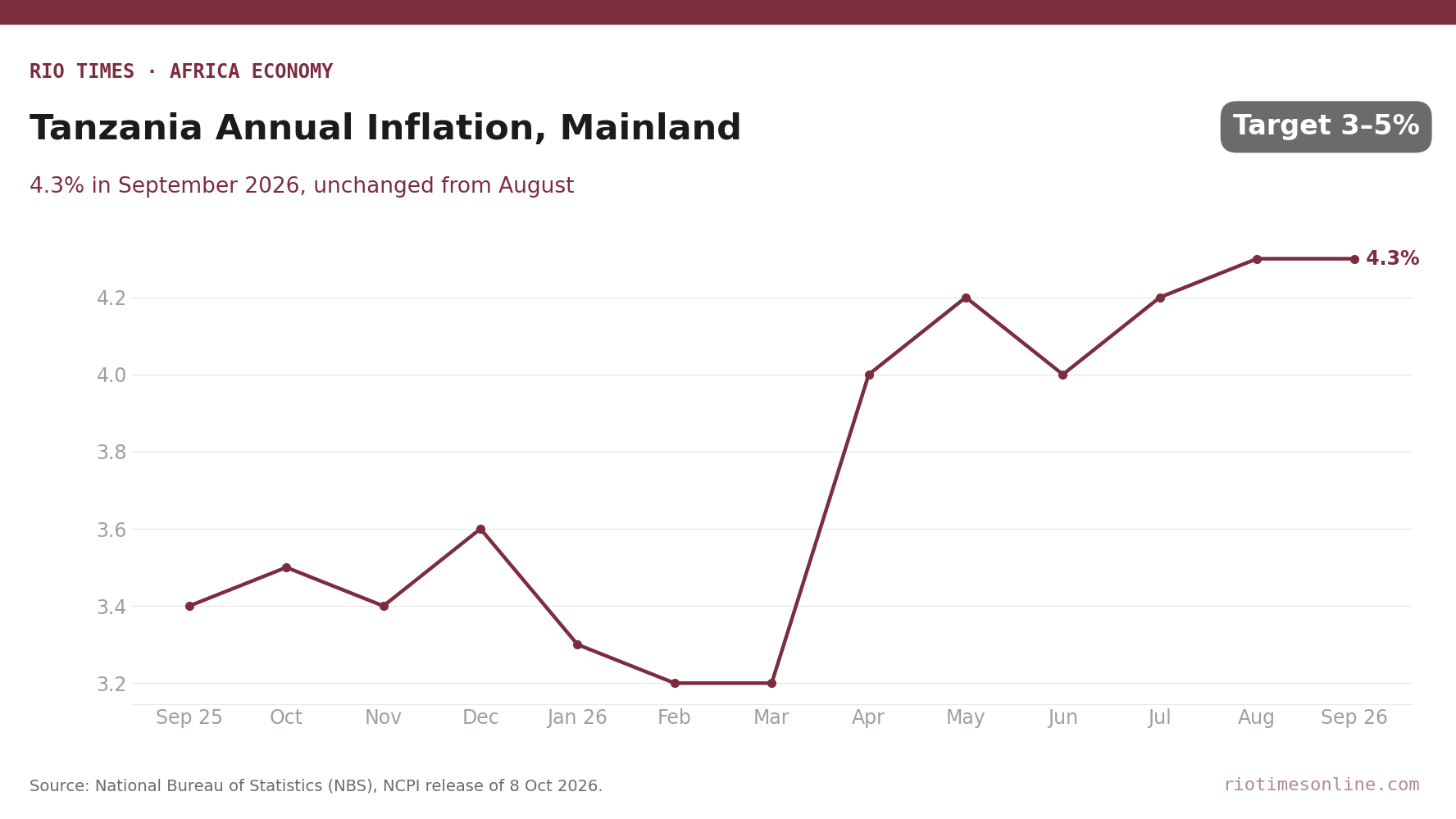
Tanzania inflation held at 4.3 percent in September, the National Bureau of Statistics said on Thursday 8 October. That matches August and is the highest annual rate the bureau has published in the past 13 months. For foreign investors and visitors, the message is mixed: prices remain inside the official 3 to 5 percent target, but fuel and transport costs are rising fast.
The National Bureau of Statistics (NBS) is the government agency that compiles official data for mainland Tanzania. Its consumer price index tracks 383 goods and services in all 26 regional headquarters on the mainland. Zanzibar, the semi-autonomous island region, publishes its own figures.
On a monthly basis, the index barely moved. It rose 0.1 percent, from 124.93 in August to 125.07 in September. A 0.5 percent monthly drop in food prices offset rises in transport, housing costs and household goods.
Fuel and Transport Drive the Rise
The pressure is concentrated in a few places. Transport prices were 14.0 percent higher than a year earlier, by far the steepest rise of the 13 spending groups. Transport carries a weight of 14.1 percent in the basket, so it pulls the headline number up.
The energy, fuel and utilities index rose 7.8 percent on the year. Services rose 6.1 percent. Goods rose a gentler 3.4 percent.
The bureau’s list of monthly price moves shows where households felt it. Motorcycle taxi fares rose 5.8 percent in September alone, and taxi fares 1.9 percent. Firewood rose 4.6 percent, cement 3.9 percent and cooking gas 1.7 percent.
The central bank attributes the rise mainly to higher world oil prices, which lifted domestic energy and transport costs. The Rio Times reported the October increase in Tanzania Fuel Prices Rise, Petrol Hits US$1.53 a Litre.
Food tells a calmer story. Food and non-alcoholic beverage inflation edged up to 3.9 percent from 3.7 percent, but food prices fell on the month. Core inflation, which strips out unprocessed food, energy and utilities, stayed at 4.1 percent. That suggests the fuel shock has not yet spread widely through the economy.
The Central Bank Holds Its Rate
The data landed alongside a policy decision. The Bank of Tanzania, the country’s central bank, is led by Governor Emmanuel Tutuba. Its Monetary Policy Committee met on Wednesday 7 October and kept the Central Bank Rate at 6.25 percent for the quarter ending December 2026.
In its statement on Thursday 8 October, the committee called its current stance “restrictive” and said Tanzania inflation is projected to stay within the 3 to 5 percent target. It also said policy would remain “agile and flexible” to limit risks.
The bank named two threats. The first is the conflict in the Middle East, which it said has kept world fuel prices at times above US$100 a barrel. The second is El Niño, the warm-water climate pattern that can bring heavy rain, flooding and crop losses to East Africa.
There are buffers. The bank said foreign exchange reserves stayed above US$6 billion, enough for 4.3 months of imports in September, above the national floor of four months. It credited exports of gold, tourism and manufactured goods for cushioning higher import and freight bills. The mainland economy grew 6.0 percent in the first quarter of 2026, according to NBS.
The next rate meeting is on Wednesday 6 January 2027, with the decision due the following day.
How Tanzania Compares With Its Neighbours
Tanzania still has the lowest rate of the three East African neighbours in the bureau’s table. A comparison table published by NBS with the release puts Kenya’s September inflation at 6.8 percent and Uganda’s at 4.6 percent, citing the Kenya and Uganda statistics offices.
All three have moved up since the start of the year. Tanzania inflation was 3.2 percent as recently as March, according to the bureau’s own series. The jump came in April, when it reached 4.0 percent.
What It Means for US Readers
For investors, the picture is of a stable economy absorbing an oil shock rather than one losing control of prices. Inflation is in the target band, the central bank is holding rather than cutting, and gold exports are supporting the reserves.
For the currency, the Bank of Tanzania’s mean indicative rate on Friday 9 October was about 2,631 shillings per US dollar.
For travellers, the main change is in getting around. Fares for taxis and motorcycle taxis, known locally as bodaboda, are rising fastest. Visitors on safari or beach trips may see that in transfer costs, while the wider basket is rising more slowly.
The world oil prices that worry Dar es Salaam also set what US drivers pay at the pump. Tanzania’s figures show how a fuel shock moves first through transport, then into wider prices if it lasts.
What Is Not Known
It is not known how hard El Niño rains will hit harvests and food prices in the coming months. Food is the largest group in the basket, at 28.2 percent of the weights.
It is also unclear whether fuel prices will ease or climb again in November. The central bank has not said what level of inflation would make it raise its rate.
September inflation for Zanzibar was not included in the mainland release. The central bank said Zanzibar inflation slowed to 5.6 percent in August, still above its 5 percent target. NBS will publish October mainland data on Monday 9 November.
For more on Tanzania’s markets, see Tanzania Stock Market Loses US$166 Million in a Week.
Frequently Asked Questions
What was Tanzania inflation in September 2026?
Annual headline inflation on the mainland was 4.3 percent in September 2026, the same as in August, according to the National Bureau of Statistics.
Why are prices rising in Tanzania?
Mainly fuel. Transport prices rose 14.0 percent on the year and energy and utilities 7.8 percent, as world oil prices climbed during the Middle East conflict.
Did the Bank of Tanzania change interest rates?
No. In its 8 October statement it kept the Central Bank Rate at 6.25 percent for the quarter ending December 2026. The next decision is due on 7 January 2027.
Is Tanzania inflation higher than in Kenya and Uganda?
No. NBS figures put September inflation at 6.8 percent in Kenya and 4.6 percent in Uganda, both above Tanzania’s 4.3 percent.
When is the next inflation release?
The National Bureau of Statistics will publish October figures on Monday 9 November 2026.
Sources: National Bureau of Statistics, National Consumer Price Index for September 2026 (press release and neighbouring-countries table, 8 October 2026); Bank of Tanzania, Monetary Policy Committee Statement MPC No. 245 (8 October 2026); Bank of Tanzania, indicative exchange rates (9 October 2026).
Editorial responsibility: Matthias Camenzind, Editor-in-Chief · Editorial standards · Report an error