Two Jets, Two Camps: The Fighter Race Quietly Splitting South America
Defense
Key Facts
The choice each country makes reveals as much about its politics as its airspace, as a handful of nations finally replace fleets that can no longer fly and line up behind one of two rival jets. What is happening is narrower than headlines suggest, more interesting than any arms race, and driven by aircraft bought in the 1970s and 1980s that have been patched together long past their intended retirement.
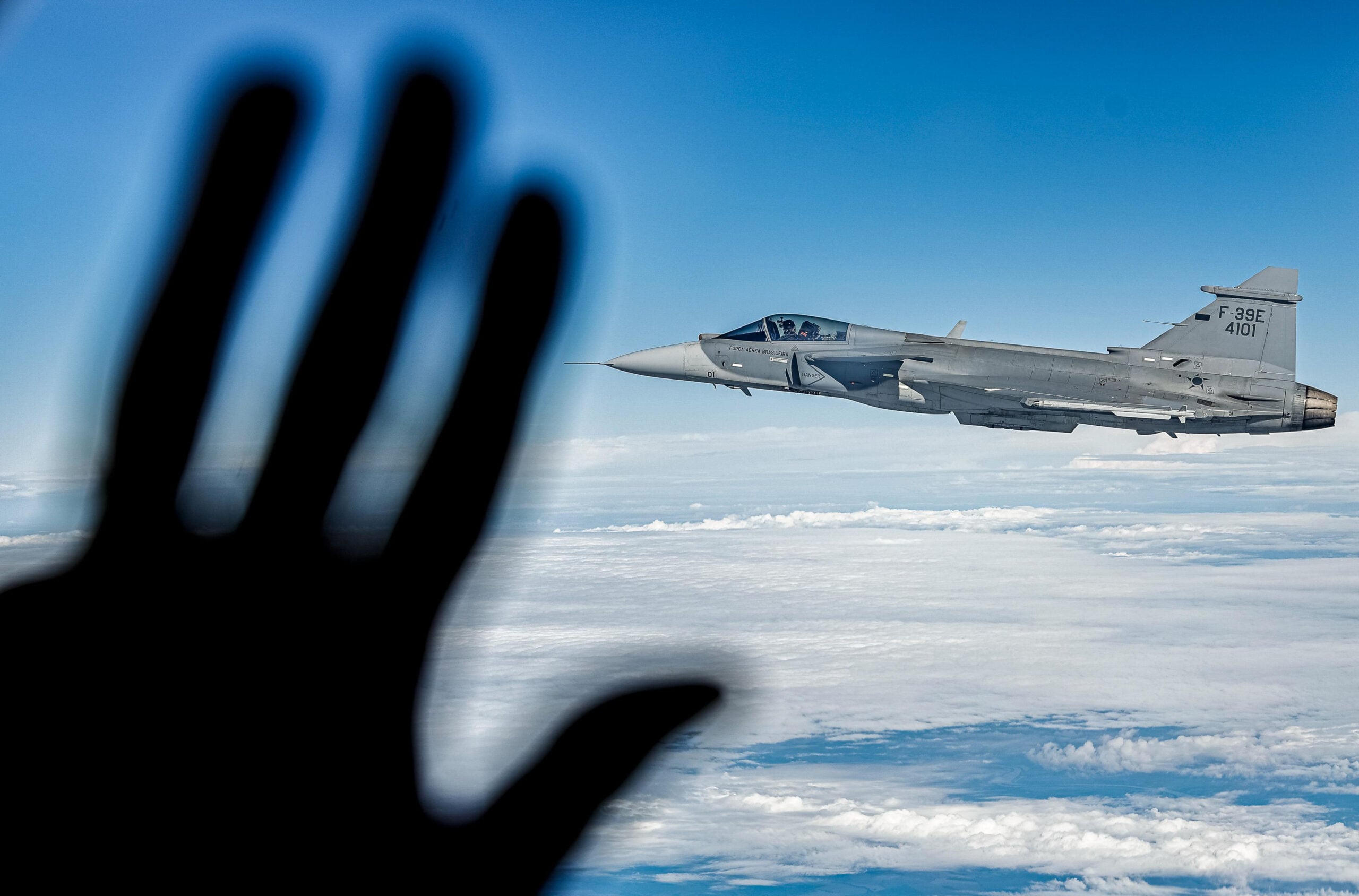
For most of the past two decades, the story of military aviation in South America was one of decline. Air forces flew aircraft bought in the 1970s and 1980s, kept them patched together long past their intended retirement, and rarely found the money to replace them.
That is now changing, but not in the way headlines suggest. There is no regional arms race.
The continent has not seen a war between states since the brief Ecuador-Peru clash of 1995, and overall military spending has stayed close to flat. What is happening is narrower and, for an outside observer, more interesting.
A handful of countries are finally replacing fleets that can no longer fly, and as they do, they are lining up behind one of two rival jets. On one side sits the Swedish Gripen, built increasingly in Brazil.
On the other sits the American F-16, the most widely flown Western fighter in history. The choice between them is rarely just about which plane flies better.
Why the South America fighter map is being redrawn now
The trigger is simple: the old jets are running out of road. According to industry trackers, the region’s combat fleets still include types no longer flown anywhere else on earth, some more than forty years old.
Peru is the starkest case. By 2026, its frontline force had reportedly dwindled to a handful of barely serviceable Soviet-era MiG-29s and French Mirage 2000s, only a few of them flyable at any given moment.
Western sanctions on Russia after 2022 made the MiGs almost impossible to maintain, accelerating a problem that had been building for years. A country that was once among the region’s better-equipped air powers found itself struggling to keep two combat jets in the air.
Argentina had it worse still. The country operated without a true frontline fighter for nearly a decade after its old Mirages were retired, leaving one of South America’s larger nations effectively unable to police its own skies.
Against that backdrop, the recent flurry of orders is less a build-up than a catch-up. The question facing each government was not whether to spend, but whose aircraft to buy, and that single decision pulls a country toward one camp or the other for the next thirty or forty years.
The Gripen camp: Sweden, Brazil and a home-built jet
The first camp is built around the Saab Gripen E, known in Brazil as the F-39. Brazil committed to it back in 2014, signing for thirty-six aircraft in a deal worth around $5.4bn.
What made the choice distinctive was not the plane but the terms. Brazil had weighed the American Super Hornet and the French Rafale before settling on the Swedish jet, partly on cost and partly on what Saab was willing to share.
Brazil did not simply want to buy jets; it wanted to learn to build them. The contract included a sweeping technology-transfer arrangement, sending hundreds of Brazilian engineers to Sweden and establishing a final-assembly line at Embraer’s Gavião Peixoto plant in São Paulo state, the only such line anywhere outside Sweden.
Of the thirty-six aircraft Brazil ordered, fifteen are being assembled domestically, and Brazilian factories now produce major sections of the airframe used on jets built in both countries. The arrangement was designed to seed a domestic industry, not just deliver a fleet.
The first fully Brazilian-assembled Gripen rolled off the line in early 2026, a milestone the government treated as proof that its build-at-home strategy works. President Lula presented the aircraft personally, a sign of how much political weight the program now carries.
Colombia became the camp’s second member. In late 2025 it signed for seventeen Gripens in a contract valued at roughly $3.4bn, the largest military purchase in the country’s history, replacing a fleet of Israeli-made Kfir jets that dated to the 1980s.
Saab and Embraer have discussed handling part of that order through the Brazilian line, which would deepen the regional cluster further. If that happens, Colombian technicians would train in Brazil, knitting the two air forces into a shared support network.
For Sweden, the appeal is obvious. A jet that is cheaper to buy and to fly than its rivals, able to operate from rough, remote airstrips, suits countries with long borders, thin budgets and stretches of jungle and mountain to patrol.
For Brazil, the prize is bigger than any single sale: a domestic aerospace industry that can sustain, upgrade and eventually help export the aircraft. The country wants to be a producer, not just a customer.
Live Company IntelligenceEmbraer SA ADR — the full investor dossier
Wall Street view
Valuation & profitability
Price & risk
$58.1452-wk high
$66.87
Revenue trend · 6y
Ownership
Dividend
The F-16 camp: America’s enduring grip
The rival camp is anchored by the Lockheed Martin F-16, a design first flown in the 1970s that has nonetheless remained the West’s default fighter, with roughly three thousand in service across some twenty-nine countries.
Chile and Venezuela have flown earlier versions for years, Chile’s bought in the 2000s and Venezuela’s acquired in the 1990s before relations with Washington collapsed. Chile, in fact, has long fielded one of the most capable combat fleets in South America.
How many of Venezuela’s F-16s remain flyable is anyone’s guess; outside trackers suggest only about half the original two dozen. Cut off from American spares for two decades, Caracas has kept them aloft through improvisation and cannibalised parts.
Argentina joined the camp the cheap way. After years of frustrated attempts to find a fighter, Buenos Aires bought two dozen second-hand F-16s from Denmark for around $300m, with help from US military financing.
Britain had repeatedly blocked Argentine attempts to buy aircraft containing British components, a lingering echo of the Falklands war, which narrowed Argentina’s options and pushed it toward the American jet. The first aircraft arrived in late 2025, ending nearly a decade in which the country had no real fighter at all.
Peru delivered the camp its most dramatic recruit. After an eighteen-month contest, Lima first signalled in mid-2025 that it would pick the Gripen, citing lower cost and faster delivery.
Then its politics intervened. The decision was never formalised before a wave of upheaval swept through the government.
A wave of impeachments and caretaker governments swept through Lima, and an interim administration reopened the file. In early 2026 it reversed the decision in favour of the new-build F-16 Block 70, the most advanced version of the type.
Lockheed Martin confirmed the selection, and US officials said Peru planned two squadrons of a dozen jets each, with first deliveries due around 2029. The choice arrived alongside a Washington offer to designate Peru a major non-NATO ally, a status that would widen its access to American defence financing.
Peruvian officials were unusually candid that the switch was political rather than technical. The episode left Sweden with a second painful near-miss in the region, having appeared to win, then lost, a major contest.
The American engine inside the Swedish jet
Here lies the subplot that complicates the neat two-camp picture. The Gripen, for all that it is Swedish-designed and increasingly Brazilian-built, flies on an American engine, the General Electric F414.
That single fact hands Washington a quiet lever. Because the engine and other components are American, the United States can withhold the export approvals a Gripen sale needs, giving it an effective veto over where the Swedish jet ends up.
Saab has spent years trying to reduce that dependency, but it has not eliminated it. The same constraint applies to almost any modern Western fighter, because the supply chains behind them run through a small number of countries.
The lever is not hypothetical. Colombia’s Gripen purchase has been shadowed by the risk of US restrictions on the F414 engine, and a leading Colombian opposition figure openly asked Washington to hold up the deal until after the country’s elections.
In other words, even when a country chooses the non-American jet, America retains a hand on the outcome. Independence in defence procurement, the episode shows, is always partial.
This is why the contest is about far more than aircraft. Choosing a fighter means choosing a decades-long relationship of spare parts, software updates, pilot training and political goodwill.
The hardware is the visible part; the dependency is the lasting one. A jet bought today binds a country to its supplier well into the middle of the century.
Brazil’s bet: turning a purchase into an industry
What sets Brazil apart from every other buyer in the region is its ambition to climb the value chain rather than simply sit at the bottom of it. The Gripen deal was the centrepiece of a wider doctrine: build domestically rather than buy off the shelf.
The same logic runs through Brazil’s other big programs, from a navy submarine effort to a locally assembled frigate line and an army armoured-vehicle project. The Gripen is the most visible proof of the approach, because a supersonic fighter is the hardest thing on that list to build.
The payoff Brazil is chasing is an aerospace base that outlives any single contract. Its planemaker Embraer already sells the C-390 military transport abroad, and the country’s authorized defence exports reached record levels in 2025.
A fighter-assembly line, a radar-maintenance centre and a trained engineering workforce together turn a one-off arms deal into an enduring capability. The same model has begun to spread to other parts of the country’s defence industry, from missiles to armoured vehicles.
There is a reciprocal twist that underlines the depth of the Sweden-Brazil tie: Sweden chose Embraer’s C-390 transport for its own air force, making the relationship a genuine two-way street rather than a simple buyer-seller arrangement.
What the split is really about
It would be easy to read the divide as a straightforward proxy fight between Washington and its rivals, but the picture is messier and more revealing. The camps track political alignment, but imperfectly.
Colombia, under a government often at odds with Washington, leaned away from the F-16 and toward the Gripen. Peru, amid political chaos, leaned back toward the United States.
Argentina, governed by a self-described admirer of America, took the F-16 in part because Britain had blocked its alternatives. Each decision blended budgets, industrial hopes, delivery timelines and diplomacy in different proportions.
What unites them is the recognition that a fighter purchase is one of the longest commitments a state can make. The jets bought this decade will still be flying in the 2050s, and the support relationships built around them will shape alliances, data access and dependency for just as long.
Two newcomers are circling the edges of this contest, though neither has yet reshaped it. China’s state arms maker has marketed cheap drones and missiles at regional defence fairs and sold surveillance drones to Peru.
Its government-to-government sales, however, stay thin and concentrated in Venezuela and Bolivia, and analysts warn that Chinese systems tied to Beijing’s satellite-navigation network could expose sensitive data. The Gulf is the more aggressive entrant, with the United Arab Emirates’ EDGE Group spending around $500m to buy into Brazilian defence firms and producing inside the region rather than exporting finished weapons.
Neither yet competes at the level of a frontline fighter, which remains a two-horse race between the Gripen and the F-16. But their presence is a reminder that the map could fragment further as more sellers crowd in.
It is also worth keeping the scale honest. These are modest fleets by global standards, a dozen jets here, two dozen there, in a region that remains one of the least militarised on earth.
The drama lies not in the numbers but in the direction of travel, and in who gets to sell, sustain and influence. A small order can still carry outsized strategic weight.
Why a foreign reader should care
For an investor or executive watching from London or Munich, the fighter contest is a useful window onto something larger: how a middle-income region negotiates its place between competing great powers without being captured by any of them.
The same dynamics that shape a jet deal, technology transfer, supply-chain dependency, the quiet leverage of a single critical component, recur across far bigger sectors, from telecoms to energy to critical minerals. South America’s fighter map is a small, legible model of a much wider strategic question.
It also flags a genuine industrial story. Brazil is attempting something rare for a developing economy: to move from buyer to builder to exporter in one of the most demanding industries that exists.
Whether it succeeds will matter for the region’s economic weight, not just its defence posture. A South America that can build its own advanced hardware is a different economic proposition from one that only imports it.
More: Brazil news in English, every day from The Rio Times.
Frequently Asked Questions
Which South America fighter camps are forming?
Two are taking shape: one built around Sweden’s Saab Gripen, increasingly assembled in Brazil and also chosen by Colombia. The other is built around the American Lockheed Martin F-16, flown by Chile and Venezuela and newly chosen by Argentina and Peru.
Why does the United States have influence over the Swedish Gripen?
The Gripen flies on an American-made General Electric engine and uses other US components, so its export needs Washington’s approval. That gives the United States an effective veto over where the Swedish jet can be sold, even though it is not an American aircraft.
Is South America in an arms race?
No, the region has not fought a war between states since 1995 and overall military spending has stayed roughly flat. The recent orders are mostly a catch-up to replace fleets too old to fly, not a competitive build-up.
Connected Coverage
First Brazil Gripen Fighter Rolls Off the Line
How Peru Picked a Fighter Jet, Then Tore Up the Deal and Switched
This article was produced by The Rio Times’ automated newsroom system. How we use AI · Report an error · Editorial responsibility: Matthias Camenzind, Editor-in-Chief
Read More from The Rio Times