Lima’s Next Mayor Inherits US$1.47 Billion in City Debt

ECONOMY · PERU
Key Facts
- —The country Peru is a copper and gold exporter of about 34 million people. Lima, its capital, is home to roughly a third of them and runs its own municipal budget.
- —Why it matters Lima city hall owes S/5.05 billion (about US$1.47 billion), 3.5 times the fiscal-rule limit, Peru’s Consejo Fiscal reported in July 2026.
- —Why now Sunday’s 4 October vote picks who inherits that debt from 1 January 2027. ONPE’s count has Renovación Popular narrowly ahead, with Avanza País second.
- —What happened On 5 October business daily Gestión revived the July warning. Outgoing mayor Renzo Reggiardo said on 4 October that his successor gets a city “in the black”.
- —The numbers Debt service will top S/500 million (about US$145 million) a year in 2028 to 2035. That exceeds average yearly city investment.
- —What it means for you Visitors and firms in Lima may see slower roadworks and fewer new projects. City bonds are rated locally, AA-(pe) and PEAA, both stable.
- —Still open Who formally takes office, whether Lima seeks new terms on its bonds, and how arbitration losses with Rutas de Lima are paid.
- —Prediction markets Polymarket gives Rafael López Aliaga a 94% chance of becoming Lima’s mayor, and so of inheriting the debt (5 October, 12:29 p.m. ET).
Lima municipal debt of a record US$1.47 billion awaits whoever wins Sunday’s count in Peru’s capital, business daily Gestión warned on Monday, 5 October. For American travellers and companies, the city of ten million is the country’s front door, so its finances shape the roads and services they use.
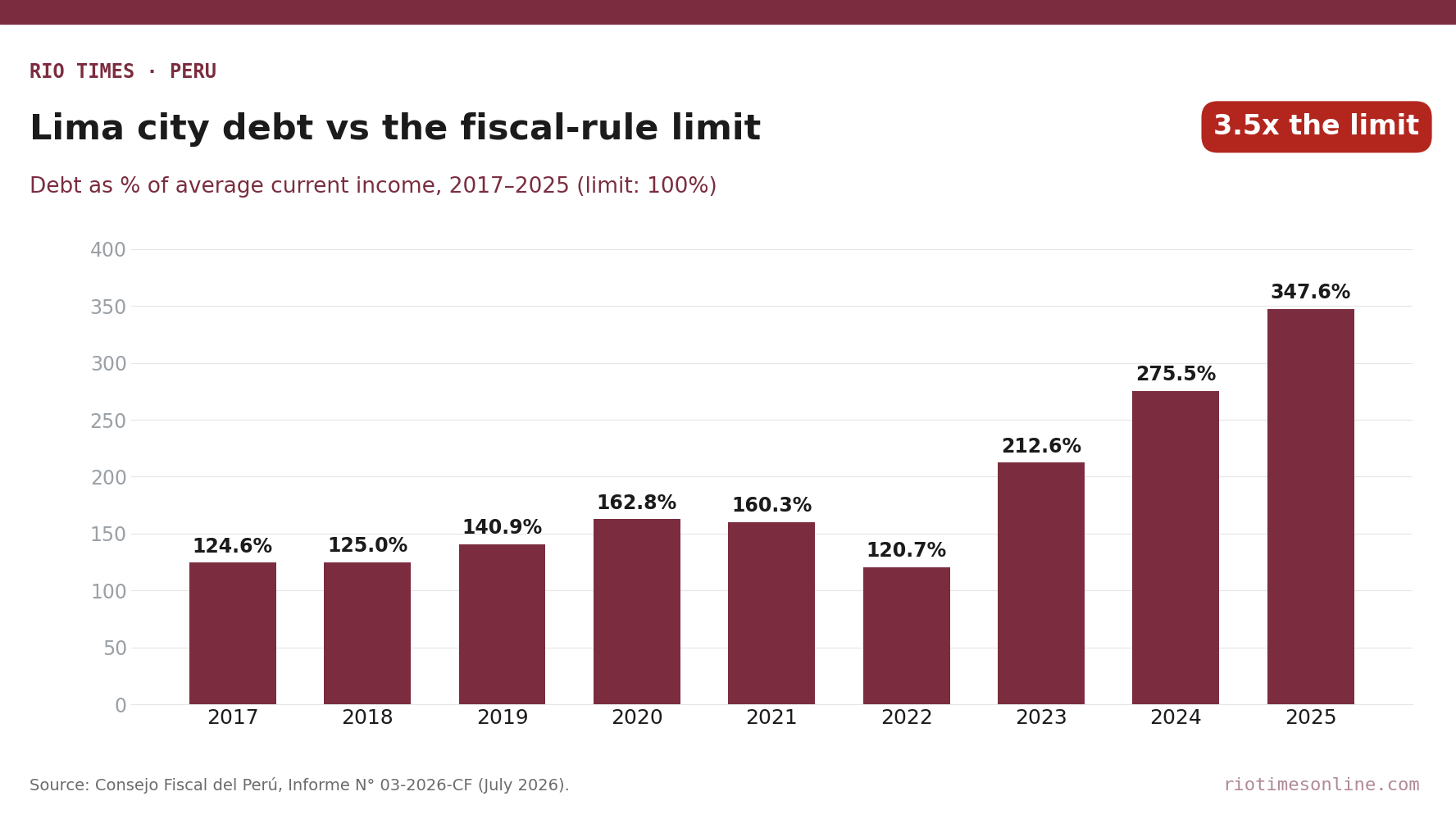
Gestión revived a July 2026 report by the Consejo Fiscal, Peru’s independent fiscal watchdog. It put the debt at S/5.05 billion (about US$1.47 billion), or 347.6% of average current income, roughly three and a half times the legal ceiling.
Who Inherits the Bill
The count by ONPE, Peru’s national electoral office, was 92.687% complete on Monday morning and has Renovación Popular narrowly ahead. Renovación Popular is the conservative party led by Rafael López Aliaga.
Francis Allison, a former mayor of Lima’s Magdalena del Mar district, is second for Avanza País, less than one point behind. Avanza País ran retired general José Williams for president in April.
Renovación Popular has no mayoral candidate, Gestión notes. López Aliaga, a former Lima mayor, heads its list as first councillor, and it is unclear whether he could take the post.
Our earlier report, Peru Lima Mayor Race: López Aliaga Warns Election Judges, covers that dispute. The new term runs from January 2027 to the end of 2030.
How the Debt Was Built
Most of the debt comes from a S/4 billion (about US$1.16 billion) bond programme. It was sold in four issues from December 2023 to September 2025. López Aliaga launched it as mayor before leaving to run for president.
The issues were S/1.205 billion (about US$350 million), S/1.25 billion (about US$363 million) and S/1.3 billion (about US$378 million). A final S/245 million (about US$71 million) followed on 30 September 2025.
Gestión, citing the watchdog and the private think tank IPE, says debt rose from S/1.4 billion (about US$407 million) in 2022. It put the figure above S/5 billion (about US$1.45 billion) by the second quarter of 2026.
Gestión cites a balance of almost S/5.4 billion (about US$1.57 billion) against average current income of about S/1.5 billion (about US$436 million). Debt therefore exceeds three years of income.
Why the Bill Arrives Later
For now the city mostly pays interest. In 2025 it paid S/276 million (about US$80 million) and earned S/124 million (about US$36 million) on unspent cash.
That left a net cost of S/152 million (about US$44 million), the Consejo Fiscal says. The bigger step comes when principal repayments start in 2028.
From 2028 to 2035, debt service is projected above S/500 million (about US$145 million) a year. Between 2003 and 2025 the city invested an average of S/495 million (about US$144 million) a year.
Extra revenue from a sales-tax share and larger transfers helps. Even so, the watchdog projects net outflows of S/2.61 billion (about US$758 million) over 2027 to 2035.
Court and arbitration losses add pressure. Firm liabilities stood at S/993 million (about US$289 million) at end-2025, with contingent claims of S/4.91 billion (about US$1.43 billion).
The Case for Calm
The outgoing mayor, Renzo Reggiardo of Renovación Popular, who took over when López Aliaga left to run for president, rejects the alarm. After voting on Sunday he said his successor will receive a city “in the black”, with money and major works under way.
He told reporters that S/4 billion (about US$1.16 billion) had gone into “tangible works”, according to Gestión. Both local ratings on the city’s debt carry a stable outlook.
The bonds are also backed by a trust that collects property, vehicle and transfer taxes first. That protects bondholders, though it squeezes money for services.
The weak point is delivery. At 13 July 2026, the 58 bond-funded projects showed 24.6% financial progress, and 33 had no physical progress at all.
What It Means for You
For visitors and foreign firms in Lima, the main risk from Lima municipal debt is slower roadworks and fewer new city projects once principal repayments start in 2028. The bond trust takes tax income first, which leaves less for services.
For investors, the bonds are in soles. The Consejo Fiscal says the city holds AA-(pe) and PEAA ratings from the local agencies Apoyo & Asociados and Pacific Credit Rating, both with a stable outlook. The Consejo Fiscal’s warning concerns the city’s own budget, not Peru’s national debt.
What Is Not Known
ONPE has not finished the count, and some tally sheets have gone to special electoral juries. The final order of the top two may still change.
It is not known whether the next administration will try to refinance the bonds or ask the Economy Ministry for support. The Consejo Fiscal has urged the city and the Economy Ministry to disclose its court and arbitration liabilities.
Claims involving the toll-road firm Rutas de Lima, put at S/1.43 billion (about US$416 million), also remain open. That Lima municipal debt figure could rise if more rulings go against the city.
More: Peru Poll: Former Mayor López Aliaga Leads Race to Run Lima by 12 Points, from The Rio Times.
What Prediction Markets Say
Bets on who becomes Lima’s mayor are, in effect, bets on who inherits the debt. On Polymarket’s “Lima Mayoral Election Winner” market, López Aliaga traded at about 94% and Allison at about 5% at 12:29 p.m. ET on 5 October.
About US$486,000 has been traded on the market. López Aliaga’s price is up about seven points over the past week, though the bets do not settle the open question over his eligibility.
Why we show this: prediction markets turn real-money bets into a live probability that moves within minutes of the news, which is why investors, campaigns and newsrooms in the United States now follow them closely. We show them next to polls and official results, never instead of them.
How much debt does the city of Lima have?
In a July 2026 report, the Consejo Fiscal put the city’s total debt at a record S/5.05 billion (about US$1.47 billion) after its 2025 bond issues. On 5 October, Gestión cited a balance of almost S/5.4 billion (about US$1.57 billion).
Why is Lima allowed to exceed Peru’s debt limit?
Peruvian law exempts regional and local governments that hold two credit ratings of A or higher. Lima has AA-(pe) from Apoyo y Asociados and PEAA from Pacific Credit Rating.
What does the outgoing mayor say about the debt?
Renzo Reggiardo said on 4 October that his successor will receive a city “in the black”, with money and major works under way. He said S/4 billion (about US$1.16 billion) had gone into tangible works, Gestión reported.
Sources: Consejo Fiscal del Perú, Informe N° 03-2026-CF (July 2026); Andina, ONPE count at 92.687%, 5 October 2026; Gestión, 5 October 2026 (IPE estimates, Reggiardo remarks); ONPE results platform.
This article was produced by The Rio Times’ automated newsroom system. How we use AI · Report an error · Editorial responsibility: Matthias Camenzind, Editor-in-Chief
LatAm Markets: Live Signals → — real-time movers, turnover leaders and FX across Latin America.