Narcocorrido Sanctions Stay in Jalisco, Mexico, as Supreme Court Voids Only ‘Vice’ Clause
JUSTICE · MEXICO
Key Facts
- —The country Mexico. Jalisco, home state of Guadalajara, tightened its penal code in 2026 after a concert projected images of a cartel leader.
- —What happened On 28 September 2026 the Supreme Court struck the words “some kind of vice” from Jalisco laws. On 29 September the state said its narcocorrido sanctions remain in force.
- —The numbers Glorifying a crime at a public show still carries six months to a year in prison and fines of 3,519 to 7,038 pesos (about US$195–391), Milenio and Eje Central reported.
- —What it means for you Songs about organised crime are not banned as a genre. Performers and venues can still be prosecuted or fined if a show is judged to glorify crime.
- —Still open How prosecutors and courts will draw the line in practice, and whether anyone fined since March will benefit from the retroactive part of the ruling.
Narcocorrido sanctions remain in force in Jalisco, the western Mexican state government said on 29 September. It spoke a day after the Supreme Court struck part of the state’s law against glorifying crime at concerts.
Several outlets first reported that the court had lifted the ban altogether. The ruling was narrower: it removed only the words “some kind of vice”, leaving the offence of praising a crime intact.

What the Supreme Court decided
The case, known as Action of Unconstitutionality 48/2026, was brought by the National Human Rights Commission (CNDH), Mexico’s federal rights ombudsman. It challenged a decree Jalisco’s state congress approved on 28 January 2026.
The court voided the phrase “or of some kind of vice” in Article 142 of the state penal code. It also struck matching wording from the law creating the State Entertainment Agency, which oversees public shows.
The justices said “vice” was too vague to carry criminal penalties. Punishing praise of a vice meant basing a sentence on a moral judgement, the ruling said, according to El Informador.
It called that “punitive paternalism”, incompatible with the principle that criminal law intervenes only as a last resort. Milenio reported the draft was written by Justice Yasmín Esquivel.
Why Jalisco says little has changed
The state government said the ruling did not touch public incitement to commit crimes, nor praise of crimes themselves. Those clauses, it argued, still cover narcocorridos, ballads that celebrate drug traffickers.
It added that a separate reform, obliging town councils to regulate music that glorifies criminals at public shows, was never challenged. The state stressed it bans no musical genre, El Financiero reported.
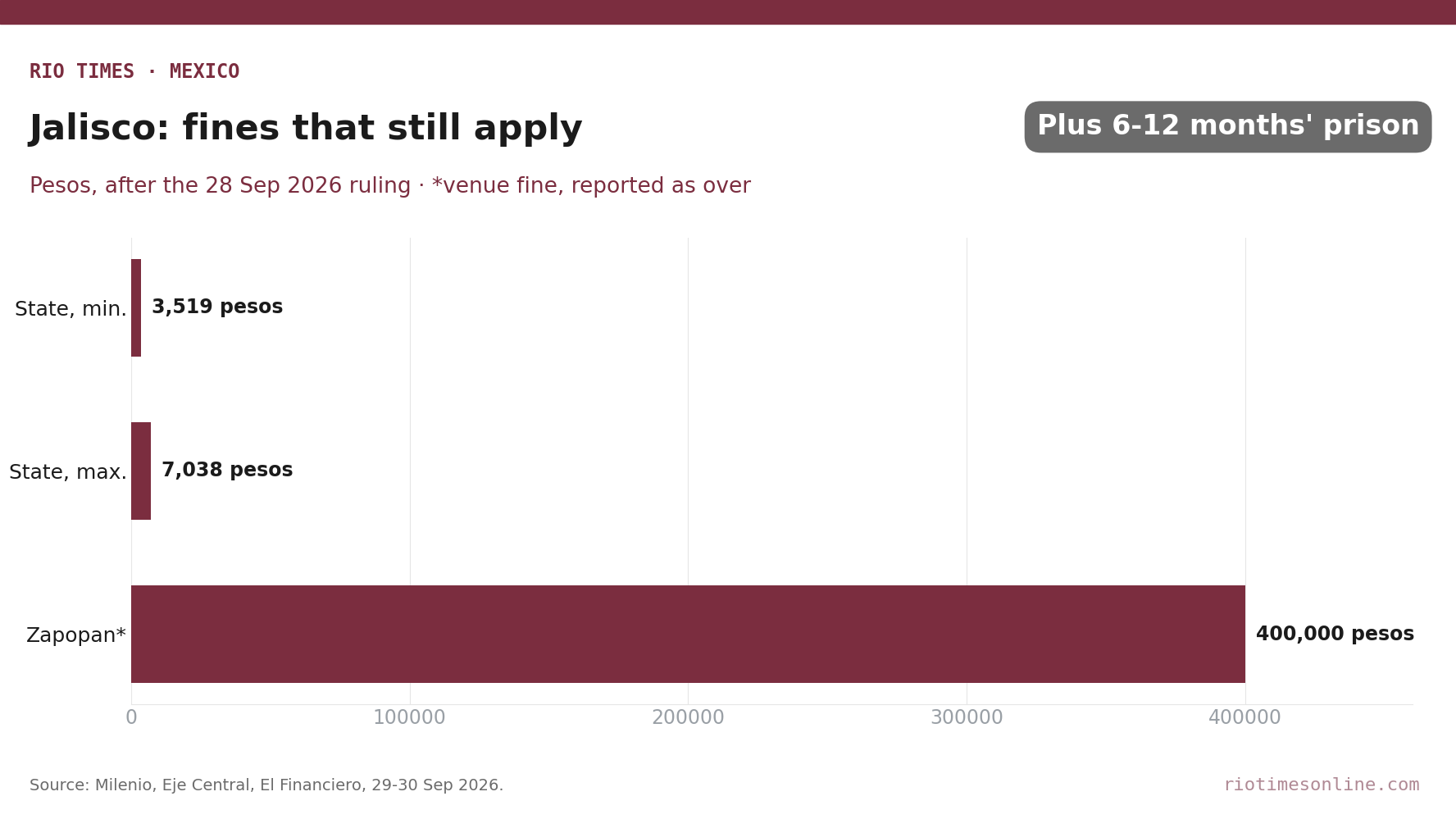
The penalties that survive are six months to a year in prison and fines of 30 to 60 UMA, Mexico’s indexed unit for fines. Milenio and Eje Central put that at 3,519 to 7,038 pesos (about US$195–391), at 18.02 pesos per US dollar on 30 September.
Municipal narcocorrido sanctions can be far heavier. In Zapopan, the Guadalajara suburb, venue fines exceed 400,000 pesos (about US$22,200), El Financiero reported.
How the dispute began
The trigger was a concert on 29 March 2025 at the Auditorio Telmex in Zapopan. The band Los Alegres del Barranco projected images of Nemesio Oseguera, “El Mencho”, then leader of the Jalisco New Generation Cartel.
Governor Pablo Lemus then barred such acts from state-run events, and state prosecutors opened an investigation into the band. The state congress later toughened the penal code.
A legislative group, Hagamos, noted that the “vice” wording had sat in the code since 1982. The 2026 decree mainly added public shows and raised the penalties.
For background on the genre, see Narcocorrido: how Mexican culture expresses the importance of drug trafficking in the country. The same court this week also ruled on Chihuahua Electoral Reform: Mexico Court Keeps Crime Annulment, Voids Bans.
What Is Not Yet Known
The ruling on the penal code applies retroactively to early March 2026, when the reform took effect. It is unclear how many people were sanctioned under the “vice” wording and may now benefit.
Nor is it clear how prosecutors will separate a song that describes crime from one that glorifies it. The court said any such case remains subject to judicial review.
Sources: El Financiero, Jalisco government statement, 29 Sep 2026; El Financiero, ruling report, 29 Sep 2026; El Informador, 29 Sep 2026; Milenio, 30 Sep 2026; Eje Central, 30 Sep 2026. Exchange rate: open.er-api.com, 30 Sep 2026.
This article was produced by The Rio Times’ automated newsroom system. How we use AI · Report an error
Read More from The Rio Times