Mexico Foreign Investment Reform Reaches Senate Floor With Security Checks on Takeovers
ECONOMY · MEXICO
Key Facts
- —The country Mexico, the second-largest economy in Latin America and a top destination for factories serving the United States. It has no formal national-security review of foreign takeovers yet.
- —What happened On 29 September two Senate committees approved the reform by 17 votes to 6 and sent it to the floor. The 30 September agenda lists it for first reading.
- —The numbers The investment commission would grow from 10 to 14 voting members, adding Defence and the Navy. Review deadlines fall from a proposed 60 working days to 45 (Senate, Expansión, 29 September).
- —What it means for you Foreign buyers taking more than 49 percent of a sizeable Mexican company in energy, data, mining or advanced technology would need prior approval. Minority stakes are not covered.
- —Still open The date of the floor vote, the asset threshold that triggers a review, and the lower house, which must also pass the bill.
The Mexico foreign investment reform has cleared its committee stage in the Senate. On Tuesday 29 September two joint committees approved it by 17 votes to 6 and sent it to the full chamber.
The bill gives Mexico a national-security filter for foreign takeovers in strategic sectors. Critics, including an ally of the ruling party, warn that the filter is drawn too loosely.

What the committees approved
The committees on Economy and on Legislative Studies approved the text, the Senate said in a bulletin. President Claudia Sheinbaum sent the initiative on 30 August, as The Rio Times reported when the bill reached the Senate.
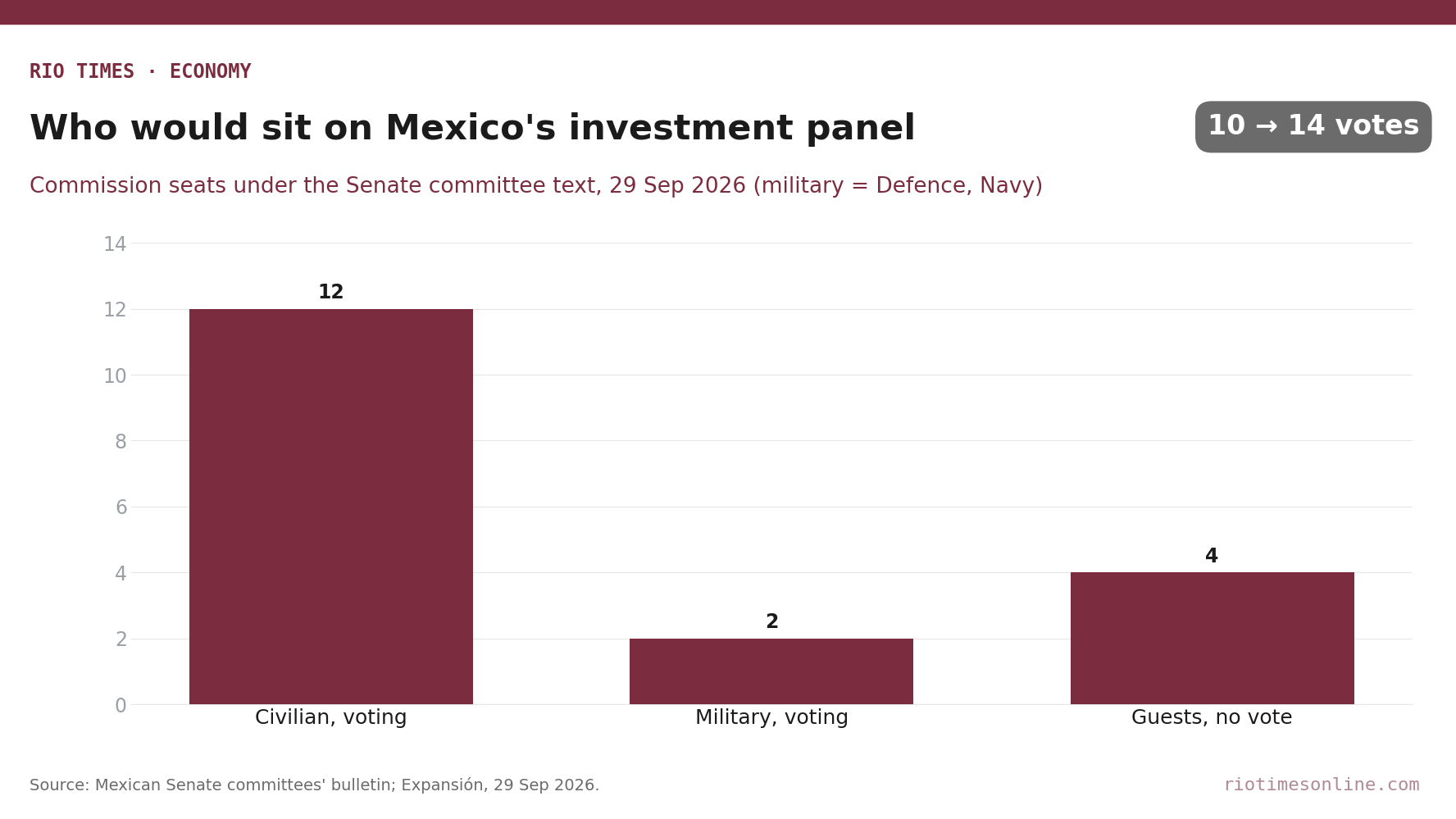
The reform enlarges the National Foreign Investment Commission, the cabinet-level body that rules on foreign stakes. Its voting members would rise from 10 to 14, according to Expansión.
The new voters are the Defence Ministry, the Navy, the Security Ministry and the Digital Transformation and Telecommunications Agency. The attorney general, national intelligence centre, tax authority (SAT) and financial intelligence unit would attend security cases without a vote.
Which deals would be screened
Review would apply only when three conditions are met, Expansión reported from the committee debate. A foreign stake must exceed 49 percent, and the target’s assets must pass a threshold the commission will set.
The third condition is the sector. The draft lists energy, transport, health, communications, mining, data storage, digital systems, aerospace and defence, Excélsior reported.
Critical technologies are also covered, from artificial intelligence and semiconductors to quantum and nuclear. The commission could approve a deal, attach conditions to it or block it.
The committees cut the proposed deadline for a decision from 60 working days to 45. In security cases, a missed deadline would not mean automatic approval.
Criticism from allies and opposition
Senator Yeidckol Polevnsky of the Labour Party (PT), a partner of the ruling Morena party, said the filter works against the government’s own push for investment. “With this you discourage everything,” she said, according to Expansión.
She also objected to borrowing United States review criteria, which she called biased against Asian countries, chiefly China. She asked for a tighter definition of economic national security.
The conservative National Action Party (PAN) questioned giving the armed forces a vote on an economic body. Senator Miguel Márquez Márquez said the power to add “analogous” sectors later weakens predictability for investors.
The case for the reform
Supporters answer that 12 of the 14 voting members would be civilian. They note that the United States, Canada, Australia and European Union members already screen foreign deals.
“Mexico does not have to choose between investment and sovereignty,” said Senator Manuel Huerta Ladrón de Guevara, who chairs one of the committees. Current law already lets the commission stop deals on security grounds but sets no procedure.
The reform adds oversight too. The commission would have to report to Congress every six months on its security reviews, the Senate said.
Investment has held up while the bill advanced. The Economy Ministry put foreign direct investment at a record US$34.97 billion in the first half of 2026.
What Is Not Yet Known
El Universal reported that the floor could debate the Mexico foreign investment reform on Wednesday. The Senate’s agenda for 30 September lists it for first reading, the step before debate and vote.
No floor vote had been reported by early afternoon. The asset threshold is still unknown, and the Chamber of Deputies must pass the bill before it becomes law.
Sources: Mexican Senate, committee bulletin, 29 September 2026; Senate order of business, 30 September 2026; Expansión, 29 September 2026; El Universal, 29 September 2026; Excélsior, 25 September 2026.
This article was produced by The Rio Times’ automated newsroom system. How we use AI · Report an error
In depth
Read More from The Rio Times