Brazil Markets: Ibovespa & the Real — September 30, 2026
Key Facts
- Banks carried the day, with Banco do Brasil climbing 2.6% and Itaú adding 1.4% as investors rotated into financial names
- Vale was the drag, falling 2.2% as iron ore weakened in China and UBS BB cut its price target; Brent crude settled 2.6% lower at US$102.59 a barrel
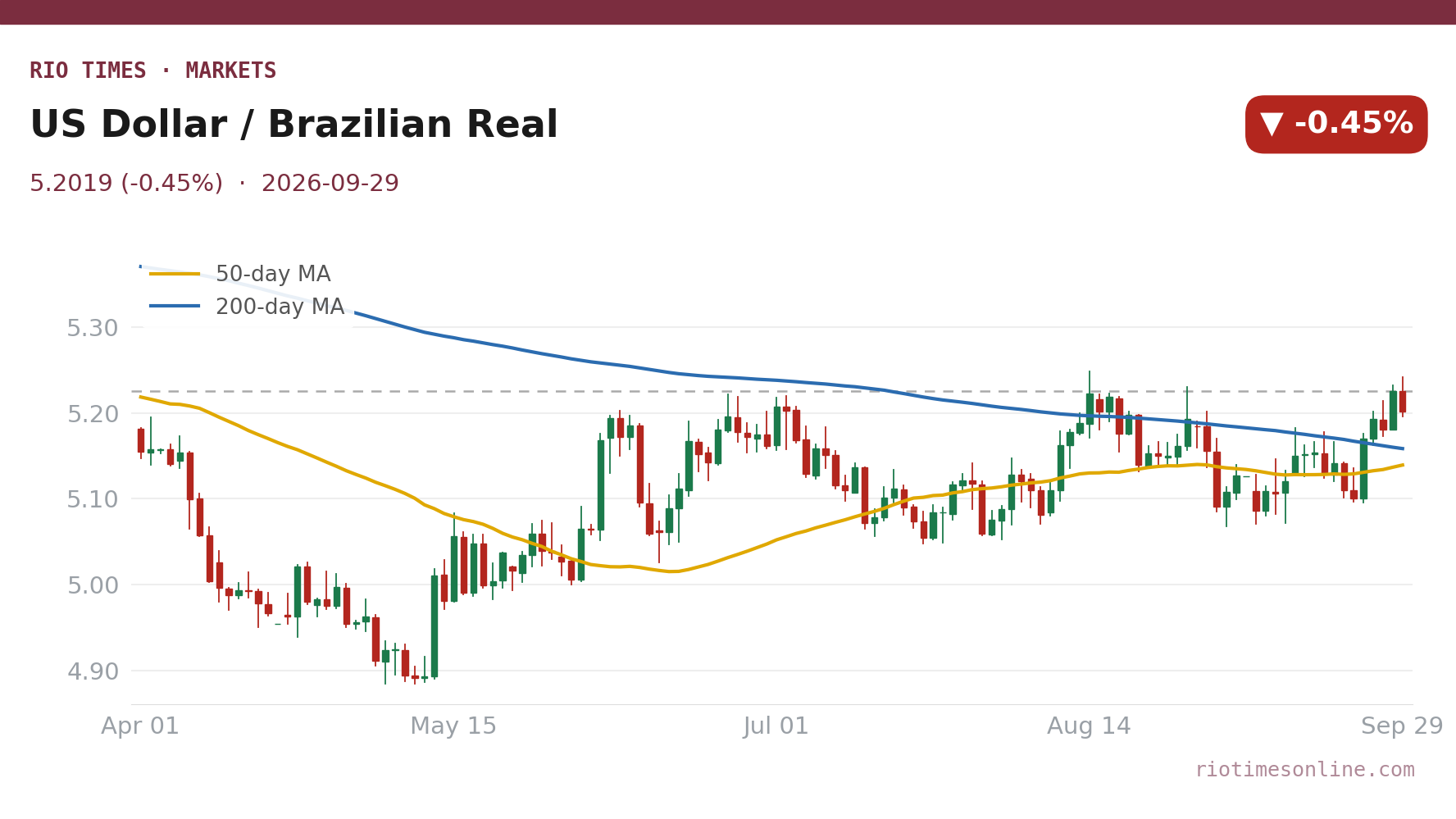
- The real firmed, with the dollar closing at 5.2019 per US dollar, down 0.45% on the session, the real’s best day since 21 September
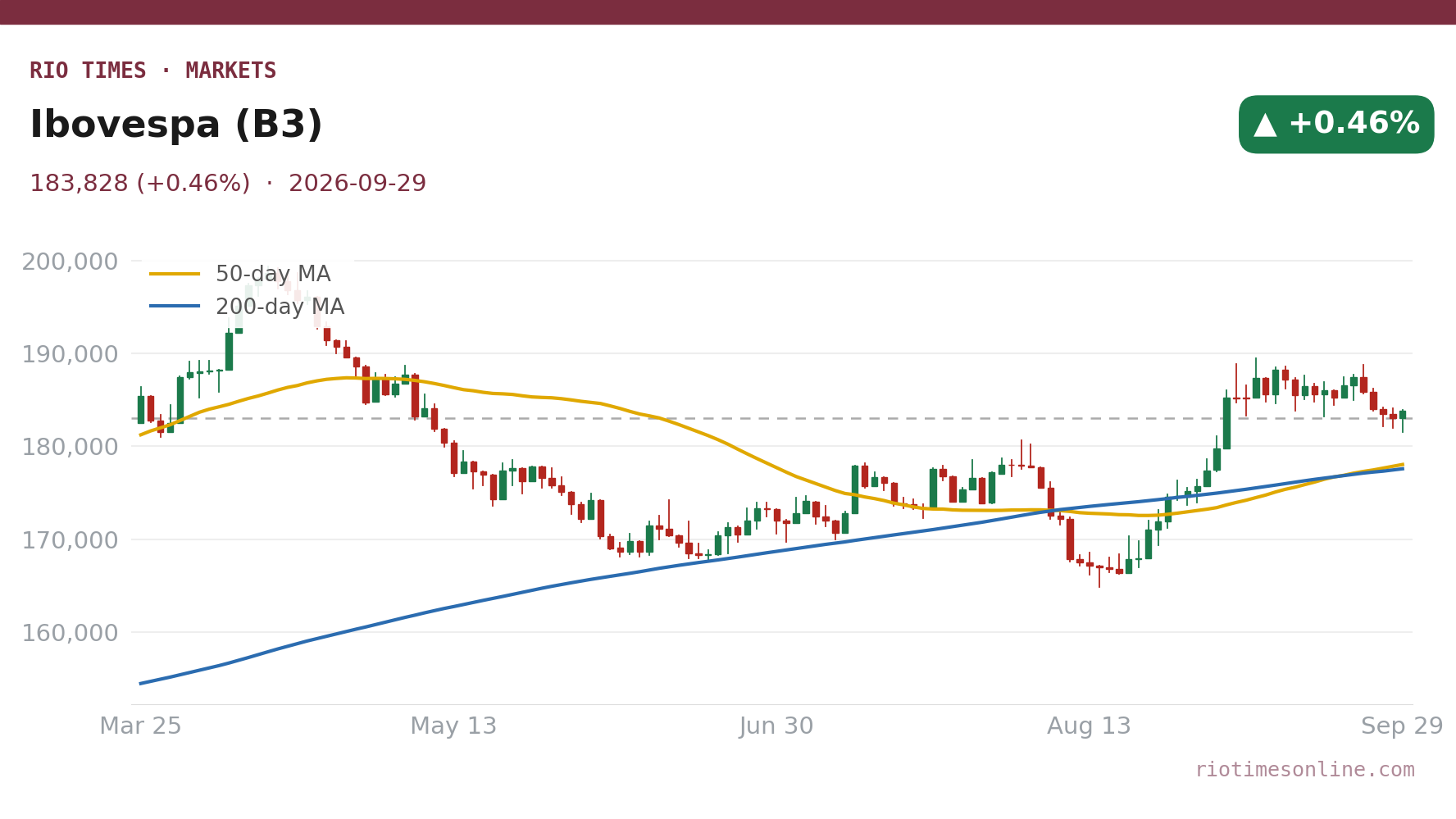
- The index ended a four-session losing streak, finishing at 183,828 points, still about 7.5% below its 52-week closing high
- Volume concentrated in the giants, with Vale, Petrobras, B3 and the big banks dominating turnover on the B3 exchange
- Jobs data ran hot: Brazil created 165,827 formal jobs in August, far above forecasts, while the IGP-M price index rose 1.57% in September; neither stopped the real or local bond yields from easing
Today’s Focus
Brazil’s Ibovespa stock index closed 0.46% higher at 183,828 points on Tuesday, snapping a four-session losing streak. The recovery was led by the country’s large banks, with Banco do Brasil up 2.6%, Itaú Unibanco up 1.4% and Bradesco up 0.7%.
The real, Brazil’s currency, strengthened 0.45% to 5.2019 per US dollar, even as the dollar index edged higher against major currencies. Vale, the mining giant, was the main drag, falling 2.2% on softer Chinese iron-ore futures.
Petrobras preferred shares rose 0.8% despite Brent crude falling 2.6% to US$102.59 a barrel. Cheniere said on Tuesday it had signed a 22-year deal to sell Petrobras about 0.8 million tonnes a year of liquefied natural gas.
Tuesday’s data were strong. Formal job creation (Caged) reached 165,827 in August, far above forecasts, and unemployment held at 5.3%. The IGP-M rose 1.57% in September. Brazil’s 10-year bond yield still eased to 14.135% from 14.18%.
What matters today. Banks and state-linked names supported the index while commodity exporters lagged, a domestic rotation rather than a global risk-on signal. Today’s fiscal figures and the 4 October election are the next tests.

01 The session in one read
Brazil’s main stock index, the Ibovespa, ended Tuesday up 0.46% at 183,828 points, breaking a four-day losing streak. The gain came on a day when US markets were soft (the S&P 500 fell 0.17%), which makes the move notable.
The star performers were banks. Banco do Brasil led the large caps with a 2.6% gain, while Itaú Unibanco added 1.4% and Bradesco rose 0.7%. B3, the company that runs the São Paulo stock exchange, also gained 1.4%.
On the downside, Vale, Brazil’s iron-ore giant, fell 2.2%, tracking weaker Chinese iron-ore futures. Petrobras, the state-controlled oil producer, diverged from oil’s slide, with its preferred shares up 0.8% despite Brent crude dipping 2.6%.
The real appreciated 0.45% against the dollar, closing at 5.2019 per US dollar. That was the real’s best day since 21 September, even as the dollar index rose 0.17% against major currencies.
The evidence points to a sector rotation within Brazil, not a broad-based global rally. US indices were slightly negative, and commodity prices fell, yet Brazilian financials and some retailers still advanced. That suggests investors were moving into names leveraged to local credit and consumer demand. Strong jobs data and a firm IGP-M do not argue for faster rate cuts, so the move looks more like relative value than a rates bet. The key variable to watch is whether bank strength persists without support from Vale or overseas markets.
02 The day’s numbers
| Measure | Level | Change | Read |
|---|---|---|---|
| Ibovespa | 183,828 | +0.46% | First gain in five sessions |
| USD/BRL | 5.2019 | -0.45% | Real firms vs dollar |
| Session range | 181,562 – 183,951 | — | Closed near the high |
| 52-week closing high | 198,657 | — | 14 April; index still 7.5% below |
| Friday’s close | 183,477 | — | Reclaimed on Tuesday |
The Ibovespa closed near the top of its session range, signalling that buying pressure strengthened into the close. It ended the day just above Friday’s close of 183,477, a reference level for short-term traders.
At 183,828 points, the index remains about 7.5% below its 52-week high of 198,657, but it is well above its 52-week closing low of 140,680 (10 October 2025). The real remains about 6% weaker than its strongest close of the past year, 4.8909 per US dollar on 11 May.
Live Market IntelligenceBrazil — Live Market Board
Rio Times · Live Market Intelligence
Brazil — Live Market Board
| Instrument | Last | Change | YoY | Prev. | High | Low | Volume |
|---|---|---|---|---|---|---|---|
| IBOV | 183,827.59 | +0.46% | +21.85% | 182,991.13 | 168,310 | 167,142 | — |
| USD/BRL | 5.16 | +0.01% | -5.13% | 5.16 | 5.18 | 5.14 | — |
| SELIC | 14.00% | — | — | — | — | — | |
| PETR4 | 41.64 | -0.05% | +35.19% | 41.66 | 41.97 | 41.15 | 41,499,400 |
| VALE3 | 72.97 | +0.83% | +30.75% | 72.37 | 73.54 | 72.66 | 17,658,000 |
| ITUB4 | 38.60 | -1.03% | +4.57% | 39.00 | 39.34 | 38.39 | 29,487,800 |
| BBDC4 | 16.85 | +0.36% | +3.50% | 16.79 | 16.90 | 16.67 | 19,416,900 |
| BBAS3 | 19.37 | +0.47% | +0.73% | 19.28 | 19.44 | 19.16 | 11,069,200 |
| B3SA3 | 14.26 | -0.21% | +12.73% | 14.29 | 14.47 | 14.11 | 33,037,800 |
| ABEV3 | 14.89 | -0.80% | +21.91% | 15.01 | 15.07 | 14.81 | 16,453,100 |
| WEGE3 | 47.59 | +0.49% | +29.99% | 47.36 | 48.08 | 47.36 | 3,364,600 |
| PRIO3 | 59.14 | -0.19% | +50.67% | 59.25 | 59.81 | 58.74 | 3,325,600 |
| SUZB3 | 41.33 | +2.35% | -23.55% | 40.38 | 41.48 | 40.35 | 3,914,900 |
| RENT3 | 34.68 | -0.09% | +0.84% | 34.71 | 34.96 | 34.35 | 7,979,100 |
| AZZA3 | 15.89 | -2.63% | -53.76% | 16.32 | 16.42 | 15.82 | 1,330,300 |
| CSNA3 | 4.30 | +0.47% | -42.65% | 4.28 | 4.41 | 4.26 | 10,076,100 |
| GGBR4 | 24.69 | +2.19% | +51.38% | 24.16 | 24.85 | 24.18 | 7,047,600 |
| ENEV3 | 24.21 | -1.38% | +70.49% | 24.55 | 24.64 | 23.99 | 9,297,000 |
03 Why it moved — banks rotate up as commodities sag
The session had a clear domestic rotation feel. Investors sold some of Brazil’s commodity exporters and bought banks, which are seen as beneficiaries of Brazil’s high interest-rate environment in the short term.
Banco do Brasil’s 2.6% jump was the standout among large caps. The bank has been a favourite for income-seeking investors because of its dividend payouts and state-linked profile.
Vale’s 2.2% drop to R$69.61 (US$13.38) tracked lower Dalian iron-ore futures. UBS BB also cut its target price for the stock to R$77 (US$14.80) from R$85 (US$16.34), keeping a neutral rating. Iron ore is Vale’s lifeblood, and China is its biggest customer.
Petrobras managed a 0.8% gain in its preferred shares even as Brent crude fell 2.6% on reports that Saudi Arabia had boosted flows through its East-West pipeline. Cheniere Marketing signed a 22-year agreement to sell Petrobras about 0.8 million tonnes a year of liquefied natural gas on a free-on-board basis, announced on Tuesday.
CSN, the steelmaker, fell 9.8% after its mining arm CSN Mineração cut its 2026 iron-ore output guidance to 39–41 million tonnes from 45–47 million. It also raised its cash-cost guidance to US$25–26 a tonne from US$22–23.50, citing higher sea freight costs.
04 Tuesday’s data, one by one
Our Tuesday edition flagged the IGP-M, unemployment and the Treasury’s August result, plus election polls, US yields and oil. Here is how each landed.
IGP-M inflation (FGV), 08:00 BRT. The general price index rose 1.57% in September, just under the 1.60% forecast and after a 0.22% fall in August. Over 12 months it is up 3.34%. The print sat near the top of the forecast range, a sign of wholesale price pressure. The market took it calmly.
Bank lending (central bank), 08:30 BRT. The credit stock grew 0.5% in August, in line with forecasts, after 0.3% in July. No market reaction.
Unemployment (IBGE PNAD), 09:00 BRT. The jobless rate was 5.3% in the three months to August, in line with forecasts and unchanged. IBGE put the employed population at a record 103.5 million.
Caged formal jobs (Ministry of Labour), afternoon. Brazil added 165,827 formal jobs in August, against forecasts of roughly 86,000 to 96,000 and 58,570 in July. A labour market this firm gives the central bank little reason to speed up rate cuts from the current 13.75% Selic.
Central government result (Treasury), afternoon. The Treasury, central bank and social security posted a primary deficit of R$13.6 billion (US$2.6 billion) in August. That was smaller than the R$14.2 billion (US$2.7 billion) threshold our Morning Call had flagged. The January–August deficit reached R$94.9 billion (US$18.2 billion).
Market reaction. The strong data did not hurt local assets. The real gained 0.45% and Brazil’s 10-year bond yield eased to 14.135% from 14.18%. Banks led the stock market.
Global items. The US 10-year Treasury yield edged up to 5.249%, and the dollar index rose 0.17%. US consumer confidence fell to 81.9 in September from 88.6, well below the 89.2 forecast. Brent fell 2.6%, which did not stop Petrobras from rising. Election polls remain the key domestic risk before Sunday’s first round.
05 The day’s movers
| Driver | Close | Change | Note |
|---|---|---|---|
| Vale | R$69.61 (US$13.38) | -2.2% | US$389m traded (R$2.0bn); iron ore, target cut |
| Petrobras PN | R$49.10 (US$9.44) | +0.8% | US$228m traded; LNG deal with Cheniere |
| B3 | R$17.90 (US$3.44) | +1.4% | US$194m traded; exchange operator |
| Banco do Brasil | R$22.04 (US$4.24) | +2.6% | US$158m traded; bank-led rally |
| Itaú Unibanco | R$42.30 (US$8.13) | +1.4% | US$144m traded; bank-led rally |
| Bradesco | R$17.78 (US$3.42) | +0.7% | US$143m traded; bank-led rally |
| Azza | R$17.15 (US$3.30) | +10.5% | Top gainer; no company news |
| CSN | R$5.40 (US$1.04) | -9.8% | Mining arm cut 2026 output guidance |
Vale handled the heaviest turnover, with around US$389 million in shares changing hands, yet fell 2.2%. That shows active selling, not just a lack of interest.
Azza’s 10.5% surge made it the day’s top gainer, with no company news behind it; it is a smaller, less liquid name. CSN was the biggest large-cap loser, down 9.8%, after its mining arm cut its production outlook.
06 The regional scoreboard
| Index | Country | Close | Change |
|---|---|---|---|
| IPC | Mexico | 65,110.57 | +0.26% |
| IPSA | Chile | 11,055.91 | -0.73% |
| Merval | Argentina | 2,782,561 | -0.58% |
| COLCAP | Colombia | 2,559 | -0.79% |
Brazil’s +0.46% was the best result among the region’s main markets, ahead of Mexico’s IPC at +0.26%. Chile, Colombia and Argentina all closed in the red.
The regional picture was mixed, with no single dominant driver. The live market board above carries all the verified closing levels for the region.
07 The technical picture
The Ibovespa’s close above 183,477, Friday’s close, matters for short-term traders. It recaptured a level lost on Monday, the last day of the four-session losing streak, offering a tentative sign that selling pressure has paused.
The index is still 7.5% below its 52-week high, so the broader trend remains under pressure. A break back below 183,477 could resume the downtrend, while holding above it opens room towards 185,000.
08 What to watch
- Fiscal data, 08:30 BRT: The central bank publishes August public-sector accounts; gross debt is forecast at 83.1% of GDP after 82.5%, with a nominal deficit of about R$109 billion (US$21 billion) expected
- Producer prices, 09:00 BRT: IBGE’s August producer price index, forecast at -0.4% on the month after -0.83%
- China and the US: China’s official factory PMI came in at 50.1 overnight, in line with forecasts, a test for Vale; US ADP jobs (09:15 BRT) and August PCE inflation (09:30 BRT) follow
- Colombia and quarter-end: Colombia’s central bank decides on rates at 15:00 BRT; today is also the last trading day of the quarter
- Election week: Fresh polls before Sunday’s 4 October first round remain the key risk for the real and state-linked stocks
Background: What Is Vale? Brazil’s Mining Giant Explained: Iron Ore, the Dam Legacy and What to Watch.
Background: Ibovespa Ends Four-Week Winning Run as CSN Leads Steel Sell-Off.
Frequently Asked Questions
What is the Ibovespa?
It is Brazil’s main stock index, tracking the most traded companies on the B3 exchange in São Paulo.
Why did banks rise?
Investors rotated into Brazilian financials, which benefit from high local interest rates, while selling commodity exporters like Vale.
What is the real?
The real is Brazil’s currency. On Tuesday it strengthened 0.45% against the US dollar, closing at 5.2019 per US dollar.
Why did Vale fall?
Chinese iron-ore futures declined and UBS BB cut its price target. Iron ore is Vale’s core product and China its largest customer, so the stock dropped 2.2%.
What did Tuesday’s jobs data show?
Brazil created 165,827 formal jobs in August, far above forecasts, and unemployment held at 5.3% in the three months to August.
Source: RT live market data, close of Tuesday 29 September 2026; exchange figures from B3.
This article was produced by The Rio Times’ automated newsroom system. How we use AI · Report an error
LatAm Markets: Live Signals → — real-time movers, turnover leaders and FX across Latin America.
Read More from The Rio Times