Key Facts
- The dollar is little changed overnight leaving Latin American currencies, and the region’s high-yield carry trades, as the main focus before Brazil’s mid-month inflation numbers due this morning.
- Wall Street closed firm on Tuesday with the S&P 500 up modestly and the Nasdaq ahead as investors looked past recent volatility, a backdrop that typically helps risk appetite in emerging markets.
- Brazil’s mid-month IPCA-15 inflation is due at 9:00 BRT with economists expecting a monthly deflationary print around -0.3 per cent, which would support the case for the central bank to keep cutting the Selic benchmark interest rate.
- Mexico’s next trade reading lands later this week after June’s surplus came in near US$4.1 billion, a read on how US demand is filtering through to the region’s second-biggest economy.
- Gold is little changed near US$4,620 an ounce while copper holds near US$6.58 a pound a mix that sends a neutral signal for resource-heavy markets like Chile and Peru and leaves Brazil’s consumer-led names less exposed to commodity swings.
Today’s Focus
Latin American assets open Wednesday looking at two things: a dollar that is barely moving and a Brazilian inflation report that could shape how long the Selic keeps falling. The dollar index is a shade softer near 98.9, US ten-year Treasury yields have eased toward 4.6 per cent, and the real is little changed from the prior session.
That matters because a stable dollar, falling US yields, and a possible negative monthly inflation print in Brazil all strengthen the narrative that foreign money can keep chasing Latin American real yields. Brazil’s Ibovespa has strung together five straight gains, led on Tuesday by rate-sensitive retailers such as Magazine Luiza and Assaí.
But this is not a one-country story. Mexico’s IPC is coming off a solid 0.79 per cent gain, Chile’s copper-heavy IPSA is in the frame, and Argentina’s Merval is holding near its highs after a long rally. The regional tone is more about waiting for the next catalyst than chasing the last one.
What matters today. Today’s Brazilian inflation print — and, later this week, Mexico’s trade figures — will tell investors whether the two biggest economies in the region can keep attracting foreign flows into local assets.

| Instrument | Level | Session |
|---|---|---|
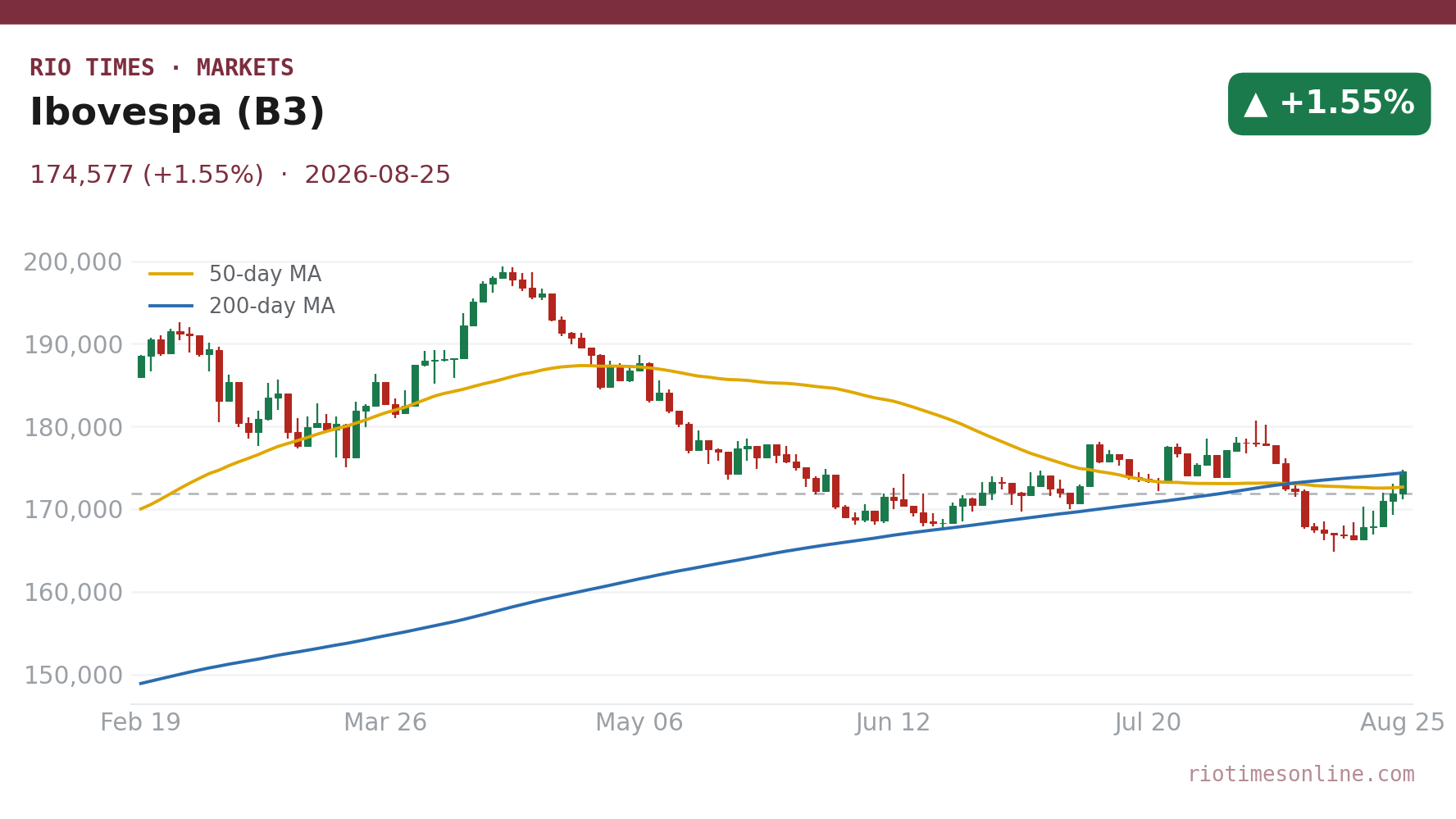
| Ibovespa (Brazil) | 174,577 | +1.55% |
| S&P 500 (US) | 7,677 | +0.32% |
| USD/BRL (PTAX) | 5.1490 | -0.04% |
| USD/MXN | 16.95 | +0.01% |
| USD/CLP | 914.2 | +0.15% |
| USD/COP (TRM) | 3,081.67 | +0.82% |
Tuesday close, 2026-08-25. USD/BRL is the BCB PTAX fixing; USD/COP is the official TRM fixing valid from Wednesday.
01 The overnight session in one read
The overnight picture is calm, almost flat. The dollar index is barely changed near 98.9, US ten-year Treasury yields have eased toward 4.6 per cent, and Brent crude is steadying near US$87 a barrel early Wednesday after Tuesday’s 3 per cent slide, which keeps the region’s energy exporters from getting too excited.
Copper eased 0.3 per cent to about US$6.58 a pound, pausing after a strong run. That combination — stable dollar, soft yields, no commodity spike — leaves most Latin American markets trading on their own domestic stories today.
For Brazil, that means the mid-month IPCA-15 inflation report at 9:00 BRT. For Mexico, July trade figures land later this week, after June’s surplus of about US$4.1 billion gave a fresh read on how the manufacturing sector is holding up.
The evidence points to a steady, mildly constructive open: a softer dollar, lower US ten-year yields, and confirmed strength in Brazil’s rate-sensitive leaders all line up in the same direction. The mid-month IPCA-15 is the swing factor; if the monthly print comes in as deflationary as economists expect, real-rate appeal improves and local financials and consumer names should hold their bid. The variable to watch is whether the print’s core services detail backs the disinflation story or complicates the central bank’s easing path.
02 The board before the open
| Instrument | Level | Change | Read |
|---|---|---|---|
| Ibovespa | 174,577 | +1.55% | Brazil strength continues, five straight gains |
| Mexbol (IPC) | 66,293 | +0.79% | Mexico joins the rally |
| IPSA | 11,451 | -0.76% | Chile lags as copper rally pauses |
| Merval | 3,009,029 | +0.46% | Argentina holds firm after long run |
| COLCAP | 2,508 | -0.09% | Colombia barely moves |
| USD/BRL (PTAX) | 5.1490 | -0.04% | Real steady into inflation data |
| DXY (dollar index) | 98.9 | -0.09% | Dollar soft, supportive for EM FX |
| US 10Y yield | ≈4.6% | easing | Lower yields help carry trades |
The board shows a region that is digesting rather than extending. Brazil’s Ibovespa is the clear standout, up again, with Mexico posting a solid gain while Chile and Colombia sit slightly in the red. The real is barely changed against the dollar, which tells you the Brazilian move is being driven by local flows and rate expectations rather than currency swings.
The softer dollar index and lower US ten-year yield are quietly helpful for all of Latin America. When US yields fall, the gap between what investors can earn in local bonds and in US paper becomes more attractive, and that tends to bring foreign money into the region’s currencies and equities. Rio Times · Live Market Intelligence
Live Market IntelligenceLatin America — Cross-Market Board
Latin America — Cross-Market Board
Instrument Last Change YoY Prev. High Low Volume
IBOV
209,066.90
+1.38%
+21.85%
206,220.24
168,310
167,142
—
IPSA
11,044.42
+0.18%
—
11,024.22
11,210
10,984
1,513,213,483
IPC MEX
66,048.57
+1.63%
+12.17%
64,986.91
66,121
65,405
108,886,187
MERVAL
2,828,027
-0.16%
+30.51%
3,022,485
3,042,365
2,991,150
—
COLCAP
2,531.15
+0.21%
—
9.04
9.05
9.02
4,133
BVL PERÚ
59,610.00
+2.26%
—
—
—
—
—
USD/BRL
5.16
+0.01%
-5.13%
5.16
5.18
5.14
—
EUR/BRL
5.95
+1.01%
-5.83%
5.89
5.98
5.94
—
USD/MXN
17.06
-0.24%
-8.58%
17.10
17.08
17.01
—
USD/CLP
913.98
+0.04%
-5.67%
913.65
915.11
906.68
—
USD/COP
3,140
+0.03%
-22.04%
3,139
3,141
3,105
—
USD/PEN
3.36
-0.66%
-4.82%
3.38
3.38
3.35
—
USD/ARS
1,493
+0.10%
+12.96%
1,491
1,494
1,480
—
USD/UYU
40.27
+1.24%
+1.80%
39.77
40.27
40.23
—
USD/PYG
5,939
+1.68%
-19.54%
5,841
5,939
5,925
—
USD/BOB
11.64
-0.76%
+72.04%
11.73
11.72
11.64
—
USD/DOP
58.34
+1.25%
-3.44%
57.62
58.34
58.04
—
USD/CRC
445.92
+0.89%
-9.71%
441.97
448.50
445.92
—
03 What the data shows — consumer and retail names lead Brazil’s charge
| Stock | Move | Close | Note |
|---|---|---|---|
| MGLU3 (Magazine Luiza) | +9.13% | R$4.54 | Retailer jumps as rate-cut hopes build |
| ASAI3 (Assaí) | +7.82% | R$8.96 | Wholesale food retailer rallies with real income theme |
| CURY3 (Cury) | +7.49% | R$32.58 | Homebuilder rides the easing bet |
| BBAS3 (Banco do Brasil) | +5.22% | — | State bank surges to a daily high of R$19.57 |
| BRKM5 (Braskem) | -13.11% | R$4.11 | Petrochemical firm files for out-of-court restructuring |
| PETR3 (Petrobras ON) | -2.05% | R$45.98 | Oil major slides with crude’s 3% drop |
Prices in reais. At the BCB PTAX fixing of 5.1490 per dollar on August 25, R$5.15 bought about US$1.
Brazil’s winning stocks on Tuesday were overwhelmingly consumer and rate-sensitive names, and that is a meaningful signal. Magazine Luiza, Assaí and homebuilder Cury all rose sharply, which means funds were actively buying the part of the market that gains most when the Selic falls.
The losers tell their own story. Braskem plunged 13.11 per cent after filing for out-of-court restructuring on Monday, a move that also pulls the stock out of B3’s main indices. Petrobras fell about 2 per cent as crude slid, while Vale rose 2.04 per cent and Banco do Brasil jumped 5.22 per cent — a split session for the heavyweights.
04 Brazil and the currencies
The real is holding near 5.15 to the dollar, with the official PTAX fixing at 5.1490 on Tuesday, barely moved overnight. A softer dollar index has given Latin American currencies a mild tailwind, but the bigger test comes this morning when Brazil reports the mid-month IPCA-15 inflation reading.
Economists are looking for a monthly deflationary print of about 0.3 per cent, which would pull the 12-month rate toward 4.34 per cent and reinforce the central bank’s room to keep cutting the Selic. Lower rates typically make local equities more attractive, especially consumer names, but they can also reduce the carry appeal of the real.
The rest of Brazil’s week is busy too: the central bank releases July current account and foreign direct investment figures on Thursday at 11:30 BRT, and the IBGE’s continuous household survey on unemployment lands the same day.
Elsewhere in the region, the Mexican peso is steady near 16.95 per dollar, the Chilean peso is tracking copper near 914 per dollar, and the Argentine peso continues its slow managed depreciation. The Colombian peso showed the most movement on the board after the official TRM fixing computed from Tuesday’s session jumped 0.82 per cent to 3,081.67, valid from Wednesday.
05 The regional setup
| Index | Country | Change |
|---|---|---|
| Ibovespa | Brazil | +1.55% |
| Mexbol (IPC) | Mexico | +0.79% |
| IPSA | Chile | -0.76% |
| Merval | Argentina | +0.46% |
| COLCAP | Colombia | -0.09% |
The regional table shows a split between Brazil-led strength and a more cautious tone in the Pacific-facing markets. Brazil, Mexico and Argentina finished in positive territory, while Chile and Colombia slipped. It is not a unified regional story.
Mexico’s trade balance, due later this week, will be the next hard data point for the country’s exporters. June’s surplus of about US$4.1 billion confirmed that shipments to the US remain healthy, though the market will also watch for any sign that tariff-related disruptions are starting to bite.
06 The technical picture
Brazil’s Ibovespa is the clear momentum leader after five straight positive sessions, sitting at its best levels in recent weeks. The index has carved out a clear recovery from its early-August lows, which is a constructive setup for trend followers.
Mexico’s IPC joined the move on Tuesday with a 0.79 per cent gain to 66,293 points, breaking out of the middle of its recent range. Chile’s IPSA, by contrast, is lagging the region, weighed down by the pause in copper after a very strong run.
The dollar index and US ten-year yields are the hidden technical drivers here. Both are pointing lower, and if that continues, the path of least resistance for Latin American assets is upward, particularly for the rate-sensitive and consumer-heavy Brazilian names.
07 What to watch
- Brazil IPCA-15 mid-month CPI at 9:00 BRT: The monthly print and the year-on-year number will set the tone for rate expectations and the real.
- Mexico trade balance later this week: A surprise in either direction will move the peso and the export-heavy IPC.
- US jobless claims tomorrow: Though not today, positioning ahead of this number can dampen risk-taking in the final hour.
- Copper near US$6.58 a pound: A further slide could drag Chile and Peru, while a push back toward recent highs would support them.
Frequently Asked Questions
Why does Brazil’s inflation report matter for the whole region?
Because Brazil is the largest economy in Latin America and its central bank rate decisions influence how global funds allocate across all emerging markets.
What is the Selic?
The Selic is Brazil’s benchmark interest rate, set by the central bank, and it directly affects borrowing costs, mortgage rates and the attractiveness of Brazilian assets to foreign investors.
Why do falling US Treasury yields help Latin America?
When US yields fall, the extra return from owning higher-yielding Latin American bonds and currencies becomes more attractive, pulling money into the region.
What does negative monthly inflation mean for Brazilian stocks?
It gives the central bank room to cut rates, which lowers funding costs for consumers and companies, and typically boosts retail, housing and banking stocks.
Market data: B3 and Estadão (Ibovespa, stocks); BCB PTAX (USD/BRL); BMV (IPC); SFC (TRM); regional indices via Investing.com
This article was produced by The Rio Times’ automated newsroom system. How we use AI · Report an error · Editorial responsibility: Matthias Camenzind, Editor-in-Chief
LatAm Markets: Live Signals → — real-time movers, turnover leaders and FX across Latin America.