Key Facts
- The dollar is firming ahead of Friday’s US payrolls and the Fed chair’s Jackson Hole speech, with the DXY up about two tenths overnight near 99.1.
- Brazil’s real slipped only modestly to 5.1513 per dollar on Wednesday, while Colombia’s peso slid about 0.8% and Chile’s peso actually firmed.
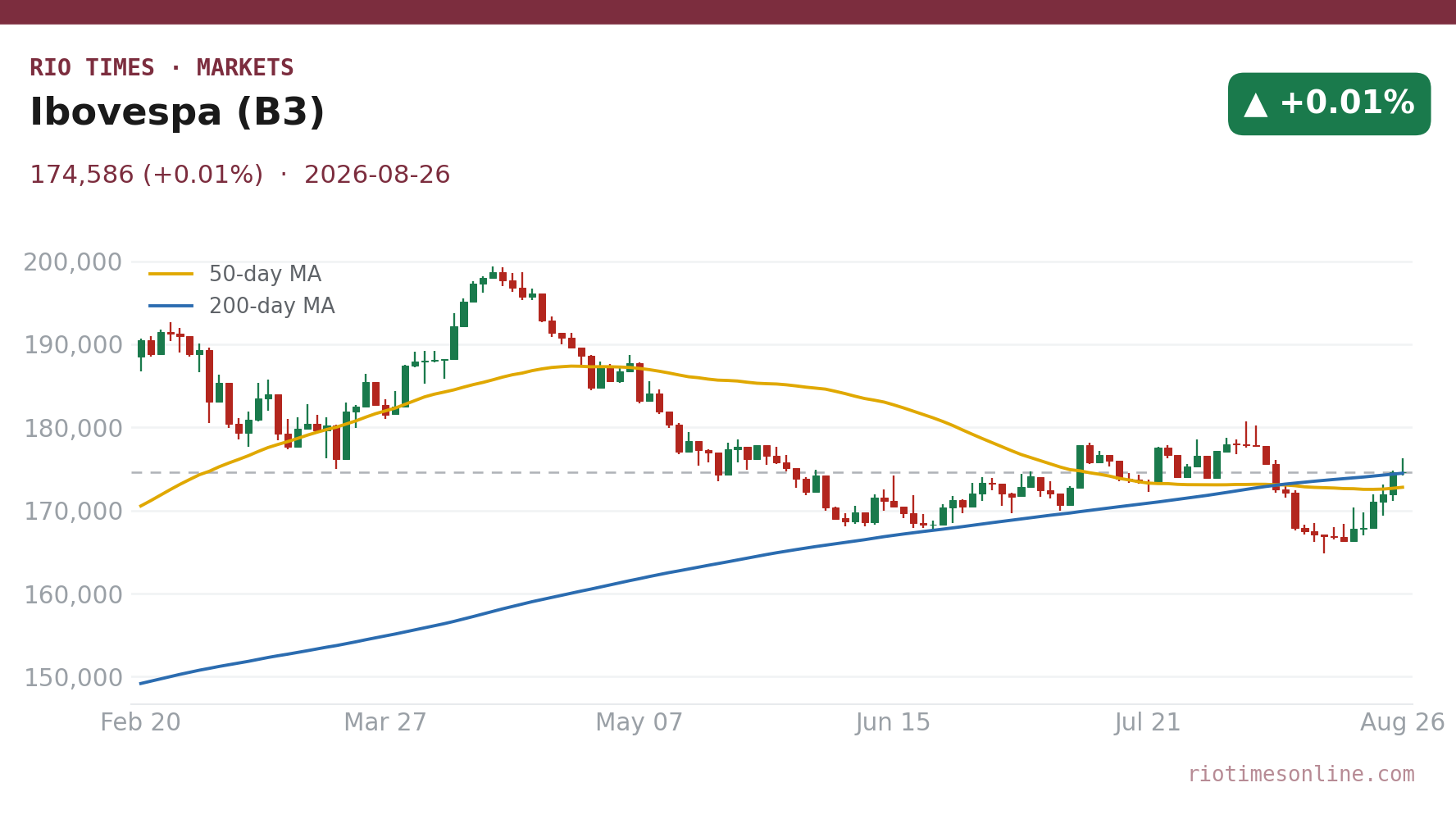
- São Paulo’s Ibovespa has now strung together six straight positive sessions, though the latest gain was little more than a rounding error at 0.01%.
- Argentina’s Merval rose 0.53% on Wednesday while Mexico’s IPC slipped 0.15% and Chile’s IPSA fell 0.5%, leaving no single regional mood to trade.
- A heavy data morning awaits with Brazilian unemployment at 9:00 BRT, external accounts at 11:30 BRT and Mexico’s trade balance and jobless rate at 9:00 BRT.
Today’s Focus
The regional setup is one of wait-and-see caution rather than conviction. A firming dollar — the DXY measure of the US currency is up about two tenths overnight — is the headwind, and it is already visible in Colombia, where the peso slid about 0.8% on Wednesday.
Yet Brazil is bucking that pressure remarkably well. The real slipped only 0.01% to 5.1513 per dollar, and the Ibovespa — Brazil’s main stock index — has now risen for six straight sessions, even if the latest move was microscopic. Retailer Magalu led Wednesday’s gainers while Braskem collapsed for a second day, and Petrobras helped support the index.
The morning brings a genuine data-jam. Brazil reports PNAD unemployment at 9:00 BRT and the central bank’s external accounts at 11:30 BRT, while Mexico delivers its trade balance and jobless rate at 9:00 BRT. Over it all hangs Jackson Hole, which opens today with Fed chair Kevin Warsh due to speak on Friday.
The mood is not bearish, but it is cautious. Traders are holding positions light ahead of a run of numbers that could shift rate expectations from São Paulo to Mexico City.
What matters today. The morning’s data load will determine whether the real’s resilience is a fluke or a signal.
| Instrument | Level | Session |
|---|---|---|
| Ibovespa (Brazil) | 174,586 | +0.01% |
| S&P 500 (US) | 7,676 | -0.02% |
| USD/BRL | 5.1513 | +0.22% |
| USD/MXN | 16.95 | +0.03% |
| USD/CLP | 911.43 | -0.35% |
| USD/COP | 3,082 | +0.82% |
| USD/ARS | 1,514 | +0.17% |
Source: market close, 26 August 2026.
01 Overnight markets in one read
Overnight trading is one of quiet tension rather than movement. The DXY, which tracks the dollar against a basket of major currencies, is up about two tenths — enough to keep a lid on emerging-market enthusiasm but not enough to spark a broad retreat.
Commodities are providing little help. Gold is down, retreating from its record run, while oil is steady after Iran and Oman reached a deal on Hormuz transits. Neither moves the needle much for Petrobras or Ecopetrol at the open.
The S&P 500 slipped 0.02% to 7,675.70 on Wednesday, a second small step back from the record, and the Nasdaq edged lower with it. After the bell, Nvidia beat estimates with a strong revenue outlook, which lifted index futures heading into Thursday.
Treasury yields are edging higher, with the benchmark 10-year around 4.66 percent. That is a mild headwind for everything that pays a dividend in Latin America.
The evidence is mixed: a firmer dollar is normally bad for the region’s currencies, yet Brazil is holding firm and the Ibovespa’s six-session streak shows domestic buyers are not panicking. Colombia’s peso slide shows the dollar’s strength is starting to bite at the edges. The variable to watch is Brazil’s PNAD jobs and external-accounts data, which could push the market to conclude the real has run too far, too fast.
02 The board before the open
| Instrument | Level | Change | Read |
|---|---|---|---|
| DXY (dollar basket) | 99.11 | +0.20% | Firming dollar, mild regional headwind |
| USD/BRL | 5.1513 | +0.22% | Real slips modestly, still the region’s anchor |
| USD/MXN | 16.95 | +0.03% | Peso stable ahead of trade data |
| USD/CLP | 911.43 | -0.35% | Chilean peso firmed against the dollar |
| USD/COP | 3,082 | +0.82% | Colombian peso the weakest link |
| Gold | $4,624/oz | -0.67% | Overnight level; pullback after record run |
| US 10Y | 4.66% | +3 hundredths | Higher yields temper risk appetite |
| VIX | 15.21 | -1.55% | Fear gauge calm, not complacent |
The board tells a clear story: the dollar is doing the pushing and Latin America is feeling it unevenly. The real is the outlier — down only two tenths while Colombia’s peso slid about 0.8%.
That divergence is the early signal for today’s session. Mexico is sitting tight ahead of its jobs and trade numbers, while Chile’s peso quietly firmed even as its stock market fell. Rio Times · Live Market Intelligence
Live Market IntelligenceLatin America — Cross-Market Board
Latin America — Cross-Market Board
Instrument Last Change YoY Prev. High Low Volume
IBOV
208,295.98
+1.57%
+21.85%
205,079.25
168,310
167,142
—
IPSA
10,926.50
-0.42%
—
10,972.40
11,210
10,984
1,513,213,483
IPC MEX
69,010.67
+0.12%
+12.17%
68,929.72
66,121
65,405
108,886,187
MERVAL
3,017,221
—
+30.51%
3,022,485
3,042,365
2,991,150
—
COLCAP
2,533.22
+0.47%
—
9.04
9.05
9.02
4,133
BVL PERÚ
59,903.86
-0.06%
—
—
—
—
—
USD/BRL
5.16
+0.01%
-5.13%
5.16
5.18
5.14
—
EUR/BRL
5.95
+1.01%
-5.83%
5.89
5.98
5.94
—
USD/MXN
17.06
-0.24%
-8.58%
17.10
17.08
17.01
—
USD/CLP
913.98
+0.04%
-5.67%
913.65
915.11
906.68
—
USD/COP
3,140
+0.03%
-22.04%
3,139
3,141
3,105
—
USD/PEN
3.36
-0.66%
-4.82%
3.38
3.38
3.35
—
USD/ARS
1,493
+0.10%
+12.96%
1,491
1,494
1,480
—
USD/UYU
40.27
+1.24%
+1.80%
39.77
40.27
40.23
—
USD/PYG
5,939
+1.68%
-19.54%
5,841
5,939
5,925
—
USD/BOB
11.64
-0.76%
+72.04%
11.73
11.72
11.64
—
USD/DOP
58.34
+1.25%
-3.44%
57.62
58.34
58.04
—
USD/CRC
445.92
+0.89%
-9.71%
441.97
448.50
445.92
—
03 What the data shows — the real decoupled, the region did not
| Stock | Move | Turnover | Note |
|---|---|---|---|
| MGLU3 (Magazine Luiza) | +3.74% | R$89m | Top gainer of the session |
| BRKM5 (Braskem) | -14.36% | R$76m | Biggest faller; second straight double-digit fall |
| ASAI3 (Assaí) | -6.58% | R$211m | Heavy selling in the retailer |
| RAIZ4 (Raízen) | -4.17% | — | Extended its recent slide |
| PETR4 (Petrobras PN) | +0.24% | — | Closed at R$41.45, supporting the index |
The B3 screen shows a market rotating rather than breaking out. The standout gain was Magazine Luiza, up 3.74 percent on R$89 million of turnover, while cash volume across the exchange ran near R$24 billion.
Far more dramatic is Braskem, down 14.36 percent after a 13 percent fall on Tuesday — a two-day collapse past 25 percent as investors digest restructuring talk around its controller. Assaí slid 6.58 percent on heavy volume, the busiest name among the fallers.
The anchor of the session was Petrobras again, which edged up 0.24 percent and helped hold the index in positive territory. Off the index, Habib’s filed for judicial recovery on Wednesday with R$265 million in debts, a vivid symptom of how high real rates have squeezed consumer businesses.
04 Brazil and the currencies
The real’s resilience is remarkable given the dollar is firming elsewhere. At 5.1513 per dollar, Brazil’s currency slipped only 0.22 percent while Colombia’s peso sank about 0.8 percent. That is not a vote of confidence in Brasília — it is a vote about the Selic, the benchmark rate.
With the Selic at 14.00 percent after a fourth straight quarter-point cut, Brazil still offers one of the world’s most attractive real yields, and carry trade money keeps arriving. The six-session gain in the Ibovespa, even if tiny, suggests foreign accounts are still willing to stay long São Paulo.
This morning’s PNAD unemployment and external-accounts data matter here. A jobless rate around the expected 5.3 to 5.4 percent would keep the labour market tight enough to slow further rate cuts, which helps the currency. A surprise jump would do the opposite.
Foreign direct investment is the second number to watch. It ran at US$9.07 billion in June against a US$7.9 billion consensus for July, and a firm print would confirm that long-term capital still likes Brazil’s story despite the political noise.
05 The regional setup
| Index | Country | Change |
|---|---|---|
| Merval | Argentina | +0.53% |
| Ibovespa | Brazil | +0.01% |
| IPC | Mexico | -0.15% |
| IPSA | Chile | -0.5% |
The regional table shows no single mood. Argentina’s Merval climbed 0.53 percent to 3,024,971, while Mexico’s IPC slipped 0.15 percent to 66,191 and Chile’s IPSA fell 0.5 percent to 11,369
The Chile split is worth noting: the peso firmed to 911.43 per dollar even as stocks fell. Colombia’s peso, by contrast, slid about 0.8 percent, the sharpest currency fall in the region.
Argentina’s gain is steady rather than spectacular, typical of a market that keeps grinding higher as investors bet on the economic turnaround. Mexico now waits on Thursday’s trade balance and unemployment readings at 9:00 BRT.
06 The technical picture
The Ibovespa’s six-session upward streak is more about absence of bad news than any real buying impulse. At around 174,586, the index remains 12.1 percent below its 52-week high of 198,657 — a reminder of how far the market fell during earlier stress.
The VIX, Wall Street’s fear gauge, is at 15.21 and falling, which suggests traders are not bracing for a shock. That calmness, combined with a firm dollar, usually means range-trading rather than breakouts for Latin American stocks.
The Mexican IPC is in reasonable technical shape, sitting about 8 percent below its own 52-week high, while the S&P 500 is less than 2 percent off its peak. That gap between US strength and Latin lagging is the real structural story.
07 What to watch
- Brazil PNAD unemployment at 9:00 BRT: consensus around 5.3–5.4 percent, versus 5.4 percent in the prior reading.
- Brazil external accounts at 11:30 BRT: current-account consensus of minus US$6.6 billion and FDI of US$7.9 billion.
- Mexico trade and jobs at 9:00 BRT: a trade surplus near US$3 billion is penciled in, with unemployment seen at 3.0 percent.
- Jackson Hole opens today: Fed chair Kevin Warsh speaks Friday, the same day as US payrolls, Brazil’s Caged and IGP-M.
Frequently Asked Questions
Why is Brazil’s real holding up better than its neighbours?
Because the Selic rate still offers one of the world’s highest real yields, attracting carry-trade money even when the dollar firms.
What does a firmer dollar mean for Latin American stocks?
It usually makes imports costlier and raises debt-service burdens in local currency, so it is a mild headwind, unless a country exports oil or metals.
Which market is most at risk today?
Colombia — its peso slid about 0.8 percent on Wednesday, the region’s sharpest fall, and Mexico’s IPC also slipped ahead of Thursday’s data.
Is the Ibovespa’s six-day win streak meaningful?
Barely. The latest gain was just 0.01 percent, so it is more of a holding pattern than a rally.
Market data: RT
This article was produced by The Rio Times’ automated newsroom system. How we use AI · Report an error · Editorial responsibility: Matthias Camenzind, Editor-in-Chief
LatAm Markets: Live Signals → — real-time movers, turnover leaders and FX across Latin America.