Today’s Focus
It is a morning shaped far more by local data than by the overnight tape, which was a quiet drift lower. The Bank of Japan left policy untouched, Europe opened mixed, and US futures are barely changed — leaving Latin Americans free to focus on an unusually busy calendar inside the region.
The biggest cluster sits in Santiago. Chile publishes retail sales, industrial production, manufacturing output, and the unemployment rate all at once. Consensus expects a slight improvement in retail but deep year-on-year contractions in mining-heavy industrial production — numbers that will test the IPSA’s recent composure after it managed a small gain in Wednesday’s session.
Mexico gets its preliminary second-quarter GDP reading at midday — the first broad snapshot of whether Latin America’s second-largest economy is really running at the 1.3–1.5% annual pace that analysts expect after a near-flat first quarter. That number will steer the peso, which has been remarkably calm against the dollar.
Then there is Brazil’s budget. The National Treasury releases the primary surplus, nominal balance and gross-debt-to-GDP ratio at 11:30 BRT. A miss on the nominal deficit — consensus sees minus 133.2 billion reais — would test a market already dealing with an Ibovespa that has dropped more than 12% from its 52-week high and an inflation rate that is running above the target band.
What matters today. Chile’s retail and copper data, Mexico’s GDP, and Brazil’s fiscal print will dominate — three local stories that can override the cautious global mood in real time.

| Instrument | Level | Session |
|---|---|---|
| Ibovespa (Brazil) | 173,885 | -1.52% |
| S&P 500 (US) | 7,316 | -1.52% |
| USD/BRL | 5.1174 | -0.07% |
| USD/MXN | 17.4369 | +0.03% |
| USD/CLP | 933.63 | +0.29% |
| USD/COP | 3,211 | +0.21% |
| USD/ARS | 1,496 | -0.28% |
Source: market close, 29 July 2026.
01 The overnight tape in one read
The Bank of Japan left its key overnight rate at 1%, exactly as expected, and signalled in its quarterly outlook that it intends to proceed with great caution — not a tightening, yet not a pivot either. That left the yen comfortably stable and did nothing to disturb the funding-currency dynamics that underpin large carry positions in high-yielding Latin American currencies such as the Mexican peso and the Brazilian real.
Europe’s early trade was unenthusiastic, with the DAX and CAC 40 edging fractionally lower as investors weighed some softer German employment numbers. The mood was not a rout, simply a holding pattern ahead of a cascade of US data due tomorrow — including the Employment Cost Index and the Chicago PMI — that will shape the final session of the month.
US futures are pointing to a flat or slightly red open after the S&P 500 gave back 1.52% on Wednesday, wiping out Tuesday’s bounce and closing at 7,316. The prior-session selling was broad: technology and energy led the way down, and Brent crude continued to retreat overnight as demand concerns resurfaced, which directly threatens the revenue picture for Latin America’s oil exporters such as Petrobras in Brazil and Ecopetrol in Colombia.
The dollar was little moved against most Latin American counterparts in electronic trade overnight. No local currency broke its recent range, though the Colombian peso softened marginally ahead of the business-confidence print this afternoon — a setup that leaves local traders waiting for their own catalysts rather than importing conviction from New York or Tokyo.
The evidence points to a cautious open across Latin America because the dominant external cue — a soft Wall Street close and steady oil slide — pulls the same way as domestic uncertainty. Brazil’s budget figures could easily disappoint given the election-year spending pressures that the central bank itself flagged in June. Chile’s production data will almost certainly show metal output still in contraction territory, though the retail sales print offers a possible upside surprise. Mexico’s GDP is the wildcard: a beat would give the peso a bid and lift the IPC from its 7% discount to its 52-week high, while a miss may reinforce the view that the economy is losing momentum. The variable to watch is the nominal budget balance in Brasília — a number worse than minus 133 billion reais could turn caution into a proper risk-off local session.
02 The board before the open
| Instrument | Level | Change | Read |
|---|---|---|---|
| Ibovespa future | 174,080 | +0.11% | Faint bid after 1.5% fall |
| S&P 500 (prior close) | 7,316 | −1.52% | Broad-based risk-off in NY |
| IPC Mexbol (prior close) | 66,476 | −1.23% | Stuck ~7% off 52-wk high |
| IPSA Chile (prior close) | 10,936 | +0.52% | Defied weak regional mood |
| Brent crude | — | lower | Demand jitters into Aug expiry |
| DXY dollar index | — | flat | BoJ steer did not move the needle |
The board after Wednesday’s close sets a cautious scene. The S&P 500’s 1.52% drop to 7,316 was mirrored almost exactly by the Ibovespa, which settled at 173,885 — a mechanical correlation that leaves B3 with little independent momentum unless local news forces a break. The IPC in Mexico fell a chunky 1.23% to 66,476, deepening its discount to the 52-week high above 71,600 and suggesting that foreign participants are trimming exposure into the GDP print.
Chile’s IPSA was the sole green spot, adding 0.52% to finish at 10,936, though turnover was modest and the move owed more to a handful of defensive names than to any macro conviction. Brent crude continued to leak lower, which will weigh on the heavily energy-weighted Colombian and Brazilian boards when trading resumes — particularly on names such as Ecopetrol and Petrobras that topped the volume list on B3 yesterday precisely because traders were repositioning. Rio Times · Live Market Intelligence
Live Market IntelligenceLatin America — Cross-Market Board
Latin America — Cross-Market Board
Instrument Last Change YoY Prev. High Low Volume
IBOV
208,763.59
+8.67%
+21.85%
192,114.55
168,310
167,142
—
IPSA
11,018.02
+0.93%
—
10,916.57
11,210
10,984
1,513,213,483
IPC MEX
64,531.68
+1.10%
+12.17%
63,828.60
66,121
65,405
108,886,187
MERVAL
2,841,487
+2.67%
+30.51%
3,022,485
3,042,365
2,991,150
—
COLCAP
2,538.58
+0.94%
—
9.04
9.05
9.02
4,133
BVL PERÚ
59,751.67
+0.18%
—
—
—
—
—
USD/BRL
5.16
+0.01%
-5.13%
5.16
5.18
5.14
—
EUR/BRL
5.95
+1.01%
-5.83%
5.89
5.98
5.94
—
USD/MXN
17.06
-0.24%
-8.58%
17.10
17.08
17.01
—
USD/CLP
913.98
+0.04%
-5.67%
913.65
915.11
906.68
—
USD/COP
3,140
+0.03%
-22.04%
3,139
3,141
3,105
—
USD/PEN
3.36
-0.66%
-4.82%
3.38
3.38
3.35
—
USD/ARS
1,493
+0.10%
+12.96%
1,491
1,494
1,480
—
USD/UYU
40.27
+1.24%
+1.80%
39.77
40.27
40.23
—
USD/PYG
5,939
+1.68%
-19.54%
5,841
5,939
5,925
—
USD/BOB
11.64
-0.76%
+72.04%
11.73
11.72
11.64
—
USD/DOP
58.34
+1.25%
-3.44%
57.62
58.34
58.04
—
USD/CRC
445.92
+0.89%
-9.71%
441.97
448.50
445.92
—
03 What the data shows — Petrobras dominates a defensive session
| Stock | Move | Turnover | Note |
|---|---|---|---|
| PETR4 | +1.9% | R$1,319m | Oil major bid as crude hedger |
| CSNA3 | −7.8% | R$105m | Steelmaker punished on margin fear |
| SANB11 | −7.4% | R$378m | Santander Brasil unit hit hard |
| SBSP3 | −5.9% | R$805m | Water utility off regulatory angst |
| PRIO3 | +2.9% | R$564m | Junior oil play caught sector tailwind |
The B3 volume league was led by Petrobras — the state-controlled oil producer — whose preferred shares (PETR4) rose 1.9% on R$1.319 billion in turnover, the heaviest on the exchange. That is noteworthy because Brent was not rallying; rather, the trade looked like a flight to a liquid, dollar-revenue name inside a weak index, the kind of positioning that often precedes a cautious open.
The pain was concentrated on the losers’ side. Steelmaker CSN (CSNA3) collapsed 7.8% on only R$105 million in volume, suggesting a fragile book. Santander Brasil (SANB11) shed 7.4% in heavier R$378 million trade, and water utility Sabesp (SBSP3) plunged 5.9% on R$805 million — the third-highest turnover on the day — pointing to genuine institutional selling rather than a noise move. These are not names that reverse on a dime, so the damage will carry into the open.
04 Brazil and the currencies
The Brazilian real barely budged on Wednesday, with the USD/BRL pair edging 0.07% lower to 5.1174 in thin, wait-and-see trade. That steadiness is striking given the Ibovespa’s 1.5% slide, and it suggests the FX market is reserving judgment for today’s fiscal numbers — the primary budget surplus, the nominal balance, and crucially the gross-debt-to-GDP ratio, which is expected to edge up to 81.5% from 81.1%.
A debt print above consensus would sharpen the narrative that election-year spending is fraying the fiscal anchor, exactly the risk flagged by the central bank’s Copom minutes in June when it delivered the third 25-basis-point cut to 14.25%. The Selic is still deeply in restrictive territory — inflation is running at 4.7% against a 3% target — but the easing cycle is clearly on a short leash, and any fiscal stumble today could reinforce market bets that the cutting window slams shut as early as August.
The Mexican peso was the epitome of calm overnight, with USD/MXN virtually unchanged at 17.44. It is trading well inside its 52-week range and awaits the GDP release at midday, where a strong quarterly print — above the 1.5% annualised consensus — could give the currency a fresh leg lower toward the 17.20 area. The IPC, down 1.23% on Wednesday, would catch a strong bid in that scenario.
Further south, the Chilean peso weakened marginally overnight, in line with the broader move in the Colombian peso, as copper prices slipped and traders squared positions before Santiago’s data barrage. The USD/ARS — the official rate — actually firmed a touch, with the peso gaining 0.28% to 1,496, though the implicit demand from the parallel market tells a different story about underlying confidence.
05 The regional setup
| Index | Country | Change |
|---|---|---|
| Ibovespa | Brazil | −1.52% |
| IPC | Mexico | −1.23% |
| Merval | Argentina | −0.71% |
| COLCAP | Colombia | +0.15% |
| IPSA | Chile | +0.52% |
The regional board after Wednesday tells a story of selective resilience. The Ibovespa and the IPC fell in lockstep with the S&P 500 — down 1.52% and 1.23% respectively — confirming that broad foreign sentiment remains the dominant driver for the two heaviest exchanges. The Merval in Buenos Aires dipped a more modest 0.71%, cushioned by the peculiar Argentine dynamic where local investors treat equities as a haven from a persistently weak peso, not as a play on global growth.
Colombia’s COLCAP managed a barely-there gain of 0.15% to 2,305, with few expectations of drama before today’s cement production and jobless figures. The standout, again, was Chile’s IPSA, which added 0.52% against the regional grain. That gains significance because it happened on the eve of the economic data dump that will set the tone for Santiago’s session — the market has not yet priced in any major disappointment, making it vulnerable to a negative surprise in retail or manufacturing.
06 The technical picture
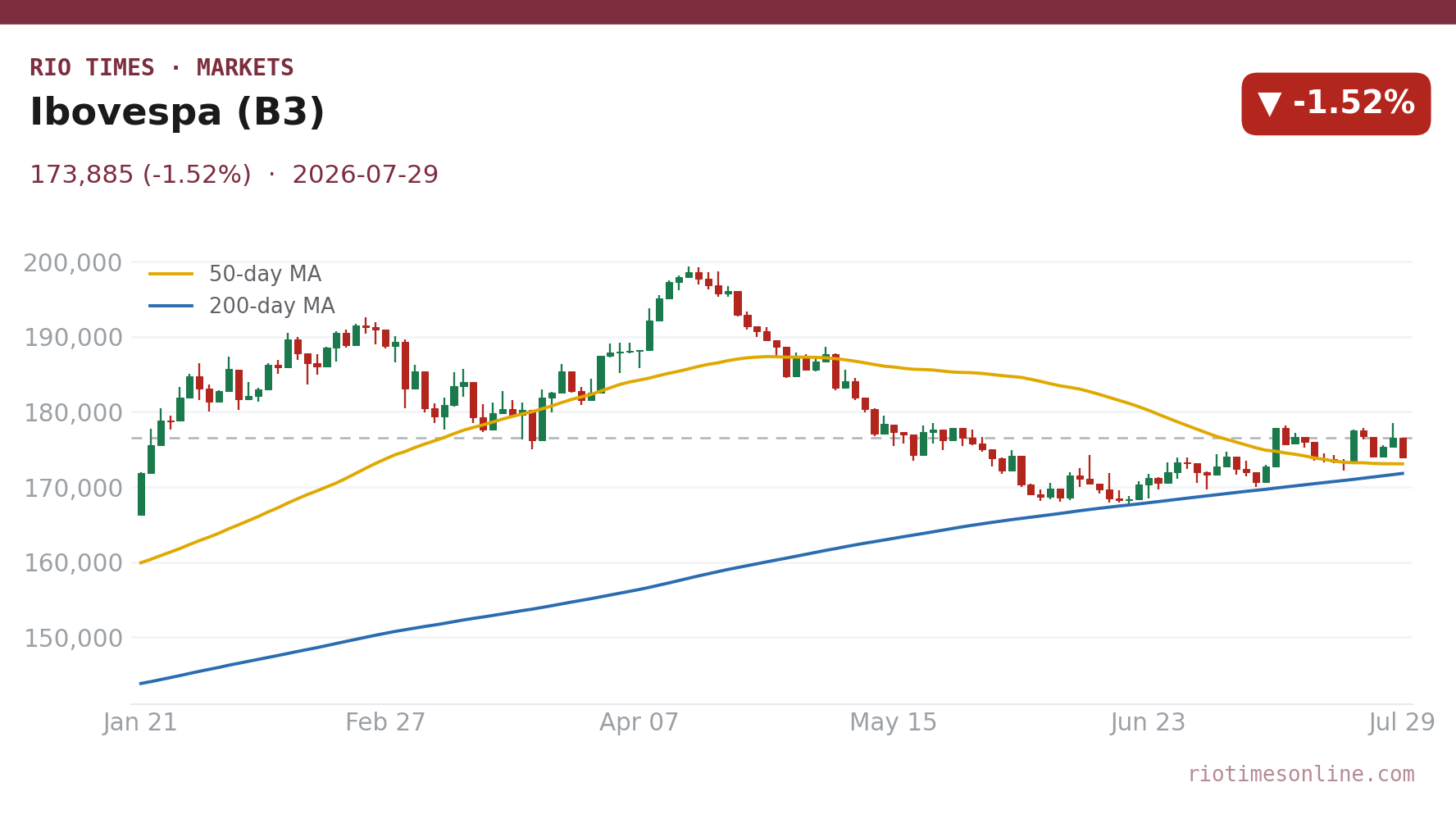
The Ibovespa’s close at 173,885 leaves it sitting 12.5% below its 52-week high of 198,657, a deep correction that is testing patience. The index has not managed a single session higher in this short run — one straight day down — and is now closer to its 52-week low of 132,129 than anyone in São Paulo would like. A break below 173,500 today on poor fiscal news would open the door to 170,000 with little visible support.
Mexico’s IPC at 66,476 is in a similar bind, 7.2% below its 52-week peak of 71,601 and grinding along a descending trendline. The GDP print at midday is the obvious catalyst: a beat could trigger the short-squeeze that carries the index back toward 68,000, while a miss may accelerate the drift toward the year’s lows near 60,774.
The S&P 500’s configuration matters enormously here because the correlation between US and Latin American equities is running high. Wednesday’s drop to 7,316 took the index to 3.9% below its 52-week high of 7,610, and the absence of a futures bounce overnight implies that Latin American boards will have to find their own footing — or simply follow the path of least resistance lower.
07 What to watch
- Brazil’s nominal budget balance at 11:30 BRT: A figure worse than the R$133.2 billion consensus deficit would test the real and drag rate-sensitive B3 names such as utilities and banks lower.
- Chile’s quadruple data release at 13:00 UTC: Retail sales, industrial output, manufacturing and the jobless rate hit simultaneously — a clean test of whether the IPSA’s recent outperformance is built on real demand or just local positioning.
- Mexico’s preliminary Q2 GDP at midday: A print above the 1.5% annualised consensus would give the peso a bid and could reverse the IPC’s recent drift; anything softer would reinforce the view that Mexico’s economy is stalling.
- The Bank of Japan’s outlook report fallout: The BoJ’s cautious tone keeps the yen from strengthening abruptly, preserving the low-volatility funding environment that Latin America’s high carry currencies — the real and the peso — rely on.
Frequently Asked Questions
Why did the Ibovespa fall so sharply on Wednesday?
It moved almost tick-for-tick with the S&P 500, which dropped 1.52% on broad selling. The Ibovespa closed at 173,885 with heavy losses concentrated in rate-sensitive names such as Santander Brasil and Sabesp.
What is the Selic and why does it matter?
The Selic is Brazil’s benchmark overnight interest rate — think of it as the country’s base cost of money. At 14.25% after three recent cuts, it is still deeply restrictive and heavily influences borrowing costs for companies and consumers across B3.
Is the Mexican peso a carry trade?
Yes. With the Bank of Japan holding at 1%, investors can borrow cheaply in yen and invest in higher-yielding pesos. A stable or gently falling USD/MXN rate signals that carry traders remain comfortable, which underpins demand for Mexican assets.
What is the COLCAP and why did it barely move?
The COLCAP is Colombia’s main stock benchmark. It added just 0.15% to 2,305 because Colombia’s central bank held rates steady at 12% and the market was waiting for today’s local data — cement output and unemployment — rather than chasing global sentiment.
Why does Chile’s data matter so much today?
Santiago publishes four key economic indicators at once: retail sales, industrial production, manufacturing output, and the unemployment rate. Taken together, they give the clearest snapshot of whether the Chilean consumer and its mining sector are recovering — which sets the direction for the IPSA index and the peso.
This article was produced by The Rio Times’ automated newsroom system. How we use AI · Report an error · Editorial responsibility: Matthias Camenzind, Editor-in-Chief
LatAm Markets: Live Signals → — real-time movers, turnover leaders and FX across Latin America.