Iron Ore: CSN Cuts Output on Freight Costs as Vale Slides 2.1%
Key Facts
- CSN Mineração cut its 2026 target for production and third-party purchases to 39–41 million tonnes from 45–47 million, citing a weaker market and higher freight costs.
- CSN Mineração fell 5.74% to R$4.76 (about US$0.92) in São Paulo; parent CSN dropped 9.85% to R$5.40 (about US$1.04).
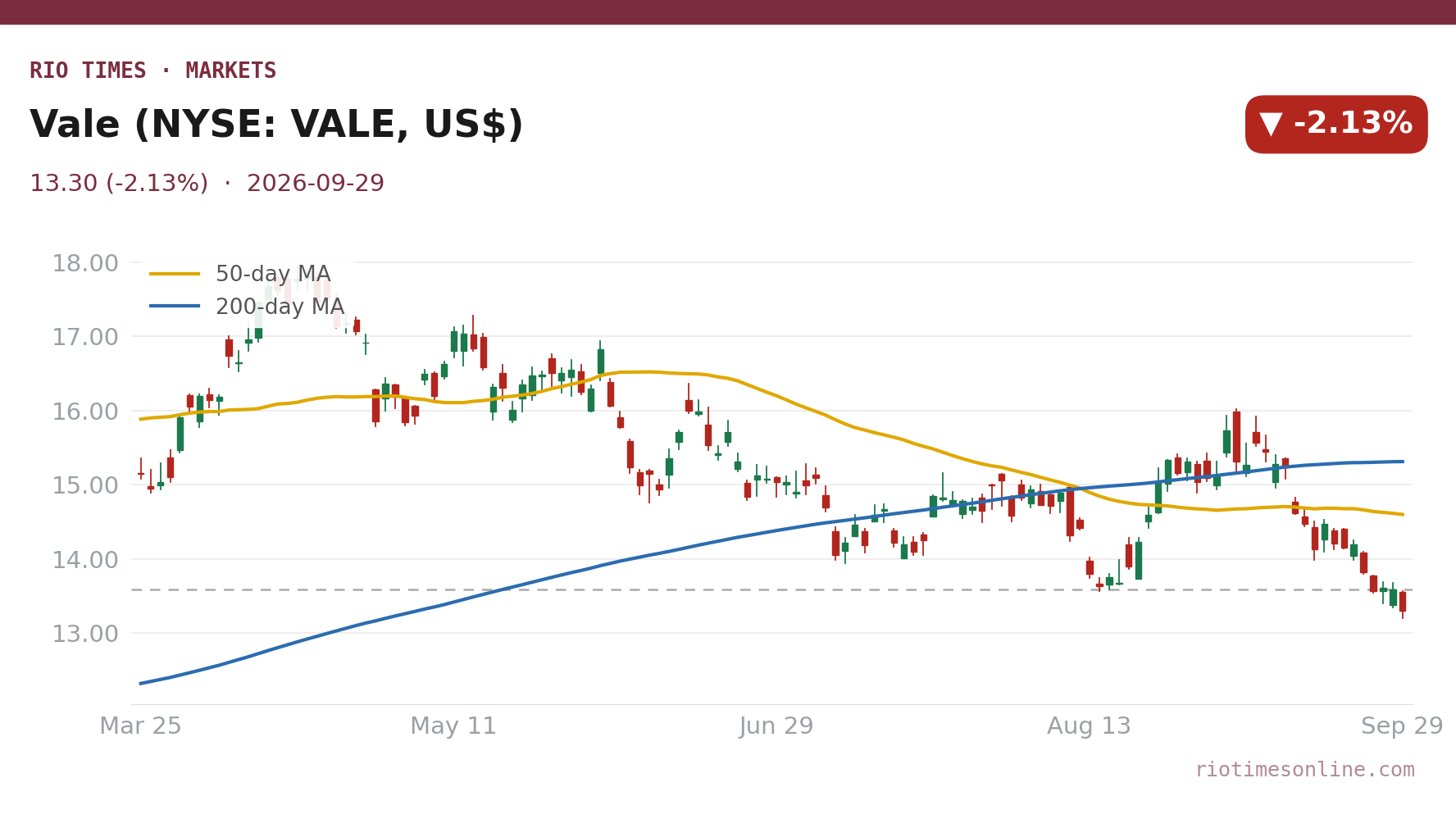
- Vale’s New York shares fell 2.13% to US$13.30 on Tuesday 29 September 2026, breaking below Monday’s US$13.59 close.
- Dalian iron ore slipped 0.78% to 699 yuan (about US$104) a tonne for the most-traded January contract, a day after a five-week low.
- Freight is the Brazilian problem. The Tubarão–Qingdao rate stands at US$43 a tonne, up 75.2% from a year earlier, mainly on higher bunker fuel costs.
- China’s factory PMI returned to growth overnight, at 50.1 in September from 49.8, but steel output and mill margins remain weak.
Today’s Focus
Iron-ore shares fell on Tuesday 29 September 2026, led by a production cut in Brazil. CSN Mineração, Brazil’s second-largest iron-ore exporter, lowered its 2026 target by 6 million tonnes to 39–41 million tonnes.
The company is temporarily reducing low-grade output at the dry-processing plant of its Pires complex in Ouro Preto, Minas Gerais. It blamed a tighter market and higher freight costs, and raised its C1 cash-cost guidance to US$25–26 a tonne from US$22–23.5.
CSN Mineração fell 5.74% to R$4.76 (about US$0.92), and parent CSN lost 9.85% to R$5.40 (about US$1.04). Vale’s New York shares dropped 2.13% to US$13.30. In China, the most-traded Dalian contract settled 0.78% lower at 699 yuan (about US$104) a tonne.
CSN is the third Brazilian miner this month to curb output because of Brazil–China freight. Mineração Usiminas and Itaminas made similar moves earlier in September.
What matters today. Brazil’s marginal, low-grade supply is starting to shut in. That supports prices over time, but for now it signals how much freight and weak Chinese steel margins are squeezing Brazilian producers.

01 The session in one read
Iron-ore equities slid on Tuesday 29 September 2026. Vale’s New York shares fell 2.13% to US$13.30, and its São Paulo shares lost 2.18% to R$69.61 (about US$13.38).
CSN Mineração dropped 5.74% to R$4.76 (about US$0.92) after cutting its production outlook. In China, the most-traded Dalian contract settled at 699 yuan (about US$104) a tonne, down 0.78%. Spot trade at Qingdao was thin, with prices down 0–3 yuan a tonne, according to Shanghai Metals Market.
The iron-ore complex is caught between weaker Chinese steel demand and freight costs that hit Brazilian shippers hardest. CSN’s cut shows that marginal Brazilian supply is already adjusting, which could eventually cushion prices. The variable to watch is Chinese mill buying after the 1–7 October holiday.
02 The board
Vale’s New York shares, the most widely watched proxy for one of the world’s two largest iron-ore exporters, closed at US$13.30, down 2.13%. They traded as low as US$13.21 during the session.
CSN Mineração fell hardest among the miners, down 5.74% to R$4.76 (about US$0.92), and parent CSN lost 9.85%. The Australian majors held up better: Rio Tinto slipped 0.26% to US$94.16 and BHP rose 0.28% to US$84.82. Real-denominated prices are converted at 5.2019 reais per US dollar.
| Asset | Level | Change |
|---|---|---|
| Iron ore (Vale, NYSE) | US$13.30 | -2.13% |
| Vale (B3) | R$69.61 (US$13.38) | -2.18% |
| CSN Mineração (B3) | R$4.76 (US$0.92) | -5.74% |
| CSN (B3) | R$5.40 (US$1.04) | -9.85% |
| Rio Tinto (NYSE) | US$94.16 | -0.26% |
| BHP (NYSE) | US$84.82 | +0.28% |
Source: RT close, 2026-09-29. Where a commodity has no spot feed, an exchange-traded tracker or leading producer is shown as a labelled proxy.
Live Market IntelligenceThe live market board
Rio Times · Live Market Intelligence
Latin America — Cross-Market Board
| Instrument | Last | Change | YoY | Prev. | High | Low | Volume |
|---|---|---|---|---|---|---|---|
| IBOV | 183,827.59 | +0.46% | +21.85% | 182,991.13 | 168,310 | 167,142 | — |
| IPSA | 11,055.91 | -0.73% | — | 11,137.23 | 11,210 | 10,984 | 1,513,213,483 |
| IPC MEX | 65,071.30 | +0.20% | +12.17% | 64,944.41 | 66,121 | 65,405 | 108,886,187 |
| MERVAL | 2,782,561 | -0.59% | +30.51% | 3,022,485 | 3,042,365 | 2,991,150 | — |
| COLCAP | 2,558.92 | -0.79% | — | 9.04 | 9.05 | 9.02 | 4,133 |
| BVL PERÚ | 60,220.45 | +0.32% | — | — | — | — | — |
| USD/BRL | 5.16 | +0.01% | -5.13% | 5.16 | 5.18 | 5.14 | — |
| EUR/BRL | 5.95 | +1.01% | -5.83% | 5.89 | 5.98 | 5.94 | — |
| USD/MXN | 17.06 | -0.24% | -8.58% | 17.10 | 17.08 | 17.01 | — |
| USD/CLP | 913.98 | +0.04% | -5.67% | 913.65 | 915.11 | 906.68 | — |
| USD/COP | 3,140 | +0.03% | -22.04% | 3,139 | 3,141 | 3,105 | — |
| USD/PEN | 3.36 | -0.66% | -4.82% | 3.38 | 3.38 | 3.35 | — |
| USD/ARS | 1,493 | +0.10% | +12.96% | 1,491 | 1,494 | 1,480 | — |
| USD/UYU | 40.27 | +1.24% | +1.80% | 39.77 | 40.27 | 40.23 | — |
| USD/PYG | 5,939 | +1.68% | -19.54% | 5,841 | 5,939 | 5,925 | — |
| USD/BOB | 11.64 | -0.76% | +72.04% | 11.73 | 11.72 | 11.64 | — |
| USD/DOP | 58.34 | +1.25% | -3.44% | 57.62 | 58.34 | 58.04 | — |
| USD/CRC | 445.92 | +0.89% | -9.71% | 441.97 | 448.50 | 445.92 | — |
Live Company IntelligenceVale SA ADR — the full investor dossier
Wall Street view
Valuation & profitability
Price & risk
$9.8852-wk high
$17.44
Revenue trend · 6y
Ownership
Dividend
03 What moved it
The company news was CSN Mineração’s guidance cut, announced in a securities filing on Tuesday. The company said the reduction at Pires could be reversed at any time if market conditions offer better margins for low-grade ore.
The background is China’s steel slowdown. Crude-steel output fell 3.7% year on year in August to 74.6 million tonnes and was down 3.1% over January to August, according to the World Steel Association. The China Iron and Steel Association has urged mills to restrain output.
Mill margins are thin. Only 7.8% of Chinese blast-furnace mills were profitable in Mysteel’s mid-September survey, down from 32.5% at the end of August. Supply is ample: Australian shipments to China rose about 6.2% week on week to 17.2 million tonnes in the week to 20 September.
04 Tuesday’s data, one by one
Our Tuesday edition told readers to watch Chinese port stocks, post-holiday restocking, steel output, Vale’s share price and the China PMIs. Here is what happened, plus the day’s main data.
- China PMIs (released overnight, Wednesday Beijing time): The official manufacturing PMI rose to 50.1 in September from 49.8, in line with forecasts. The non-manufacturing PMI jumped to 50.2 from 49.0, above the 49.3 forecast. A mild positive for steel demand, but it came after Dalian had closed.
- Vale’s share price: Vale broke lower, falling 2.13% to US$13.30 from Monday’s US$13.59 close.
- Chinese port stocks and steel output: No new weekly port-stock figure was published on Tuesday. Last week’s Shanghai Metals Market reports showed inventories building faster as mills expanded maintenance.
- Post-holiday restocking: Still to come. China’s National Day holiday runs from 1 to 7 October, and spot buying was thin before the break.
- Brazil data: The September IGP-M rose 1.57% on the month, just below the 1.60% forecast. Formal job creation in August was 165,800, well above the 95,700 forecast, and unemployment held at 5.3%. None of these moved the miners.
- US data: Conference Board consumer confidence fell to 81.9, the lowest since April 2014, and August job openings dropped to 7.08 million. The 10-year Treasury yield ended little changed at 5.25%.
05 The Latin American read
Brazilian miners are especially exposed to freight. The Tubarão–Qingdao rate, the benchmark for Brazil–China iron-ore shipping, stands at US$43 a tonne, up 75.2% from a year earlier, according to SteelOrbis. It mainly reflects higher bunker fuel costs linked to the war in the Middle East.
That raises the delivered cost of Brazilian ore in China and hits low-grade material hardest. CSN Mineração, Mineração Usiminas and Itaminas have all cut output this month for that reason.
06 The names to watch
Vale remains the bellwether. Its New York shares track the iron-ore price closely, and Tuesday’s 2.13% drop to US$13.30 shows investors expect soft Chinese demand to last.
Rio Tinto, at US$94.16, and BHP, at US$84.82, ship from Australia with much shorter voyages to China. That gives them a cost advantage when freight rates spike.
CSN Mineração is the most leveraged Brazilian play. Its 5.74% fall reflects both the weaker ore market and its higher cost guidance.
07 The outlook
The near-term outlook depends on China’s steel demand after the 1–7 October holiday. If mill profitability stays in single digits, Chinese mills are likely to keep output restrained, which would weigh on ore demand.
For Brazilian producers, freight is the wild card. At US$43 a tonne, the Tubarão–Qingdao rate erodes the competitiveness of Brazilian ore against Australian supply. More cuts to low-grade Brazilian output are possible if rates stay high.
08 What to watch
- China’s holiday: Dalian is shut from 1 to 7 October, so Wednesday is the last Chinese session before the break; Singapore futures keep trading.
- US data today: ADP private payrolls for September (forecast 70,000, prior 38,000) at 12.15 UTC; August PCE inflation (forecast 3.7% year on year) at 12.30 UTC.
- Brazil today: August fiscal results, including the primary balance and gross debt, at 11.30 UTC (8.30 am in Brasília); August producer prices at 12.00 UTC.
- Chile today: August copper production and industrial output at 12.00 UTC, a read on Andean mining activity.
- More Brazilian cuts: Whether other low-grade producers follow CSN, Mineração Usiminas and Itaminas while freight stays near US$43 a tonne.
Frequently Asked Questions
Why did iron-ore shares fall on Tuesday?
CSN Mineração cut its 2026 production target and raised its cost guidance, citing higher freight costs, while China’s steel slowdown weighed on the sector. Vale fell 2.13% to US$13.30 and CSN Mineração 5.74%.
What did CSN Mineração announce?
It cut its 2026 production and third-party-purchases target to 39–41 million tonnes from 45–47 million, and raised its C1 cash-cost guidance to US$25–26 a tonne from US$22–23.5.
What is the Tubarão–Qingdao freight rate?
It is the benchmark cost of shipping iron ore from Brazil’s Tubarão port to Qingdao in China. It stands at US$43 a tonne, up 75.2% from a year earlier.
Where did Dalian iron ore close?
The most-traded January contract settled at 699 yuan (about US$104) a tonne on Tuesday, down 0.78%.
Source: RT live market data, close of Tuesday 29 September 2026.
This article was produced by The Rio Times’ automated newsroom system. How we use AI · Report an error
LatAm Markets: Live Signals → — real-time movers, turnover leaders and FX across Latin America.
Read More from The Rio Times