Ecuador’s Noboa Rules Out Home Blackouts on 5 October

ENERGY · ECUADOR
Key Facts
- —The country Ecuador, an Andean nation of about 18 million people that uses the US dollar. Most of its electricity comes from hydroelectric dams, so dry months strain the grid.
- —Why it matters In late 2024 a drought brought household blackouts of up to 14 hours a day. A repeat would hit exporters, tourism and President Daniel Noboa’s standing.
- —Why now Noboa called these the most critical weeks of the dry season. Engineers urged short general blackouts on Friday 2 October, according to Vistazo.
- —What happened On Monday 5 October, Noboa told Radio Centro in Guayaquil that “no Ecuadorian family” would face a power cut, as El Universo and Expreso reported.
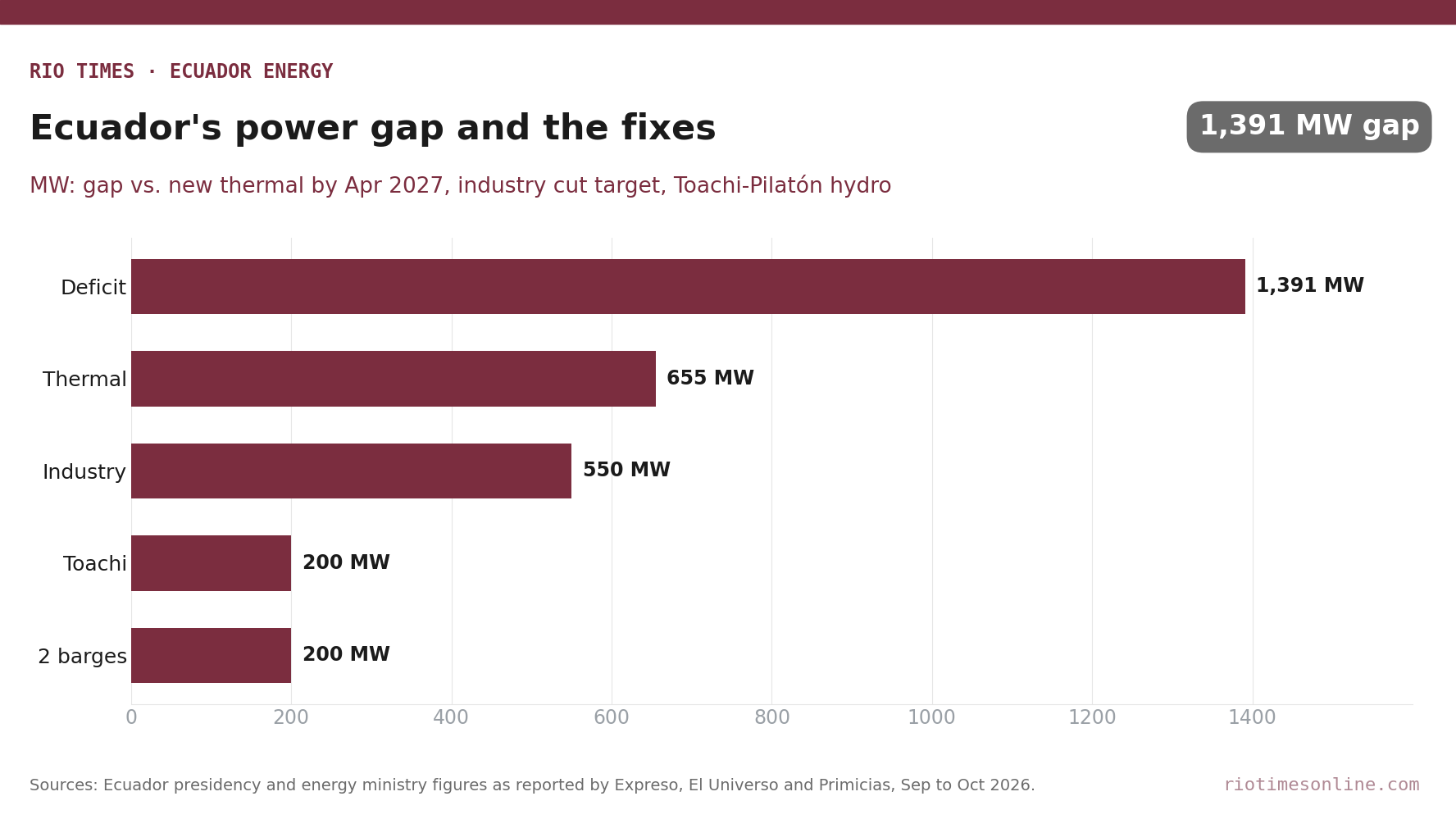
- —The numbers A deficit of about 1,391 megawatts (Expreso, 5 Oct). More than 9,000 companies on 48-hour cut rotas from 2 October (Primicias, Expreso). Mazar reservoir at 2,131.89 metres on 4 Oct (Celec).
- —What it means for you Households should keep normal supply if the pledge holds, though some medium-voltage businesses and buildings face 48-hour cuts. US buyers of Ecuadorian shrimp and bananas may see slower schedules.
- —Still open Whether rain keeps refilling the reservoirs, whether industry fully follows the cut rotas, and how long companies must keep switching off.
President Daniel Noboa pledged on Monday 5 October that homes will not face Ecuador blackouts this dry season. Ecuador’s factories are carrying the shortfall instead, with more than 9,000 companies on rotating 48-hour cuts. For US buyers of Ecuadorian shrimp, bananas and cut flowers, that means supply risk sits with exporters rather than households.
“No Ecuadorian family is going to have any power cut,” Noboa told Radio Centro, a Guayaquil station, as El Universo and Expreso reported. Noboa, a conservative businessman, has led the country since 2023 and won re-election in 2025.
The pledge rests on new hydro and thermal supply, rented barges and deep cuts in industrial demand.
What Noboa Promised on Radio Centro
Noboa did not play down the strain. “It is a critical moment, the weeks of the deepest dry season, but we are able to hold,” he said (El Universo).
He listed the plants he says are carrying the load. Toachi-Pilatón is producing more than 200 megawatts and Baba about 40, he said.
He put Daule-Peripa at roughly 170 to 178 megawatts, depending on the outlet reporting the interview. New private generation completes his picture.
Two state-rented power barges add about 200 megawatts. They have supplied the grid since 21 September, Energy Minister Juan Carlos Blum told Primicias.
“However much the haters dream of cuts, there will be no cuts,” Noboa added, in the wording reported by Expreso. His cabinet secretary, José Julio Neira, said thermal projects adding 655 megawatts will come online by April 2027.
Industry Carries the Load
The household promise depends on factories going without. On 2 October, distributors notified more than 9,000 companies of 48-hour disconnection blocks over two weeks, Primicias reported, citing a government source.
Primicias counted 185 high-voltage users, four in a second high-voltage tier and about 8,900 medium-voltage firms. A Vice-Ministry of Electricity table seen by TV channel Ecuavisa lists 8,939 medium-voltage customers, Expreso reported.
Cuts run Monday to Saturday, grouped by region, so plants can plan production.
The rationing began on 22 September with the largest users. See Ecuador Power Rationing Orders 185 Large Industrial Users to Cut One Day a Week. It has since doubled in length and widened to mid-sized companies.
The government aims to trim about 550 megawatts from national demand, Expreso reported. Before the measures, peak demand reached 5,500 to 5,600 megawatts, according to grid operator Cenace data cited by the paper.
Compliance has lagged. Only about 56% of the planned cuts took place, saving around 300 megawatts, Expreso reported. That figure came from Roberto Aspiazu, head of the Ecuadorian Energy Chamber, a business group.
Business groups have pushed back on cost and notice, as set out in Ecuador Industry Seeks Power Tariff Review. Some coastal plants say they were off the grid for three days running, which Expreso said lacks official confirmation.
The Water Behind the Promise
The real test is rainfall in the Andes. Mazar, which regulates the Paute hydro complex, stood at 2,131.89 metres above sea level at 18:00 on 4 October, data from state power company Celec show.
That is about 21 metres below its maximum of 2,153 metres. It is also about 17 metres above 2,115 metres, the level at which the Mazar turbines must stop.
The weekend brought relief. Rain in Azuay lifted the Paute river from 72.73 to 111.5 cubic metres a second between 3 and 4 October, Teleamazonas reported.
The cushion is thin, however. An engineers’ advisory council estimated Mazar could hit its critical level in 17 to 20 days if steep drops resume (Radio Pichincha).
Coca Codo Sinclair, the largest plant at 1,500 megawatts, has no large reservoir. Its river flow had fallen below the roughly 240 cubic metres a second it needs for steady output, Expreso said.
Stabilisers and Risks
Several steps support the pledge. Neira said a 1,000-megawatt transmission line with Peru will be launched in November, letting Ecuador import power in dry spells, Expreso reported.
Noboa said the government has spent more than US$60 million on transmission. Large consumers must also install their own generation by mid-December under a 2025 decree, easing future pressure on the grid.
The risks are just as concrete. Imports from Colombia have fallen to minimal levels after Colombian rules limited sales to surplus power, Radio Pichincha reported, without official confirmation.
Guayaquil residents also reported weekend outages in districts such as Urdesa. Authorities said those were not scheduled cuts, El Diario reported. They still show how fragile local networks remain during Ecuador blackouts for industry.
What It Means for You
For US importers and investors, the pledge moves the cost of the shortfall onto industry. Fruit exporters are among the companies on the cut lists, Expreso reported, so some shipments may slip.
Travellers should find normal power in homes and hotels if the pledge holds. Some businesses and shopping centres run on their own generators during cut days.
The pledge depends on rainfall. The late-2024 household blackouts of up to 14 hours remain the risk to watch if the dry spell deepens.
What Is Not Known
The energy ministry has not published a schedule for the industrial cuts beyond the two weeks that began in early October. Nor is it clear whether industry will fully follow the rota.
Officials have not detailed what would trigger household rationing if rainfall fails. Independent figures on the cost of factory shutdowns are also not yet available.
Whether Ecuador blackouts stay confined to industry now depends largely on weather. The coming weeks of rain or drought in the Paute and Coca basins will decide whether Noboa’s promise holds.
Are there Ecuador blackouts for homes right now?
No scheduled household cuts are in place. President Noboa said on 5 October that no family would lose power, while industry takes rotating 48-hour cuts.
Why does Ecuador ration electricity in the dry season?
Most of its power comes from hydroelectric dams. When river flows drop, output falls and the grid faces a shortfall of about 1,391 megawatts, according to Expreso.
Should travellers to Ecuador worry about power cuts?
Households are not on the cut schedule, but some businesses and large buildings on medium voltage are. Travellers should keep devices charged and check with their hotel.
Sources: El Universo, 5 Oct 2026; Expreso, 5 Oct 2026; El Comercio, 5 Oct 2026; Primicias, 2 Oct 2026; Primicias, 24 Sep 2026; Expreso, 4 Oct 2026; Expreso, 4 Oct 2026; Teleamazonas, 5 Oct 2026; Radio Pichincha, 5 Oct 2026; Expreso, 5 Oct 2026; El Diario, 5 Oct 2026; Vistazo, 5 Oct 2026.
Editorial responsibility: Matthias Camenzind, Editor-in-Chief · Editorial standards · Report an error
LatAm Markets: Live Signals → — real-time movers, turnover leaders and FX across Latin America.