Ecuador Industry Seeks Tariff Review as Big-User Power Price Rises to US$0.30 per kWh

ECONOMY · ECUADOR
Key Facts
- —The country Ecuador uses the US dollar and gets most of its electricity from hydropower. An early dry season is draining its main reservoir, Mazar.
- —What happened On 1 October the Chamber of Industries and Production (CIP) asked the government to review a tariff rise for the largest power users, Expreso reported on 2 October.
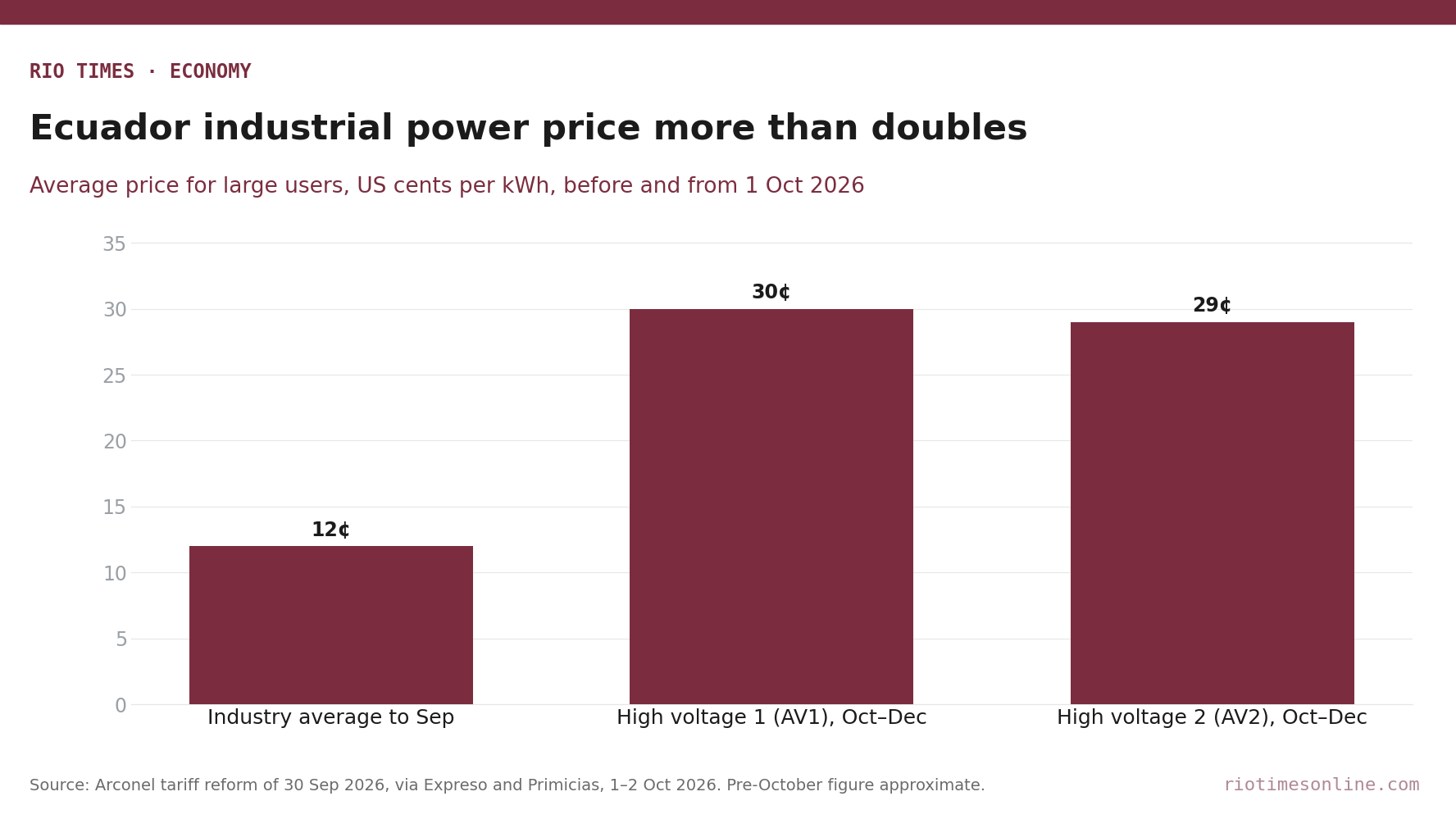
- —The numbers From 1 October to December, high-voltage users pay an average US$0.29–0.30 per kWh, up from about US$0.12, the regulator Arconel said (Expreso, Primicias, 1–2 October).
- —What it means for you Factories face higher bills and scheduled 48-hour shutdowns, which may slow deliveries. The new tariff does not apply to households, Expreso reported on 1 October.
- —Still open Whether the government will soften the tariff after meeting industry in Guayaquil on 2 October. No outcome had been reported by Saturday morning.
Ecuador’s manufacturers are pressing for an industry tariff review as power cuts spread across the business sector. The Chamber of Industries and Production (CIP) called the price rise for large users “additional pressure” on 1 October, Expreso reported.
The regulator Arconel set the new prices on 30 September for the October–December period. They arrive as rationing that began on 22 September reaches thousands more companies.
What the new tariff costs
Arconel, the Agency for the Regulation and Control of Electricity, set an average US$0.30 per kWh for high-voltage class 1 (AV1) users. Class 2 (AV2) users pay US$0.29, both Expreso and Primicias reported.
Before October, these companies paid an average of about US$0.12 per kWh. Arconel called the change “technical”, a response to the hydrological situation, according to Expreso.
Actual bills will vary by voltage, distributor and time of day. Some peak-hour energy charges reach US$0.3509 per kWh under the new schedule, Expreso reported.
Arconel director Fabricio Porras said on 2 October that the government expects to raise US$264 million through December, Primicias reported. He said the measure aims to strengthen the system’s generating capacity.
Why industry wants a review
The CIP said the productive sector has invested close to US$1 billion in generation and energy efficiency since 2024. It asked the government to treat companies already building their own plants differently.
The chamber also asked for “alternatives” that share the burden more evenly. Any extraordinary charge, it said, should be technically justified, temporary and withdrawn once the emergency ends.
On 30 September the Guayaquil Chamber of Industries (CIG) estimated the extra cost at about US$156 million by the end of 2026. It put the average increase at 185 percent, Expreso reported on 1 October.
An industry tariff review would also need to address what follows in January. The CIG asked for clarity on how prices will be set after December.
How far the power cuts reach
The cuts started with 185 AV1 and AV2 users, as reported in Ecuador Power Rationing Orders 185 Large Industrial Users to Cut One Day a Week. Larger medium-voltage users were added from 28 September, and disconnections grew from 24 to 48 hours.
On 2 October distributors notified 9,089 companies of 48-hour blocks over the next two weeks, Primicias reported, citing a government source. The total includes 8,900 medium-voltage firms, and only 47 of the 185 AV1 users fully generate their own power.
The Guayaquil bakery 400 Grados said it was told to cut its demand to zero from 06:00 on 2 October. Both Expreso and Primicias quoted its statement about halting ovens and machines.
What eases the pressure
The schedules were issued in advance, grouped by area and limited to Monday to Saturday. A government source told Primicias this answered industry’s request for time to plan production.
Mazar stood 15.85 metres above its critical operating level at 14:00 on 2 October, Primicias reported. Ports were already affected, as covered in Ecuador Power Rationing Reaches Two Guayaquil Ports as Exporters Warn of Delays.
What Is Not Yet Known
Industry representatives met electricity authorities in Guayaquil on 2 October, Expreso reported, but no result has been published. It is also unclear what tariff will apply from January 2027.
Engineers from a professional advisory council told Primicias that Mazar could reach its critical level in 17 to 18 days without rain. They stressed this is a projection, not a forecast of blackouts.
Sources: Expreso, “Industriales de Ecuador piden revisar alza de tarifas, mientras los cortes de energía se extienden” (2 October 2026) and “Industrias cuestionan alza de tarifas eléctricas en Ecuador” (1 October 2026); Primicias, “Más de 9.000 empresas de Ecuador tendrán desconexiones eléctricas de 48 horas” (2 October 2026) and “Embalse de Mazar podría tocar su nivel crítico este mes” (2 October 2026).
This article was produced by The Rio Times’ automated newsroom system. How we use AI · Report an error · Editorial responsibility: Matthias Camenzind, Editor-in-Chief
LatAm Markets: Live Signals → — real-time movers, turnover leaders and FX across Latin America.