Argentina and Brazil are working on a joint agenda to position their agro-bio industry in an increasingly hungry world
RIO DE JANEIRO, BRAZIL – Socialist-ruled Argentina and Brazil, with its patriotic Bolsonaro government, are definitely getting down to business. The two neighbors are both food and energy giants that could be at the center of world attention in the coming hunger crises.
The U.S.-led Anglo-Saxons and their European junior partners, with their unprecedented Russia ‘canceling’, have ensured that international supply chains, already permanently damaged by covid lockdowns, will soon cease to function. There will soon be shortages of all sorts.
Already now, the prices of food and fuel are rising to astronomical heights, but this could be just the beginning of a full-blown global economic crisis, with hyperinflation, famine, and where driving cars and flying planes could become a privilege for the super-rich due to fuel shortages and unaffordable liter prices for gasoline, diesel, and kerosene.
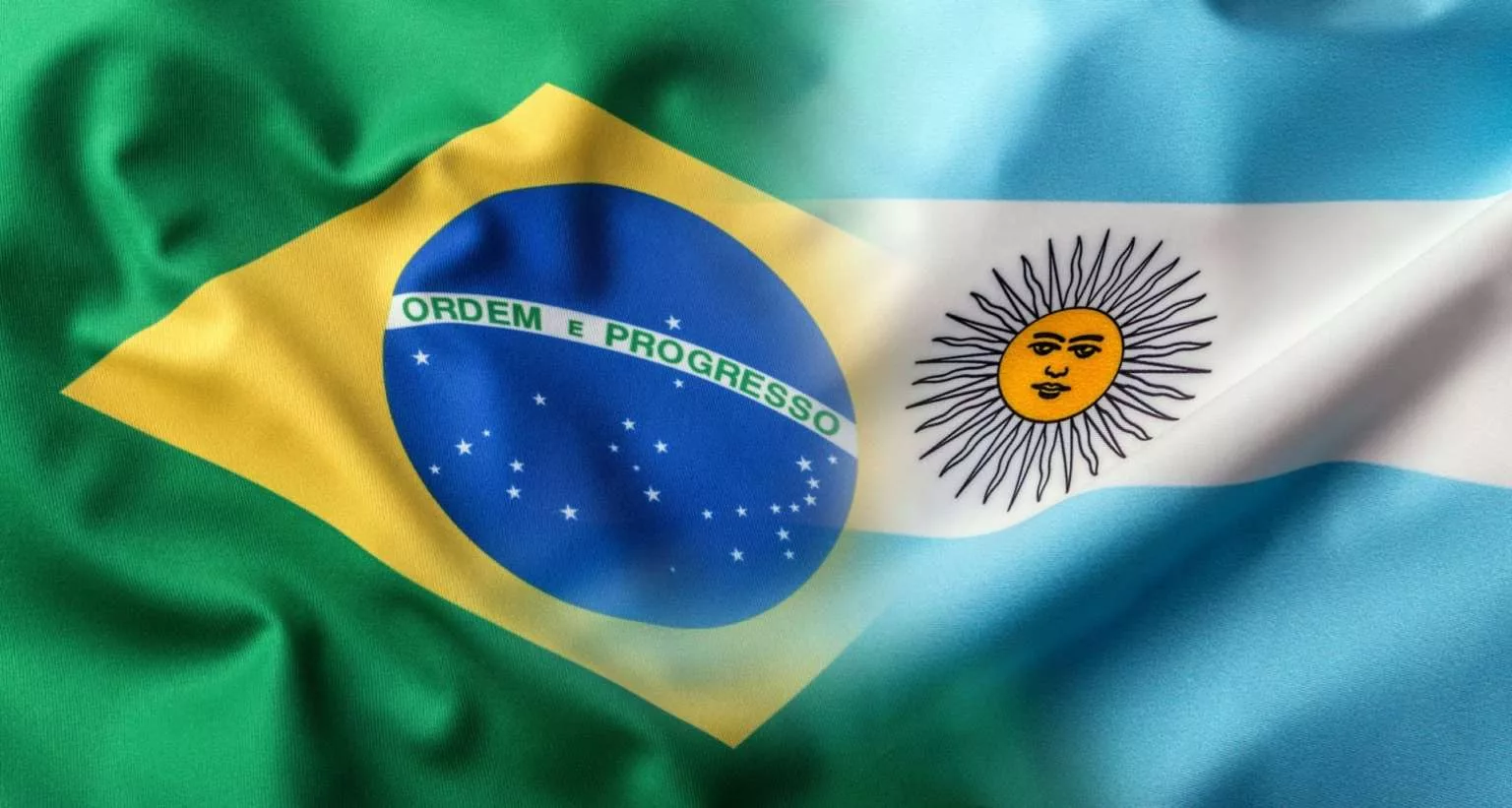
A couple of days ago, the Argentine Minister of Agriculture, Livestock and Fisheries of Argentina, Julián Domínguez, received the Ambassador of Brazil, Reinaldo José De Almeida Salgado.
During the meeting, the head of the Agriculture Department and the diplomat agreed on the need to move forward with a common agenda to improve the integration of the agro-bio industry of both countries in an increasingly complex international context and major common challenges.
In addition, Julián Domínguez stressed that “Argentina and Brazil are strategic partners” because not only do they have common challenges in third markets, but Brazil is also the third destination of Argentina’s agro-bio industrial exports.
In this sense, he pointed out that they are determined to continue advancing mechanisms to facilitate bilateral trade, such as integrated border controls and harmonization of health certificates.
“I have asked Senasa President Diana Guillén to travel to Brasilia to meet with her counterpart and discuss the upcoming agenda items,” Domínguez said.
Julián Domínguez was accompanied by the Minister of Agriculture, Livestock and Fisheries, Matías Lestina, the Undersecretary of Policy Coordination, Ariel Martínez, and the National Director for Mercosur of the Ministry of Foreign Affairs, Darío Celaya Álvarez.
FOOD SUPER POWER
Together, the two countries form a food powerhouse that can easily compete with and arguably export more than the two largest agricultural powers, the United States and China.
Brazil alone is the world’s third-largest food producer after China and the USA, and historically one of the best agricultural countries on which to base its economy. About 41% of Brazil’s vast total land area is in agricultural use and can be expanded at will.
The country has a total area of 2.1 billion hectares, and the agricultural land in Brazil is almost 867.4 million hectares. Brazilian production originally focused on sugarcane.
- Brazil is the world leader in sugar cane production, producing over 600 million tons each year.
- Brazil is the second or the largest producer of soybeans globally (depending on the year), and these beans are used in large quantities worldwide.
- Brazil is the third-largest producer of corn.
- Brazil is the world’s largest exporter of coffee, beef, and ethanol.
- Brazil is the largest producer of oranges and the 3rd largest producer of papaya and grapefruit.
- Brazil is the 4th largest producer of bananas and the 5th largest producer of coconuts.
- About 7% of Brazil’s land area is used to grow crops.
Argentina is the third-largest producer of soybeans, the fourth-largest producer of wheat, the third largest of Sunflower seeds, and one of the largest of meat. It is also one of the main exporters of wool. The wine produced in Argentina is mainly consumed domestically and produced on a large scale. The Malbec grape is a hot favorite.
The country is the second-largest producer of Canary seeds and the third-largest producer of pears. In Lemons, the two countries occupy third and fourth place.
INTEGRATION
Argentina and Brazil are already well integrated through the Southern Common Market Mercosur.
Given the recent bifurcation of global geopolitics away from an Anglo-Saxon unipolar world to a multipolar world with Russia, China, and India as a newly forming second pole, it seems existential to rethink positions if one does not want to fall under the wheels of the global power struggle that has just begun.
Although the two countries could not be more different politically, Brazil and Argentina seem to have realized that they are much stronger together than they are individually.
After meeting with his Argentine counterpart Martin Guzman in Brasilia, Brazil’s Paulo Guedes stressed that the two countries play a crucial role in food and energy security in South America and the world.
Brazilian Economy Minister Paulo Guedes said he would present Argentina as a candidate to join the New Development Bank (NDB) of the BRICS group of countries composed of Brazil, Russia, India, China, and South Africa.
Brazil is interested in gaining access to Argentina’s virtually unlimited gas reserves and welcomes Petrobras’ decision to lower the price of liquefied petroleum gas (LPG).
Brazil has huge oil reserves and both countries are global mining giants, so there is complete autonomy at this level as well.
The Brazilian minister argued that “Argentina has abundant fertilizers and the capacity to increase current production tenfold.”
“They helped us when we reduced external tariffs. It’s a story of a partnership that continues more and more. We will help Argentina under the IMF (International Monetary Fund) program. The most important goal is the integration of our economies,” he said.
A couple of days, Argentina also agreed to allow Brazil to guarantee its energy security by supplying the country with electricity as needed between May and September (Southern winter), the Argentine Economy Ministry said in a statement.
Unlike other world regions, there will be enough electricity and food in the two largest South American countries even if Russia and Ukraine can no longer or are not allowed to supply the world with either.
Guzmán said that “relations with Brazil are fundamental, and both sides are interested in greater integration. Brazil is the most important partner for Argentina in economic and trade terms. In the energy sector, we will continue to work for greater energy integration to increase production, reduce costs and improve the competitiveness of our industry.
More: Argentina news in English, every day from The Rio Times.
This article was produced by The Rio Times’ automated newsroom system. How we use AI · Report an error · Editorial responsibility: Matthias Camenzind, Editor-in-Chief