Dominican Republic Central Bank Raises Policy Rate to 5.50% From 5.25%
ECONOMY · DOMINICAN REPUBLIC
Key Facts
- —The country The Dominican Republic, the largest economy in the Caribbean, targets inflation of 4% plus or minus one point (BCRD, 30 September 2026).
- —What happened On 30 September 2026 the central bank (BCRD) raised its policy rate by 25 basis points, from 5.25% to 5.50% a year.
- —The numbers Overnight lending rises to 6.00% and deposits to 4.75%. Inflation was 5.13% in August, core 4.76% (BCRD via Diario Libre, 30 September 2026).
- —What it means for you Bank loans and credit cards in pesos are likely to cost more over the coming months, while peso deposits may pay slightly better.
- —Still open Whether this is a single precautionary step or the start of a series of increases. The bank gave no guidance on its next decision.
The Dominican Republic central bank raised its benchmark interest rate on Wednesday 30 September 2026. The policy rate rose by 25 basis points, from 5.25% to 5.50% a year.
The Banco Central de la República Dominicana (BCRD) called the move preventive. It said supply shocks, led by higher oil prices, were proving more persistent than expected.

What the central bank decided
Alongside the policy rate, the bank lifted its two standing facilities by the same margin. The one-day repo lending rate rises to 6.00% and the overnight deposit rate to 4.75%.
The bank’s own rate series shows the new level applying from October. The rate had stood at 5.25% since the last cut took effect in November 2025.
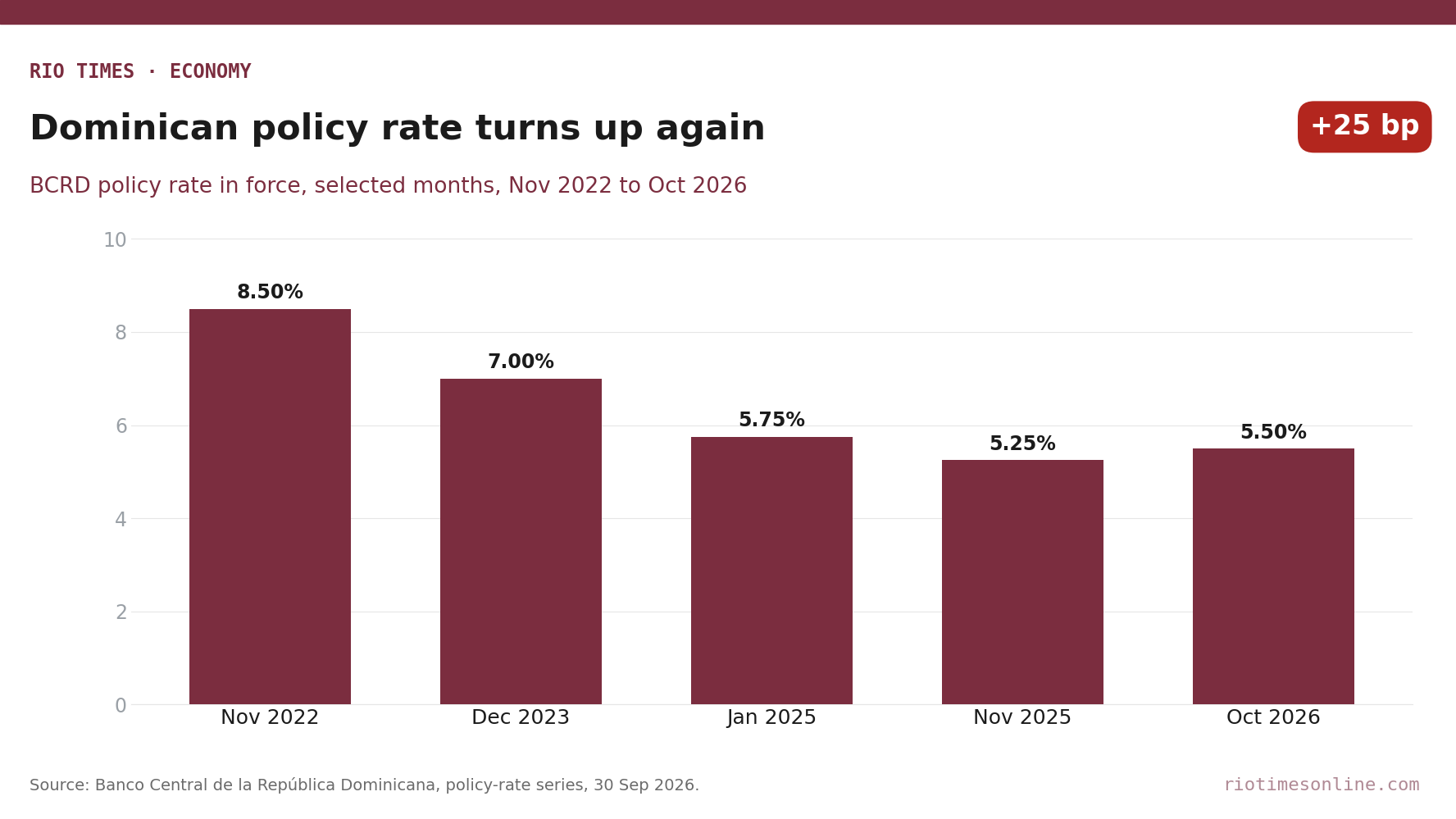
According to the same series, this is the first increase since late 2022. The rate peaked at 8.50% then and was cut step by step to 5.25%.
Why the bank raised rates now
Diario Libre quoted the bank as saying the step aims to keep inflation expectations anchored. It also wants to avoid second-round effects on prices.
El Día reported the shocks named by the bank. They include higher oil prices linked to Middle East tensions, global transport disruption and adverse weather.
The outside backdrop also shifted. Both outlets reported that the US Federal Reserve and the European Central Bank each raised rates by 25 basis points in September.
Inflation is easing, but sits at the edge
Annual inflation was 5.13% in August, down from 5.67% in June, according to the figures reported by Diario Libre and El Día. That is just above the 3% to 5% target band.
Core inflation, which strips out volatile items, was 4.76% and inside the band. The bank expects headline inflation to return to the target range in the fourth quarter.
Growth holds up, borrowers pay more
The economy is not in trouble. Diario Libre reported cumulative growth of 4.5% in the first eight months of 2026, close to the bank’s full-year projection.
El Día reported international reserves of about US$15.4 billion at the end of August, a buffer against currency pressure. The peso traded near 58.49 per US dollar on 30 September.
The cost falls mainly on borrowers. Peso mortgages, car loans and card balances tend to reprice upward after a policy rise, which may cool credit growth.
The bank said it will keep actively managing liquidity in the financial system. Rising public debt costs add to the pressure, as reported in Dominican Republic Debt Interest Passes Education Spending by 18 September.
The Dominican move follows a similar turn elsewhere in the region. See Colombia Raises Its Policy Rate to 12.25%: What Expats and Savers Need to Know.
What Is Not Yet Known
The bank did not say whether further increases will follow. Much depends on oil prices and on whether the Federal Reserve keeps tightening.
It is also unclear how fast commercial banks will pass the rise on to lending rates. September inflation data, due in October, will show whether the easing trend holds.
Sources: Banco Central de la República Dominicana, release, 30 September 2026; BCRD policy-rate series; Diario Libre; El Día; El Nuevo Diario. Exchange rate: open.er-api, 30 September 2026.
LatAm Markets: Live Signals → — real-time movers, turnover leaders and FX across Latin America.
Read More from The Rio Times