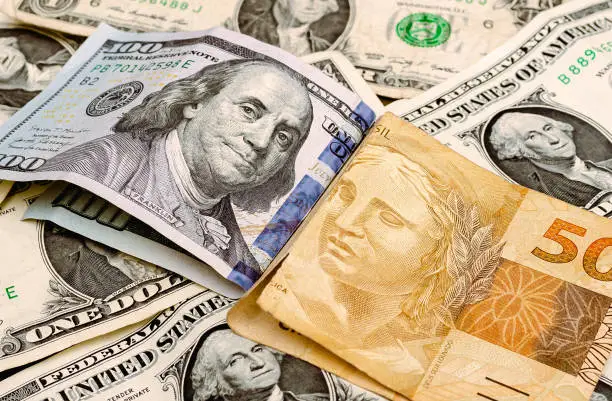
On Wednesday, the U.S. dollar ascended 1% against the Brazilian real, hinting at a broader narrative intertwined with global financial shifts and political undercurrents.
Closing at R$5.483, the dollar mirrored anxieties rooted in Japan’s financial maneuvers and the U.S.’s looming electoral decisions.
Previously, on Tuesday, the dollar had slightly retracted to R$ 5.4293, marking a modest dip.
Yet, the overall trajectory for July revealed a 1.89% decrease in the dollar‘s dominance, a fluctuation observers linked to broader economic sentiments.
This pattern shifted dramatically the following day as emerging markets felt the ripple effects.
The spotlight shone on the yen, suspected to be bolstered again by Japan’s central bank, influencing global investment strategies, notably carry trades.
Carry trades significantly impacted as investors capitalized on the differential in global interest rates.
Investors typically borrow at lower rates in one market to invest in higher-yielding markets, like Brazil. A stronger yen prompts a retreat from these strategies, pressuring currencies such as the real.
Brazilian Fiscal Policy and Currency Dynamics
In Brazil, fiscal policy remarks by President Lula during a recent interview added layers to the currency’s narrative.
His stance on prioritizing national needs over strict fiscal targets stirred market reactions. This further propelled the dollar’s ascent to R$5.4888 at its peak on Wednesday.
Moreover, the dollar’s trajectory is not isolated. Other currencies in the emerging markets spectrum, such as the South African rand and the Mexican peso, also faced downturns.
This underscores the interconnected nature of global finance. The ongoing currency drama, enriched by policy anticipations and international interventions, affects traders and investors.
It also hints at the delicate balance of economic stability in an interconnected world. Such movements underscore the complexities of global finance.
A single day’s events can echo through economies worldwide, illustrating the profound impact of fiscal policies and market sentiments on everyday financial reality.
This article was produced by The Rio Times’ automated newsroom system. How we use AI · Report an error
LatAm Markets: Live Signals → — real-time movers, turnover leaders and FX across Latin America.
Read More from The Rio Times