Chile’s Army deploys 4,000 troops due to a State of Emergency in the south and a migratory crisis in the north
The Chilean Army has deployed around 4,000 troops to support the Law Enforcement and Security Forces in the Northern and Southern Macro-zone and combat tasks in the forest fires that have affected the regions of Ñuble, Biobío, and La Araucanía.
According to the newspaper La Tercera, in the State of Constitutional Emergency Exception in force in the provinces of Biobío and Arauco in the Biobío region and the Araucanía region due to serious and repeated acts of violence and terrorist attacks, the institution has more than 1,000 officers, while in the extinguishing of forest fires another 2,000 troops.
To this contingent must be added a little more than 600 military personnel who, as of February 24, have been mobilized to the borders of the regions of Arica and Parinacota, Tarapacá, and Antofagasta to increase control tasks due to an increase in the entry of illegal persons and an increase in crime rates in these areas.
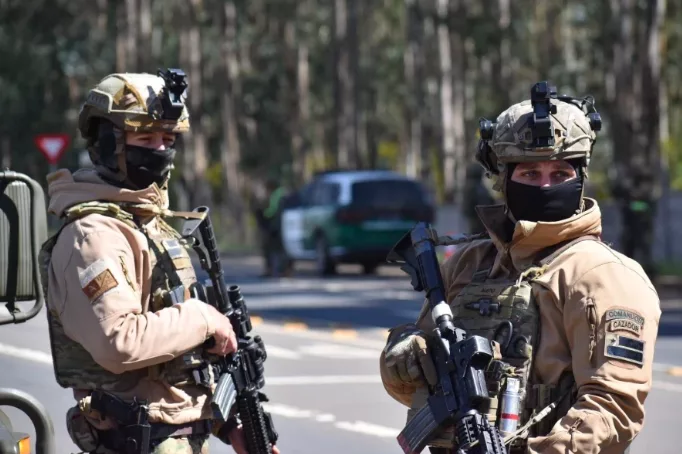
The institution explained that the number of troops deployed does not include support personnel in the respective military units who contribute to the fulfillment of these missions in the field, as well as the personnel who are carrying out other tasks, such as members of the Military Labor Corps who carry out connectivity works in isolated areas of the country.
SHIFT SYSTEM
La Tercera indicates that the designated personnel have a shift system and no special allowances or per diems since the budget used by the Chilean Army comes from its annual budget and not from a new fund for these extraordinary tasks.
This modality works differently in each zone. In the north, the Army explains, the personnel is renewed every 15 days in a staggered manner and operates along the border and in more than ten forward bases.
Before starting their operations, the military personnel carries out a 10-day pre-deployment, when they receive training to fulfill their duties.
The assigned personnel come from units of the VI and I Army Divisions.
The relays of personnel in the province of Biobío and La Araucanía occur every 30 days, and the troops belong to Army units located in the center and south of the country.
The difference in the extension of these shifts is because the terrain of operations in the north is geographically more rugged and further away from urban areas.
The Chilean Army estimates that the deployment in Arica and Parinacota, Tarapacá, and Antofagasta, valid for 90 days, will be renewed at the end of this period.
Therefore the contingent will have to remain at the border.
The military will also be required to guard the polling places in May for the elections of constitutional councilors.
TRAINING AND OPERATIONS
Throughout the year, military personnel permanently carry out training maneuvers corresponding to their respective specialties, and this deployment could have repercussions on the operation of the Land Force.
The head of AthenaLab’s Security and Defense Studies Area, John Griffiths, told La Tercera, “the international standard says that if you have 1,000 troops deployed, you have to have 1,000 in retraining and 1,000 waiting to be relieved. If you have one battalion employed, you must have one more in readiness and another in retraining”.
“These are additional missions to the employment of the force. So if you stop training, you stop training soldiers.”
“In the military, if you don’t train – for your permanent duties – you lose operationality.”
“When you take on outside assignments, you have to keep retraining. Therefore, for every third of troops that go to this contingency, you must have another third in relief and another in training. Considering this circuit, the Army should have 12,000 troops just for this.”
José Poblete, an expert in security matters and former chief advisor to the Undersecretary of the Interior, told the newspaper that military deployment must always be accompanied by specialization and training.
“The militarization of police tasks -through military personnel, equipment, or tactics- is not a novelty in the continent or the world.”
“There are good and bad results. But if it is decided to use military personnel to maintain public order in a very complex context, such as immigration control, extensive theoretical and practical training, police accompaniment during the first months and clear rules are required,” he said.
With information from Infodefensa
Editorial responsibility: Matthias Camenzind, Editor-in-Chief · Editorial standards · Report an error
Read More from The Rio Times