Chile’s Kast Visits Central Bank After 4.1% Inflation

ECONOMY · CHILE
Key Facts
- —The country Chile is the world’s largest copper producer and a long-standing favourite of US bond and equity investors, partly because its central bank is constitutionally independent.
- —Why it matters The finance minister publicly told the central bank that inflation is its job and that monetary measures must be taken. That revived a debate about the bank’s autonomy.
- —Why now September inflation came in at 4.1%, above the 3% target. The bank’s president, Rosanna Costa, ends her term as head of the bank on 3 February.
- —What happened On Friday 9 October, President José Antonio Kast and Finance Minister Jorge Quiroz made a protocol visit to the central bank and lunched with its Board.
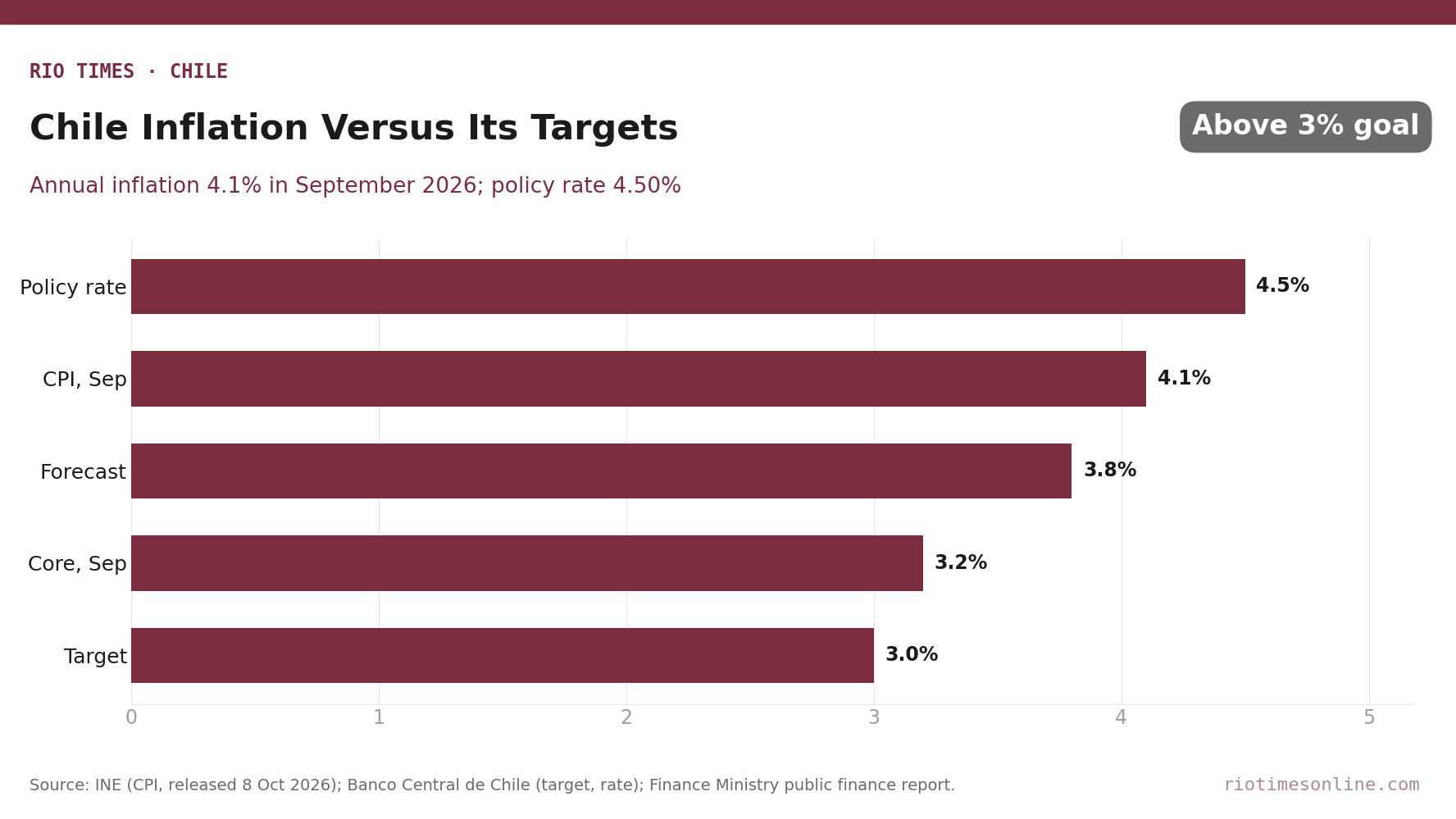
- —The numbers Consumer prices rose 0.4% in September and 4.1% over twelve months. The policy rate has stood at 4.50% since late December.
- —What it means for you No rate move was announced. Holders of Chilean pesos, bonds or New York-listed Chilean shares should watch the next rate decision and Kast’s pick to lead the bank.
- —Still open What was said at the lunch, whether Kast keeps Costa or names someone else, and whether the Board changes its cautious stance.
Chile’s President José Antonio Kast visited the Central Bank of Chile in Santiago on Friday 9 October, a day after his finance minister said inflation was the bank’s responsibility. The Kast central bank visit, with Finance Minister Jorge Quiroz at his side, ended in a working lunch with the bank’s Board. For US investors it matters because the bank’s independence is a core reason they trust Chile’s peso and bonds.
The bank described the meeting as a protocol visit. According to the presidency, the aim was “to address the recent evolution of the national economy and analyse the economic scenario, in an instance of dialogue between the government and the authorities of the autonomous entity,” as reported by Diario Financiero.
No decision on interest rates was announced, and none was expected. Only the bank’s Board can set rates.
What Quiroz Said About Inflation
On Thursday 8 October, the national statistics institute INE reported that consumer prices rose 0.4% in September. Annual inflation held at 4.1%, and prices are up 4.0% so far this year, according to INE figures reported by BioBioChile and CNN Chile. Gasoline rose 2.7% in the month and diesel 10.2%.
Speaking the same day at an event of the Unión Social de Empresarios Cristianos, a Christian business association, Quiroz was asked what the government would do about prices.
“Let us remember that inflation and the CPI are a responsibility of the Central Bank. The Central Bank is responsible for price stability,” he said, according to CNN Chile. “We would like this to come down, and whatever measures need to be taken from the monetary point of view must be taken to keep inflation in check.”
He also admitted that the government’s own forecast of 3.8% inflation for 2026, set out in its latest public finance report, “is challenging.” He added that a slowdown in price growth could still come.
Daniel Mas, who serves as both economy and mining minister, struck a similar note. “A monthly rise of 0.4% confirms that inflationary pressures remain,” he said, according to CNN Chile.
Why the Remark Touched a Nerve
The Central Bank of Chile is autonomous under the Constitution and its own organic law. The government cannot instruct it to raise or cut the monetary policy rate, known locally as the TPM. That power sits only with its Board, as BioBioChile noted in its coverage.
The bank’s mandate is to keep inflation low and stable around a 3% target over a two-year horizon. Inflation above that level for a time is not, by itself, a failure of that mandate.
BioBioChile wrote that Quiroz’s words “once again strain relations” between the Finance Ministry and the bank. It added that the minister had already faced criticism weeks ago for commenting on matters reserved for the bank. Cooperativa headlined its report on the visit as coming “after Quiroz’s questioned remarks.”
There is also a family link. Miguel Kast Rist, the president’s brother, headed the central bank in 1982. During the visit, Kast saw a banknote from that year bearing his brother’s signature, according to Diario Financiero.
Who Sat at the Table
Kast and Quiroz were received by Rosanna Costa, president of the bank. Also present were Vice President Alberto Naudon, Board members Claudio Soto and Kevin Cowan, and General Manager Luis Óscar Herrera, according to CNN Chile and Diario Financiero.
Kast is a conservative who took office on Wednesday 11 March. Quiroz is an economist who runs the Finance Ministry, which prepares the budget but has no say over interest rates.
Timing adds weight. Costa’s five-year term as head of the bank ends on Wednesday 3 February 2027, although her seat on the Board runs until Friday 28 December 2029, Diario Financiero reported. Kast must name the next president of the bank, or he could keep Costa in the job.
What It Means for You
For now, very little changes. The policy rate has stood at 4.50% since late December. At its last meeting, the Board said uncertainty was “greater than usual” and that it would assess the rate meeting by meeting, BioBioChile reported.
Analysts quoted by BioBioChile did not see an imminent rate rise. Ignacio Mieres of the broker XTB noted that core inflation, which strips out volatile items, rose 3.2% over twelve months, well below the headline figure. That points to food and fuel, not broad price pressure.
For US readers, the stake is credibility. Holders of Chilean government bonds, the peso or New York-listed Chilean shares price in a bank that answers to its mandate, not to the minister of the day. The protocol framing of the Kast central bank lunch suggests both sides want to ease the row. The risk is that the choice of Costa’s successor becomes political, which markets would read as a warning sign.
Travellers and expats will feel the inflation figures first. Fuel and electricity were among September’s sharpest price rises. A steady rate keeps borrowing costs where they are.
For background on the data, see Chile Inflation Holds at 4.1% as Core Prices Cool. For the people involved, see Who Runs Chile’s Economy, the Key Players in 2026.
What Is Not Known
Neither side has published what was said at the lunch beyond the official statement. It is not known whether Quiroz’s remarks were discussed.
Kast has not said whether he will keep Costa as head of the bank or name a successor, nor when he will decide. It is also not known whether the Board will change its cautious stance at its next meeting. The outcome of the Kast central bank meeting, in short, will show only in later decisions.
More: Chile news in English, every day from The Rio Times.
Frequently Asked Questions
Can Chile’s government order the central bank to raise rates?
No. The Central Bank of Chile is autonomous under the Constitution and its organic law. Only its Board can set the monetary policy rate, which has stood at 4.50% since late December.
Why did President Kast visit the central bank?
The presidency called it a protocol visit to discuss the economy with the bank’s Board. It came a day after Finance Minister Jorge Quiroz said inflation was the bank’s responsibility.
When does Rosanna Costa’s term end?
Her term as president of the bank ends on 3 February 2027, according to Diario Financiero. Her seat on the Board runs until 28 December 2029, and Kast must choose who leads the bank next.
Sources: Diario Financiero, 9 Oct 2026; CNN Chile, 9 Oct 2026; CNN Chile, 8 Oct 2026; BioBioChile, 9 Oct 2026; BioBioChile, 8 Oct 2026; Cooperativa, 9 Oct 2026.
This article was produced by The Rio Times’ automated newsroom system. How we use AI · Report an error · Editorial responsibility: Matthias Camenzind, Editor-in-Chief
In depth
LatAm Markets: Live Signals → — real-time movers, turnover leaders and FX across Latin America.