Burkina Faso Plans US$435 Million Irrigation Push

AGRICULTURE · BURKINA FASO
Key Facts
- —The country Burkina Faso, a landlocked Sahel nation of West Africa, has been run by a military government under Captain Ibrahim Traoré since a September 2022 coup.
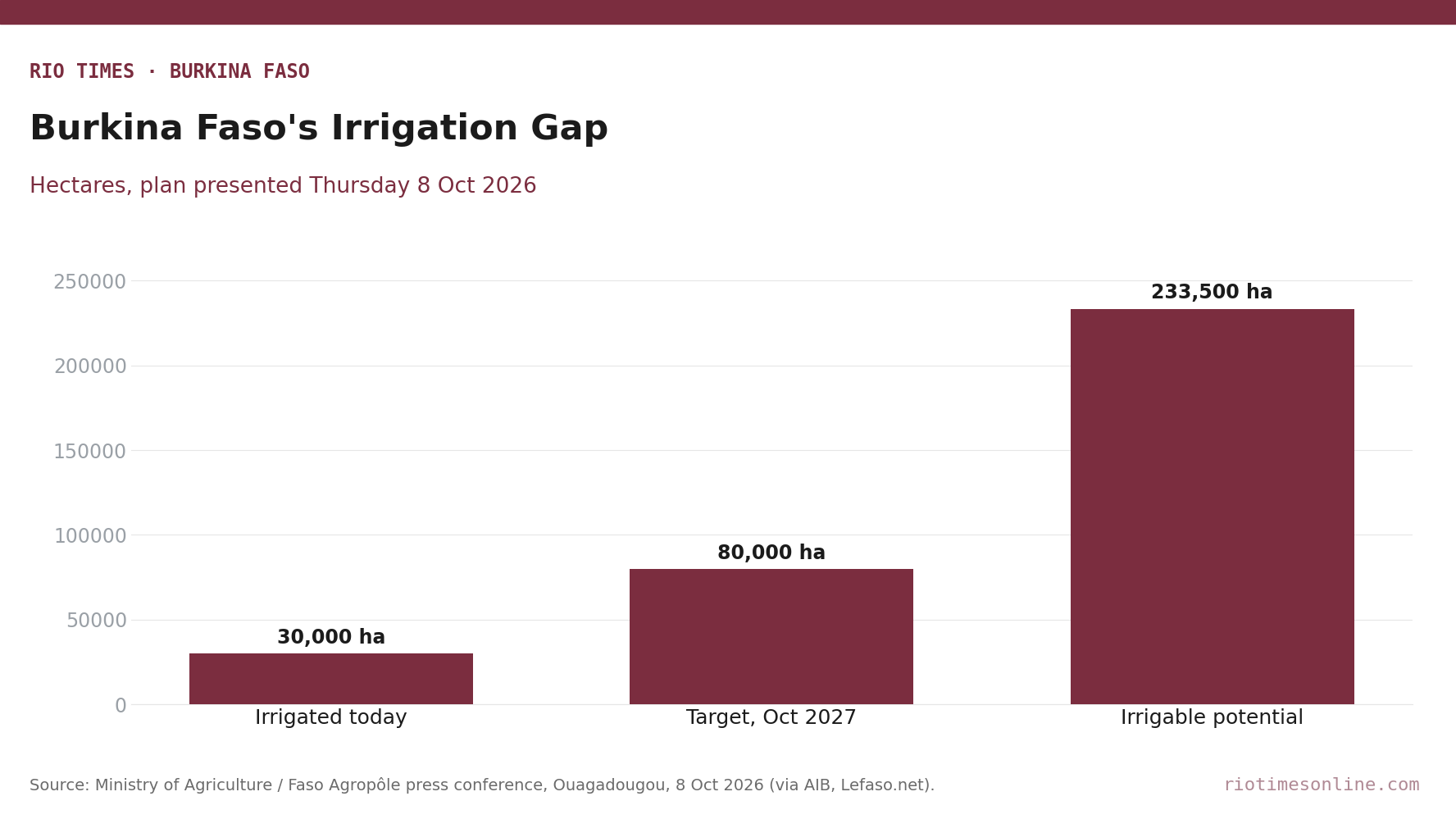
- —Why it matters Most of its farmers depend on rain. Officials say only about 30,000 hectares are irrigated and working, out of about 233,500 hectares of irrigable land.
- —Why now Weak rains and dry spells hit several regions this season. The Ministry of Agriculture calls drought “no longer an accident of the season” (translated).
- —What happened On Thursday, 8 October, the ministry presented a dry-season emergency plan costing 254.79 billion CFA francs (about US$435 million) in Ouagadougou.
- —The numbers 750 state-drilled boreholes by March 2027; 50,000 new irrigated hectares by October 2027; 8,000 farm-trained army auxiliaries mobilised.
- —What it means for US readers A Sahel military government is trying to grow more food without Western donors. Hunger, insurgency and migration in the region shape US policy.
- —Still open Officials did not say how the plan will be financed. No budget line or independent costing has been published.
The new Burkina Faso irrigation plan is worth 254.79 billion CFA francs (about US$435 million) and aims to wean farms off rain. The Ministry of Agriculture presented the dry-season emergency plan in Ouagadougou on Thursday, 8 October. For foreign readers, it is a test of whether a Sahel military government can feed its people without Western donors.
Dollar figures use the Central Bank of West African States (BCEAO) rate of about 586 CFA francs per dollar on 8 October. The CFA franc is pegged to the euro at 655.957.
The state news agency AIB says the plan was drawn up on the orders of Captain Ibrahim Traoré, the head of state. Traoré took power in a September 2022 coup and leads a military government that has pledged food self-sufficiency.
It has two parts, run in parallel. The first answers this dry season. The second aims to cut the country’s reliance on rainfall for good.
What the Plan Promises
The short-term part centres on 750 boreholes nationwide by March 2027. Each is meant to yield at least five cubic metres of water an hour, AIB reported. It also covers lowland valleys, surface water points and irrigated schemes left unfinished.
The long-term part is larger. The ministry wants 50,000 more irrigated hectares by October 2027, lifting the total from about 30,000 to about 80,000. It also plans earthworks on about 62,500 hectares.
The news site Lefaso.net reports that 93 percent of the budget goes to the 50,000 hectares. That is about 237 billion CFA francs (about US$404 million). Earthworks take 5 percent and the five short-term operations take 2 percent.
Oula Damien Ouattara, director general of the company Faso Agropôle, presented the plan. “This plan aims to durably reduce our dependence on rain by October 2027,” he said, as quoted by Lefaso.net (translated).
Who Does the Work and Who Qualifies
The government says it will rely on its own means. Machinery will come from the government-backed builder Faso Mêbo, the land-development agency SONATER, the hydro-agricultural agency ONBAH and the army’s engineering corps. Private companies will join only if needed.
It will also deploy 8,000 farm-trained Volunteers for the Defence of the Homeland (VDP). The VDP are civilian auxiliaries armed and trained alongside the army to fight jihadist groups. Seventeen drilling workshops and local craftsmen are to build pumps and irrigation gear.
The boreholes are free to applicants, but with limits. The state pays for one drilling attempt per beneficiary. If it finds water, the state also covers the casing, a pumping test and water analysis. If it fails, there is no second attempt.
Farmers must pay for the geophysical survey that locates water, plus pumps and solar panels. Applicants need at least two hectares in active use, secure land rights and a crop on the government’s 2026 to 2028 priority list.
The call for applications opens on Friday, 9 October. Files can be lodged from Monday, 12 October, until 11:59 p.m. on Sunday, 18 October. Results are due on Thursday, 22 October, and drilling should begin on Sunday, 25 October.
What It Means for US Readers
Burkina Faso matters to Washington mainly through security. The country has fought a jihadist insurgency for about a decade, and the violence has driven many rural families from their land. Our explainer Burkina Faso Explained: Traoré’s Junta, the Jihadist War, Gold and What to Watch sets out the background.
Food is part of that fight. Farmers who can grow vegetables, rice and wheat in the dry months have a reason to stay on their land. Failed harvests push people towards cities, camps and migration routes north.
The plan also says something about who pays. It names no foreign donor. Burkina Faso has left the regional bloc ECOWAS and joined Mali and Niger in the Alliance of Sahel States. The three juntas pressed their case at the United Nations last month. See Burkina Faso Speaks for Sahel Juntas at UN, Says States Back Jihadists.
For investors, the country is best known as a gold producer. A Burkina Faso irrigation plan financed at home would compete with defence spending for the same revenue. If gold prices stay high, that is easier to fund.
What Is Not Known
Officials did not say where the 254.79 billion CFA francs (about US$435 million) will come from. No budget line, loan or donor was named in the reports of the press conference.
No independent costing of the plan has been published. Insecurity in the north and east may also keep crews away from some sites.
Lefaso.net describes this as the ministry’s second plan of its kind. Officials did not set out results from earlier dry-season campaigns alongside it. Whether the 50,000-hectare target is met will only be clear in late 2027.
More: Africa news in English, every day from The Rio Times.
Frequently Asked Questions
What is Burkina Faso’s dry-season emergency plan?
It is a 254.79 billion CFA franc (about US$435 million) programme from the Ministry of Agriculture. It promises 750 boreholes by March 2027 and 50,000 new hectares of irrigated land by October 2027.
Who can apply for a free borehole?
Individual farmers and registered producer groups with at least two hectares in active use, secure land rights and a crop on the government’s priority list. Applications run from 12 to 18 October 2026.
Who pays for what?
The state pays for one drilling attempt per applicant and, if water is found, for casing, a pumping test and water analysis. Farmers pay for the geophysical survey, pumps and solar equipment.
Is foreign aid involved?
Officials did not name any foreign donor. They said the work will rely on state machinery, the army’s engineers, farm-trained auxiliaries and local craftsmen, with private firms only if needed.
Why does this matter outside Burkina Faso?
Food output in the Sahel affects hunger, displacement and migration across West Africa. Those issues shape US aid and security policy in a region where military governments have distanced themselves from Western partners.
Sources: Agence d’Information du Burkina (AIB), “Campagne sèche : Le gouvernement burkinabè acte un plan d’urgence de près de 255 milliards de FCFA”, 8 October 2026, aib.media; Lefaso.net, “Plan d’urgence de la campagne sèche 2026-2027”, 8 October 2026, lefaso.net; BCEAO exchange rates, 8 October 2026, bceao.int.
Editorial responsibility: Matthias Camenzind, Editor-in-Chief · Editorial standards · Report an error
Part of our ongoing coverage
Africa: The New Scramble — the great-power contest over the continent.