Brazil’s inflation-targeting battle hits markets
By Maria Eloisa Capurro, Martha Beck and Josue Leonel
Investors are becoming alarmed by the escalating fight over Brazil’s inflation targets, betting the government’s campaign to make the currency cheaper will backfire.
Stock markets and the currency of Latin America’s biggest economy plunged Thursday after Bloomberg News reported that President Luiz Inácio Lula da Silva’s government is pushing for an early review of the country’s inflation targets, intending to raise them.
Lula, who took office last month, has been lashing out for weeks at the Central Bank’s 13.75% interest rate, the highest in six years.

He wants to increase public spending to revive a barely growing economy and sees the high cost of borrowing as an obstacle that can be removed by setting a more flexible inflation target.
But since the criticism began, markets have been pricing in even higher interest rates, the opposite of what the president wants.
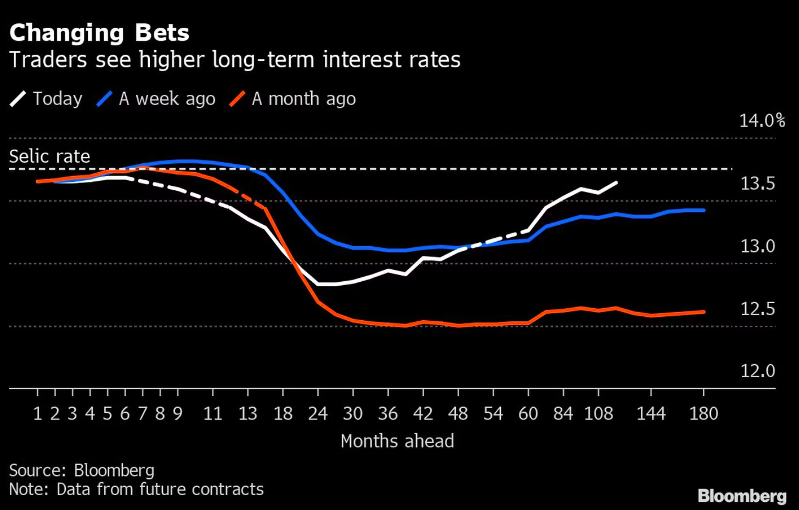
According to Adriana Dupita of Bloomberg Economics, political attacks on the central bank for keeping rates too high may be counterproductive and, on the contrary, “raise the hurdle” for the bank to start lowering them.
The Brazilian real fell by 1.4% on Thursday before recovering part of the loss in early trading on Friday.
The main stock market indicator has been falling for two days.
Several indicators of expected inflation and long-term interest rates have increased since Lula began his campaign of criticism, which has also included some attacks on the central bank’s autonomy from policy, enshrined in law just two years ago.
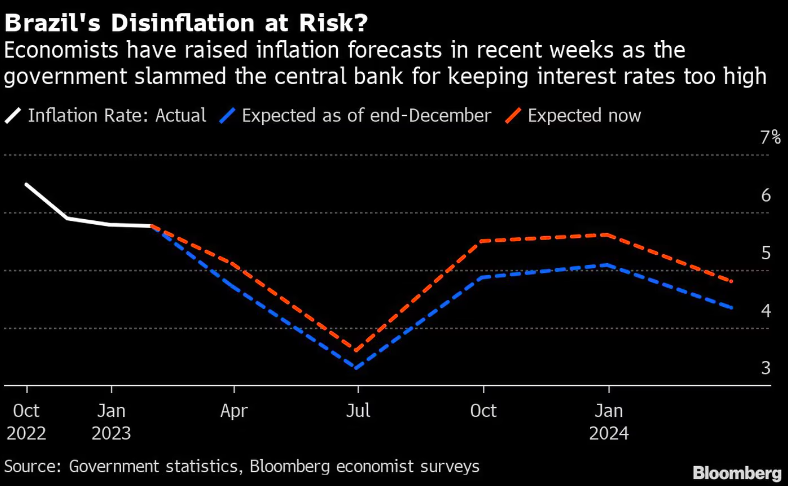
Economists surveyed by the central bank pushed back their forecast for the start of the monetary easing cycle by two months to November.
Some Wall Street banks are even more pessimistic: Credit Suisse Group AG forecasts that the first rate cut will not occur until the third quarter of next year.
NOT A GOOD SIGN
In Brazil, the central bank has the autonomy to implement the policies necessary to achieve inflation targets, but it does not set them.
That task falls to the National Monetary Council, a government body comprised of the finance and planning ministers, and Roberto Campos Neto, the current head of the central bank.
This means that Lula will likely have the final say in the decision through his hand-picked cabinet members.
But even after the Central Bank missed its inflation targets for two consecutive years – to be fair, most of its global counterparts missed them as well – lowering the target now could sow suspicion that the government has given up the fight.
“It’s not a good sign,” says Juan Prada, strategist at Barclays Plc. Changing the inflation target at a time when price shocks keep coming, and there is so much uncertainty about the government’s spending plans “calls into question the monetary regime,” he says.
And a likely consequence would be higher long-term interest rates to account for the expectation that inflation will be sustained, which will be of little help to the growth and investment that Lula values.
None of this means that Brazil’s inflation targets – currently 3.25% for 2023 and 3% for the following two years – are necessarily the right ones for its economy.
There is no precise science behind the choice of an inflation target nor consensus on the right level.
Many leading economists in the US and other advanced countries believe the 2% targets currently in place are too low.
LITTLE APPETITE
In Brazil, the target was higher when Lula came to power in the early 2000s until the government began to lower it in 2019.
“Brazil lived with a 4.5% target for a long and reasonable time,” says Sergio Werlang, an economics professor who was the architect of the inflation-targeting regime.
He said there is a case for raising it again now in an email, though any changes should be “well communicated and preferably gradual” – and it would be better to wait until the fiscal outlook is “under control.”
After getting the green light to spend R$168 billion (US$34 billion) more this year, Lula is expected to present new budget rules to ensure public debt sustainability after the previous anchor, a spending cap adjusted annually for inflation, lost credibility with investors.
Raising the inflation target suggests the government will settle for a less ambitious fiscal rule to keep spending on track in a big way, according to former central director José Julio Senna.
“If the government changes the target now, it’s a sign that there’s not much appetite for the spending cuts needed” to rein in consumer prices, he says.
Traditionally, the National Monetary Council sets inflation targets at its June meeting.
However, it is considering bringing this year’s discussion forward to review shorter-term targets, according to two government officials who know the matter.
CHECKING ALL THE BOXES
At this point, the hints about raising the target signal that Lula’s government would tolerate more inflation if it allowed lower interest rates and faster growth.
That idea is familiar in Brazil.
It was known as the “new economic matrix” under Dilma Rousseff in the 2010s and included more public spending and subsidized credit through state banks.
Efforts to turbocharge the economy back then ended with skyrocketing inflation and a deep recession.
The “policies adopted and announced right now meet all those requirements,” said Alexandre Schwartsman, head of the central bank during Lula’s first term.
Even economists who support raising targets often oppose it when inflation spikes because it looks like an admission of failure.
“The way to regain credibility is to bring inflation back to target,” says Schwartsman. Changing the target, on the other hand, would be like shooting yourself in the foot.
With information from Bloomberg
More: Brazil news in English, every day from The Rio Times.
Live Market IntelligenceBrazil — Live Market Board
Rio Times · Live Market Intelligence
Brazil — Live Market Board
+1.54%
207,454.93
+1.54%
64,653.33
-1.01%
11,004.95
+0.05%
2,860,413
+1.29%
2,538.78
+0.15%
60,766.81
-1.71%
| Instrument | Last | Change | YoY | Prev. | High | Low | Volume |
|---|---|---|---|---|---|---|---|
| IBOV | 207,454.93 | +1.54% | +21.85% | 204,302.33 | 168,310 | 167,142 | — |
| USD/BRL | 5.16 | +0.01% | -5.13% | 5.16 | 5.18 | 5.14 | — |
| SELIC | 14.00% | — | — | — | — | — | |
| PETR4 | 41.64 | -0.05% | +35.19% | 41.66 | 41.97 | 41.15 | 41,499,400 |
| VALE3 | 72.97 | +0.83% | +30.75% | 72.37 | 73.54 | 72.66 | 17,658,000 |
| ITUB4 | 38.60 | -1.03% | +4.57% | 39.00 | 39.34 | 38.39 | 29,487,800 |
| BBDC4 | 16.85 | +0.36% | +3.50% | 16.79 | 16.90 | 16.67 | 19,416,900 |
| BBAS3 | 19.37 | +0.47% | +0.73% | 19.28 | 19.44 | 19.16 | 11,069,200 |
| B3SA3 | 14.26 | -0.21% | +12.73% | 14.29 | 14.47 | 14.11 | 33,037,800 |
| ABEV3 | 14.89 | -0.80% | +21.91% | 15.01 | 15.07 | 14.81 | 16,453,100 |
| WEGE3 | 47.59 | +0.49% | +29.99% | 47.36 | 48.08 | 47.36 | 3,364,600 |
| PRIO3 | 59.14 | -0.19% | +50.67% | 59.25 | 59.81 | 58.74 | 3,325,600 |
| SUZB3 | 41.33 | +2.35% | -23.55% | 40.38 | 41.48 | 40.35 | 3,914,900 |
| RENT3 | 34.68 | -0.09% | +0.84% | 34.71 | 34.96 | 34.35 | 7,979,100 |
| AZZA3 | 15.89 | -2.63% | -53.76% | 16.32 | 16.42 | 15.82 | 1,330,300 |
| CSNA3 | 4.30 | +0.47% | -42.65% | 4.28 | 4.41 | 4.26 | 10,076,100 |
| GGBR4 | 24.69 | +2.19% | +51.38% | 24.16 | 24.85 | 24.18 | 7,047,600 |
| ENEV3 | 24.21 | -1.38% | +70.49% | 24.55 | 24.64 | 23.99 | 9,297,000 |
Editorial responsibility: Matthias Camenzind, Editor-in-Chief · Editorial standards · Report an error