By Clara Velasco*
The number of murders fell by 1% in Brazil in 2022.
There were 40,800 violent deaths nationwide – an average of more than 110 victims per day.
This is what the national homicide index created by g1 shows, based on official data from 26 states and the Federal District.
The number of violent deaths is still high, but it is a relief.

Brazil reached the lowest number in the historical series of the Brazilian Forum for Public Safety, which collects the data since 2007, and the Violence Monitor, which collects it since 2018.
It is the second year in a row that this happens: in 2021, there were 41,200 deaths (understand below the reasons that explain this reduction).
The data, however, set off a warning: the downward trend in violence in the country, which began in 2018, may be coming to an end, warn experts.
THE MAIN HIGHLIGHTS OF THE SURVEY
- Brazil had 40.8 thousand murders in 2022, the lowest number in the FBSP’s historical series – a drop of 1% compared to 2021;
- In the last quarter, however, a warning: there was a 6.5% increase in murders;
- The reduction in deaths was driven by the North (-3.5%) and Northeast (2.2%);
- Highlights were the drops in Amapá (-28.5%) and Roraima (14.1%);
- Even with the national drop of 1%, 14 Brazilian states saw an increase in the number of deaths;
- The Midwest led the increase (4.5%), led by Mato Grosso (24.1%);
- The deaths increased again in São Paulo (7.1%) and Minas Gerais (6.3%).
According to experts, several factors are behind the falling violence indicators in recent years: state public policies, changes in the dynamics of criminal groups, and more resources available to the public security sector, among others.
This survey is part of the Violence Monitor, a partnership between g1, the Center for the Study of Violence at the University of São Paulo (NEV-USP), and the Brazilian Public Safety Forum.
HISTORICAL FALL AND ITS REASONS
The number of murders in Brazil in 2022 is the lowest if the historical series of the Brazilian Forum for Public Safety, begun in 2007, and the surveys conducted by the Violence Monitor since 2018 are considered.
The level is impressive because, until 2011, the Forum counted the occurrences (in which it is possible to have more than one victim).
The data collected since 2012 by the Forum and since 2018 by g1 refer to the number of victims.
Even so, the numbers in recent years are the lowest in the historical series.
Experts from the Center for the Study of Violence at USP and the Brazilian Forum for Public Safety list some points to explain the drop in indicators in recent years:
CHANGE IN THE DYNAMICS OF THE BRAZILIAN CRIMINAL DRUG MARKET
“Today we have a more efficient, less truculent, and less costly drug market, which expands these groups’ economic and political power,” says Bruno Paes Manso from NEV-USP.
As the researcher explains in his article on the latest data from the Violence Monitor, the reduction in homicides is part of a context of greater professionalization of drug trafficking factions in the country.
These criminal organizations have developed to reduce conflicts between rival groups, the main reason for the high homicide rate in the country.
If, on the one hand, this decrease in the rivalry between criminal groups reduces violent deaths, on the other hand, it facilitates the influence of crime organizers on democratic institutions and extends the illegal practices to other activities, such as environmental crime.
CREATION OF TARGETED PROGRAMS AND OTHER PUBLIC POLICIES
“Several units of the federation adopted, during the years 2000 and 2010, homicide reduction programs based on targeting actions in the territories. The Pact for Life, in Pernambuco, the Present State, in Espírito Santo, and Pacific Ceará, in Ceará, are examples of projects that sought to integrate police actions and preventive measures,” said Samira Bueno and Renato Sérgio de Lima, of FBSP.
The specialists also mention other public policies being developed by the federation units, focused on integrating police forces with strengthening intelligence and investigation mechanisms.
REDUCTION IN THE NUMBER OF YOUNG PEOPLE IN THE POPULATION
“It has to do with demographic changes, something that we have been pointing out for some years in the Atlas of Violence, which is the reduction in the number of young people in the population. It is known that most lethal violence affects young men. And Brazil is facing a major demographic change,” said Samira Bueno from FBSP.
CREATION OF THE ‘SUSP’ AND CHANGES IN THE TRANSFER RULES
“In 2018, the federal government approved, after a 14-year process, the law that created the Unified Public Security System (SUSP), responsible for regulating the 1988 Constitution regarding the integration and efficiency of public security institutions.”
“Also, in 2018, (…) there was a change in the rules for the transfer of resources collected by the Caixa Lotteries, which, in practice, meant that about 80% of all the security money transferred to states and the Federal District from 2019 to 2021 would come from the lotteries and, thus, new resources could be allocated to the area,” said Samira and Renato.
Bruno Paes Manso highlights that, since 2018, there has been a reduction of more than 18,000 cases of deaths in the country per year.
“This includes four years of the Bolsonaro government, where more than 1 million weapons entered circulation. It’s a big unknown we must deal with,” he said.
“The [Bolsonaro] government argued that people are more afraid to rob others with more guns in circulation. Therefore, deaths decrease. This is a mistake, a line out of reality because, of the total number of deaths, less than 5% are due to robberies.”
“With more guns in circulation, as shown in several studies, circumstantial homicides, traffic fights, in bar fights increase. Suicides and domestic violence also increase.”
He also points out that there has been an increase in political homicides – that is, those motivated by political issues and opinions.
Despite these factors, deaths in general managed to fall motivated by the points mentioned above, such as changes in the criminal scenario and state public policies, the specialists defend.
In November, after the escalation of violence, the Secretary of Security and Justice of Acre, Colonel Paulo Cézar, stated that the orders for the confrontations came from the state’s prisons and the neighboring country, Bolivia.
“There is a movement involving criminal leaderships, organized crime, mainly drug trafficking,” he said.
To try to contain the escalation, the government says it is working on standardizing the prison system, besides having created a special group to police border areas and acquiring new equipment for the security forces.
TREND CHANGES IN SÃO PAULO AND MINAS GERAIS
The data show a reversal in the downward trend of deaths in Minas Gerais and São Paulo, which had been experiencing successive reductions in violent deaths in recent years.
The case of São Paulo is even more emblematic since the state registered two practically uninterrupted decades of drop in murders, going from being one of the most violent states to having the lowest homicide rate in the country.
In 2022, São Paulo had a 7.1% increase in violent deaths compared to the previous year: from 3,096 to 3,316.
Even so, the state maintained the lowest murder rate, with 7.1 deaths per 100,000 inhabitants.
In Minas Gerais, there was a 6.3% increase in violent deaths, from 2,413 in 2021 to 2,564 last year.
The state has the fourth lowest murder rate in the country, with 12 deaths per 100,000 inhabitants.
AMAPÁ: WITHOUT DISPUTE, DEATHS DROP
In 2021, Amapá went through a similar situation to Acre.
The state ended that year with a 19% increase in murders due to intense disputes between criminal factions.
In 2022, however, the situation was pacified, and the state closed the year with a significant drop of 28.5% – the biggest drop in Brazil, inclusive.
To g1 AC, Delegate General Uberlândio Gomes said that the realization of an operation aimed at fighting crimes in drug trafficking areas dominated by criminal organizations, called Operation Asfixia (Asphyxia), was essential for reducing crimes in the state.
“We highlight ‘Asfixia’, which began on March 10 and had its last phase on December 28, in which the Civil Police had two fronts of action: the fulfillment of arrest warrants and raids in several neighborhoods to increase the confrontation with organized crime, violent crimes, and drug trafficking,” he said.
See below the ranking of the states by murder rate per 100,000 inhabitants:
- Pernambuco (PE): 35.3 (deaths per 100,000 inhabitants)
- Bahia (BA): 34.2
- Alagoas (AL): 33.5
- Amazonas (AM): 33.5
- Ceará (CE): 32.2
- Rio Grande do Norte (RN): 30.9
- Rondônia (RO): 28.5
- Roraima (RR): 28
- Tocantins (TO): 27.2
- Mato Grosso (MT): 27
- Paraíba (PB): 26.9
- Pará (PA): 25,9
- Amapá (AP): 25,8
- Espírito Santo (ES): 25,6
- Sergipe (SE): 25,4
- Piauí (PI): 24,9
- Maranhão (MA): 24,8
- Acre (AC): 23,8
- Mato Grosso do Su (MS)l: 18
- Rio de Janeiro (RJ): 18
- Paraná (PR): 17,7
- Goiás (GO): 17,1
- Rio Grande do Sul (RS): 15.3
- Minas Gerais (MG): 12
- Distrito Federal (DF): 9.7
- Santa Catarina (SC): 8.7
- São Paulo (SP): 7.1
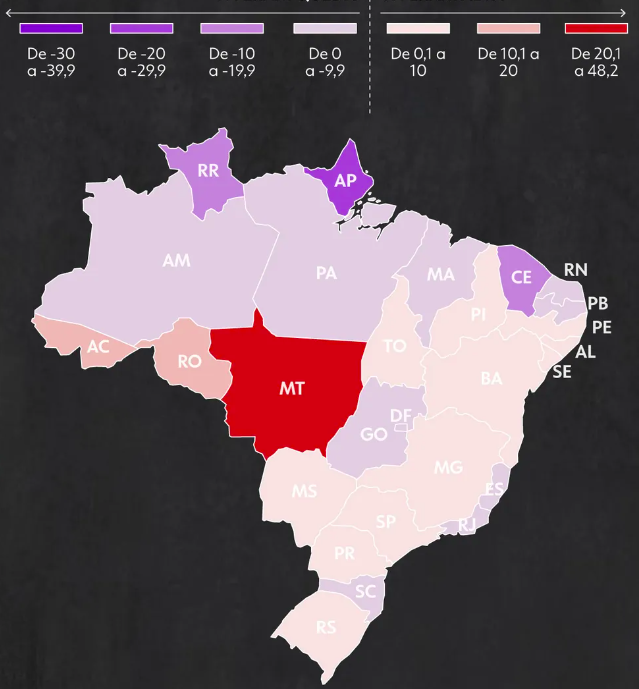
NATIONAL HOMICIDE RATE
The tool created by g1 allows tracking data on victims of violent crimes month by month in the country.
Victims of intentional homicides (including femicides), robbery, and bodily injury followed by death are accounted for. Together, these cases make up the so-called intentional violent crimes.
g1 journalists around the country requested the data, via the press office and the Access to Information Law, following the methodological standard used by the forum in the Brazilian Yearbook of Public Safety.
* With Marina Pinhoni (g1), Geisy Negreiros (g1 AC), Cau Rodrigues (g1 AL), Fabiana Figueiredo (g1 AP), Eliena Monteiro (g1 AM), Itana Alencar (g1 BA), André Teixeira (g1 CE), Pedro Alves Neto and Walder Galvão (g1 DF), Álvaro Guaresqui (g1 ES), Vitor Santana (g1 GO), Rafaelle Fróes (g1 MA), José Câmara, Rafaela Moreira, Renata Barros, Thais Libni, and Débora Teixeira (g1 MS), Pedro Mathias (g1 MT), Raquel Freitas, and Rafaela Mansur (g1 MG), Taymã Carneiro (g1 PA), Dani Fechine (g1 PB), Letícia Paris (g1 PR), Pedro Alves, Katherine Coutinho, Bruno Marinho and Ricardo Novelino (g1 PE), Maria Romero (g1 PI), Fernanda Zauli and Igor Jácome (g1 RN), Gabriela Clemente and Lilian Lima (g1 RS), Jonatas Boni (g1 RO), Samantha Rufino and Valéria Oliveira (g1 RR), Caroline Borges (g1 SC), Joelma Gonçalves (g1 SE), Vilma Nascimento and Patrício Reis (g1 TO).
With information from g1
More: Brazil news in English, every day from The Rio Times.
Editorial responsibility: Matthias Camenzind, Editor-in-Chief · Editorial standards · Report an error