
CRIME · BRAZIL
Key Facts
- —The country Brazil, South America’s largest country, borders the three Andean cocaine producers: Colombia, Peru and Bolivia.
- —Why it matters The ring hid cocaine in legal export cargo and worked with Albanian and Montenegrin mafias, showing how southern Brazilian ports feed Europe’s drug market.
- —Why now The verdict of the 22nd Federal Court of Porto Alegre was announced on Tuesday 13 October, and eight of the convicted men have already appealed.
- —What happened A panel of federal judges convicted 13 men of international drug trafficking and organised crime, with prison terms from five years and seven months to 54 years.
- —The numbers More than 14 tonnes of cocaine shipped from November 2020 to November 2022, with an estimated R$3 billion (about US$600 million) moved.
- —What it means for you US shippers and investors in Brazilian ports get a reminder that legitimate cargo can be used to hide drugs, which raises compliance and inspection risk.
- —Still open The names of those convicted have not been released, one man is a fugitive, and the appeals court has yet to rule.
- —Power Index Brazil ranks 1st of 14 in The Rio Times Latin America Power Index, with 75.0 points (October 2026 edition).
Runoff · Sunday, 25 October
Brazil Runoff 2026: Lula vs Flávio
Date, polls, debates, odds and how the runoff works, updated every day.
Brazil runoff polls · Polymarket and Kalshi odds · When results come
Prediction markets · who wins the runoff
Implied chance of winning Brazil’s presidency on 25 October, from traders’ prices.
Polymarket
Flávio Bolsonaro 85% · Lula 14.5% (US$182 million traded)
Kalshi (regulated in the US by the CFTC)
Flávio Bolsonaro 86% · Lula 14%
As of 14 October, 2:00 pm ET (19:00 Lisbon), updated every 20 minutes. Prices are bets, not polls, and can move fast.
Why we show this: prediction markets turn real-money bets into a live probability that moves within minutes of the news, which is why investors, campaigns and newsrooms in the United States now follow them closely. We show them next to polls and official results, never instead of them.
A Brazil cocaine ring accused of shipping more than 14 tonnes of the drug to Europe has drawn prison terms of up to 54 years. A federal court in Porto Alegre convicted 13 men, the court and federal prosecutors announced on Tuesday 13 October.
The case matters to US readers because the network bought from Andean producers, the region that is also the source of cocaine sold in the United States. Prosecutors say it then moved the cocaine through southern Brazilian ports to Europe with the help of Balkan mafias.
How the Brazil Cocaine Ring Was Convicted
The verdict came from a panel of judges at the 22nd Federal Court of Porto Alegre, the capital of Rio Grande do Sul state. Brazil’s Organised Crime Law lets such a panel, rather than a single judge, decide cases involving criminal organisations.
Twelve defendants were convicted of organised crime and drug trafficking offences in the case known as Operation Hinterland. A thirteenth man was cleared of one international trafficking count but convicted of the other crimes.
A woman charged in the same case was acquitted of all charges for lack of evidence. The identities of the defendants have not been made public.
Sentences range from five years and seven months to 54 years in prison. Most of the men will start their terms in a closed regime, while some received a semi-open regime.
The court also imposed fines and legal costs and ordered seized assets forfeited to the federal government. Prosecutors said these include property, aircraft, company shares, vehicles and funds.
Four of the convicted men were already in pre-trial detention, and one is a fugitive. Eight have appealed to the Federal Regional Court of the 4th Region (TRF4), the appeals court for Brazil’s three southern states.
How the Network Moved 14 Tonnes to Europe
The Federal Public Prosecutor’s Office (MPF), Brazil’s federal prosecution service, estimates the ring trafficked more than 14 tonnes from November 2020 to November 2022. It puts the money moved at over R$3 billion (about US$600 million), using the central bank rate of R$5.0096 per US dollar on 13 October.
The case began when a company based in Montenegro, a town near Porto Alegre, told prosecutors that cocaine had been smuggled to Germany in its cargo. The drug was hidden in a shipment of mimosa extract, a herbal product, in which 190 sacks had been tampered with.
German authorities estimated that about 1.7 tonnes of cocaine had been taken out of that shipment. At 2020 German prices per kilo, its market value was estimated at about R$380 million (about US$76 million).
Federal Police investigators identified two groups that worked separately but cooperated, one by land and air and one by sea. The land group brought cocaine from Peru, Bolivia and Colombia, mainly across the Paraguayan border, and distributed it in six Brazilian states.
The maritime group exported large loads to Europe hidden in ship cargo, with part of the drug arriving around the port city of Rio Grande. It dealt directly with suppliers in Colombia and Peru and marked its cocaine bricks with its own brands and logos.
Prosecutors say the network also worked with Balkan criminal groups linked to mafias from Albania and from Montenegro, the European country. A cooperating witness told the court the ring used port-services firms, first in Itajaí, Santa Catarina, and later in Rio Grande.
Members used encrypted apps and code names and co-opted port workers to avoid inspections, according to that witness. The evidence included messages on Sky ECC, Threema and WhatsApp, plus data obtained through legal cooperation with France.
The MPF said profits were laundered through legitimate and front companies with legal and accounting help. It cited pass-through bank accounts, informal hawala money transfers and fake contracts.
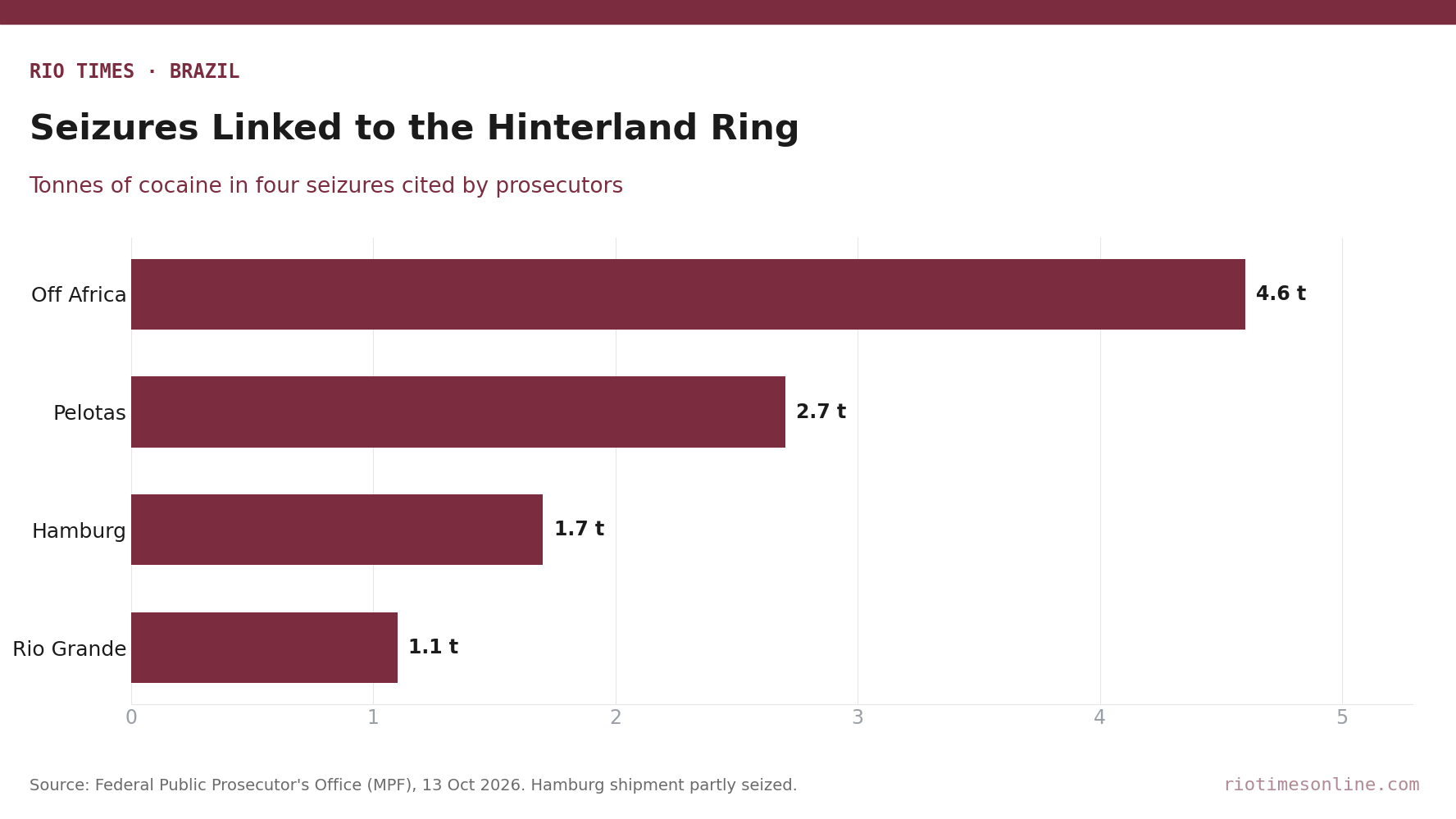
Prosecutors tied the convicted men to four large seizures in Brazil and abroad. The biggest was 4.6 tonnes on a fishing boat intercepted by the French Navy off the coast of Africa.
Another 2.7 tonnes were found in a logistics warehouse in Pelotas, in Rio Grande do Sul, and 1.1 tonnes in tannin cargo at the port of Rio Grande. A 1.7-tonne shipment was partly seized by German police in Hamburg.
What It Means for US Readers
The case shows how cocaine from Colombia, Peru and Bolivia, the Andean region that also supplies the US market, reaches Europe through southern Brazil. For US companies that ship through Brazilian ports, it is a reminder that legal cargo can be used as cover.
Exporters can be victims too, since the investigation began with a company that reported its own contaminated shipment. Checks on freight forwarders, port-service firms and buyers remain the main defence against such abuse.
The ruling also shows Brazil’s federal courts completing a complex cross-border case, with full appeal rights for the defendants. It lands as the Senate weighs tougher anti-gang rules, covered in Brazil Senate Panel Votes on Gang Crackdown.
For wider context, see Brazil Security and Crime Explained 2026 and Who Dominates Brazil, Elites and Regions Explained. Readers in the south can also use our Florianópolis city page, in the same state as the port of Itajaí.
What Is Not Known
The court and prosecutors did not publish the names of those convicted, so their individual roles and sentences are not public. It is also not known where the fugitive is believed to be.
The appeals court has not set a date to hear the eight appeals filed so far. Until the case is final, the defendants keep the presumption of innocence that Brazilian law grants during appeals.
It is unclear how much of the estimated R$3 billion (about US$600 million) has been recovered through the asset forfeiture. Officials have not said whether other members of the network remain under investigation in Brazil or Europe.
Frequently Asked Questions
What did the Brazil cocaine ring do?
Prosecutors say the ring trafficked more than 14 tonnes of cocaine from November 2020 to November 2022, mostly to Europe by sea. It hid the drug in legal cargo and worked with Albanian and Montenegrin mafias.
How long are the sentences?
Prison terms range from five years and seven months to 54 years. Most of the 13 convicted men will start their sentences in a closed regime.
Which court issued the ruling?
A panel of judges at the 22nd Federal Court of Porto Alegre issued the verdict, which was announced on Tuesday 13 October. Eight of the men have appealed to the Federal Regional Court of the 4th Region.
Why does this matter to the United States?
The ring bought cocaine from Colombia, Peru and Bolivia, the Andean region that also supplies the US market. The case also shows how legitimate export cargo can be used to smuggle drugs.
Was anyone acquitted?
A woman charged in the case was acquitted of all charges for lack of evidence. One man was cleared of a single trafficking count but convicted of the other crimes.
Sources: Federal Public Prosecutor’s Office (MPF) · Federal Court of Rio Grande do Sul (JFRS) · g1 RS · CNN Brasil · Central Bank of Brazil PTAX rate
This article was produced by The Rio Times’ automated newsroom system. How we use AI · Report an error · Editorial responsibility: Matthias Camenzind, Editor-in-Chief