Brazil’s Amazonas Declares Fire Emergency in 36 Towns

ENVIRONMENT · BRAZIL
Key Facts
- —The country Brazil, home to about 60% of the Amazon rainforest. Amazonas is its largest state, and Manaus, its capital, is an industrial free-trade hub and the gateway for Amazon tourism.
- —Why it matters Forest fires are spreading in a drought year, and smoke has pushed air quality in a city of about two million people to hazardous levels.
- —Why now The state decree and its federal recognition came on Saturday 10 October, after a public row over who refused whose help.
- —What happened Governor Roberto Cidade declared an emergency in 36 municipalities on 10 October. Brasília recognised it within hours, letting the state request federal funds.
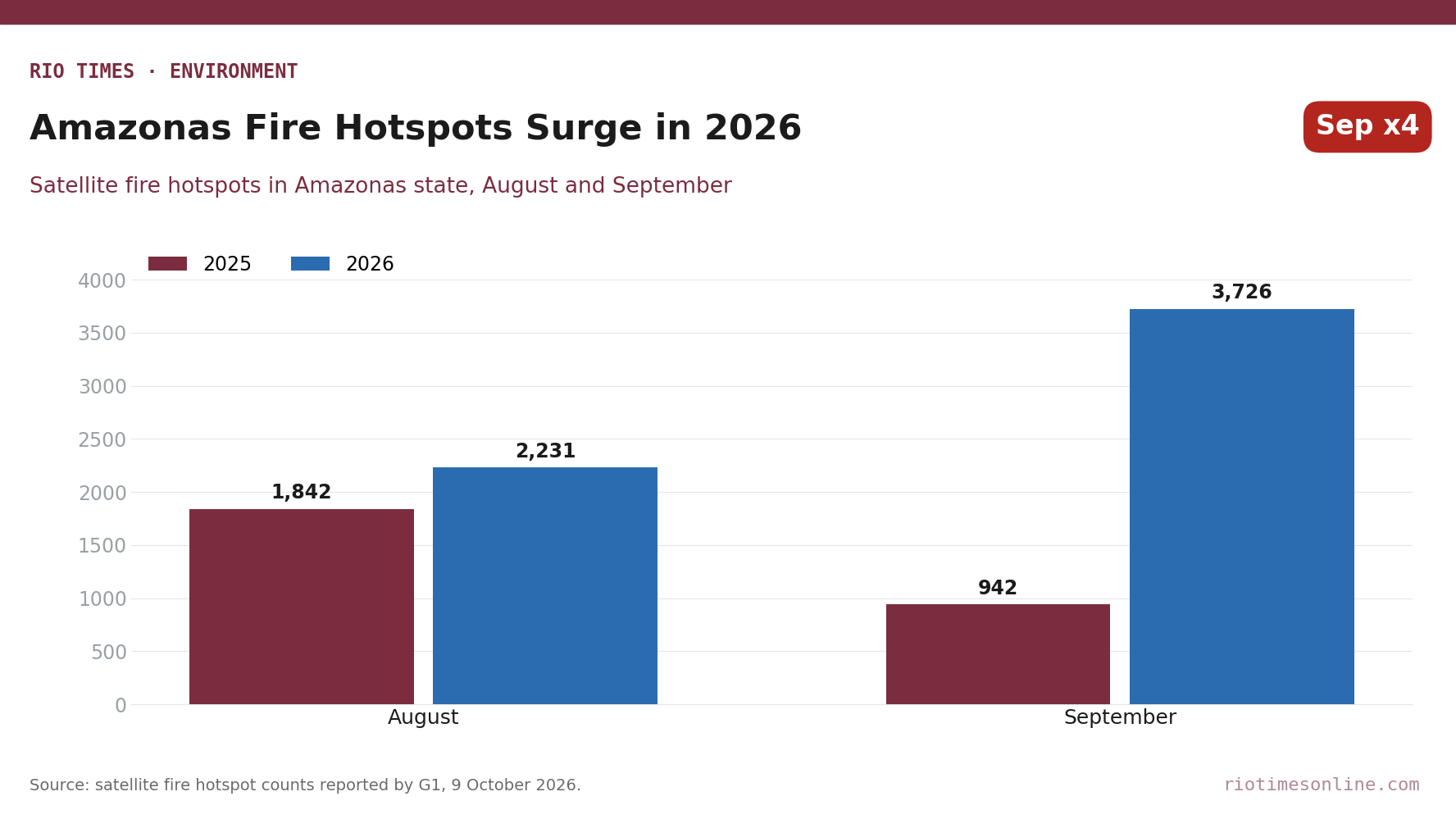
- —The numbers Amazonas logged 3,726 fire hotspots in September, against 942 a year earlier. Fine-particle pollution in Manaus hit 209.1 µg/m³ on Saturday morning.
- —What it means for you Visitors to Manaus should expect smoky mornings, cancelled city events and advice to wear masks outdoors. People with asthma or heart conditions face the highest risk.
- —Still open How fast air tankers can contain the fires, when rain returns, and how much federal money the state will request and receive.
Brazil’s Amazonas state declared an Amazonas fire emergency in 36 municipalities on Saturday 10 October, as smoke from forest fires covered Manaus for a third straight day. The federal government recognised the decree within hours, clearing the way for federal money and aircraft. For foreign visitors, investors and anyone watching the Amazon, the fire season is now a public-health and political issue.
The decree covers Manaus and its metropolitan area, the south of the state and several river towns. Among them are Itacoatiara, Parintins, Tefé, Humaitá and Lábrea, according to the list published by G1.
The Ministry of Integration and Regional Development (MIDR), which runs Brazil’s national civil defence system, said recognition was the step needed to release funds from any federal body.
Smoke Shuts Schools and Events in Manaus
At about 6 a.m. on Saturday, a sensor at the state environment secretariat (Sema) in Manaus recorded 209.1 micrograms of fine particles (PM2.5) per cubic metre. That is more than eight times the 25 µg/m³ level the Selva monitoring network of Amazonas State University (UEA) rates as good.
In Itacoatiara, about 175 km east of the capital, readings reached 2,016.1 µg/m³ that morning. Local civil defence sent a phone alert urging residents to wear masks outdoors, G1 reported.
Manaus closed its municipal schools on Friday 9 October. On Saturday evening the city hall suspended all outdoor events it had planned for Sunday 11 and Monday 12 October. Monday is a national holiday in Brazil.
The suspension covers car-free streets, activities in Cidade da Criança park, on the Glória waterfront and in Gigantes da Floresta park, and the Boi Manaus fair. The city said events would resume once conditions improve.
There was some relief by Saturday night. The municipal civil defence (Sepdec) said the city average fell from 196.4 µg/m³ at 6 a.m. to 46.4 µg/m³ in the evening. Its forecast, however, warns of a new peak of about 169 µg/m³ early on Monday.
Between 1 and 8 October, Manaus recorded 82 urgent-care visits linked to the smoke, G1 reported. Residents describe shortness of breath and coughing.
Why the Fires Are Worse This Year
Amazonas recorded 3,726 fire hotspots in September, almost four times the 942 of September 2025, G1 reported. August closed with 2,231, up from 1,842 a year earlier.
The trigger is drought. Manaus received 44 mm of rain from July to September, against the 202 mm normally expected, according to the national weather institute (Inmet). August had no recorded rain at all.
Luiz Aragão, a researcher at the National Institute for Space Research (Inpe), said most fires start on pasture and already cleared land. With the forest dried out by El Niño, they escape into the trees.
That explains a paradox. Inpe’s Deter alert system flagged 1,295 km² of Amazon forest loss from January to June, the lowest for that period since its series began in 2016. Deforestation is down, but fire is up.
The state banned the use of fire on 9 September. The state audit prosecutors’ office (MPC-AM) has since asked the state audit court to examine whether the government’s response has been effective.
Federal Aircraft Arrive After a Public Row
The federal push followed an open dispute. On Friday, Colonel Orleilso Muniz, commander of the Amazonas Military Fire Brigade, said a request for federal support had been turned down.
The Environment Ministry replied that the state had asked for help in September but stood down a federal team on 30 September, after rain eased the fires. The brigade says the state never refused help.
On Saturday, four Air Tractor water bombers and two helicopters reached Manaus, and 290 federal firefighters were assigned to the state. Two Brazilian Air Force KC-390 transport planes are due on Sunday and should start dropping water on Monday.
The Environment Ministry says 229 fires in Amazonas have been put out since the critical season began, and teams from the federal environmental agency Ibama are fighting 20 more. Environment Minister João Paulo Capobianco, after a Saturday meeting with the governor, played down the row. “We are here to act in an integrated way, to solve the problem,” he said.
Governor Cidade, of the centre-right União Brasil party, thanked the federal team. “These narratives will not help at all,” he said. Integration Minister Waldez Góes promised that “nothing will be lacking”.
Money is already on the table. Under the ProAmazon project, financed by the Amazon Fund, the state was allotted R$45 million (about US$9 million) since 2024 to equip its firefighters. It has drawn R$34.7 million (about US$7 million), leaving about R$10 million (about US$2 million), the MIDR said. Amounts are converted at the Central Bank of Brazil PTAX rate of R$4.9892 per dollar on Friday 9 October.
What It Means for You
Travellers heading to Manaus or Amazon lodges this week should check the daily air-quality bulletins and pack high-filtration face masks. City-run events are off until at least Monday. Children, older people and anyone with asthma or heart disease should limit time outdoors.
For investors, Manaus hosts a large free-trade industrial zone that makes electronics and motorcycles. No disruption to factories or shipping has been reported. The federal-state meetings took place at the zone’s own agency, Suframa.
The Amazonas fire emergency also lands in the final stretch before Brazil’s presidential runoff on 25 October, so expect the fire response to feature in campaigning. For background, see El Niño Splits Latin America Into Winners and Losers and Amazon Drought: Brazil’s Election Court Lines Up Backup Polling Sites Before Sunday.
What Is Not Known
Under the Amazonas fire emergency, it is not known how much federal money the state will now request, or how quickly it will arrive. Before the decree, the Environment Ministry said the state had not yet filed a formal request through the national civil defence system.
The ministry has not said where the 20 active fires fought by Ibama are concentrated. Nor is there a firm forecast for the return of steady rain.
Federal and state officials were due to fly over the worst-hit areas on Sunday and agree on immediate measures in the afternoon.
Frequently Asked Questions
What does the Amazonas fire emergency cover?
Governor Roberto Cidade declared an emergency in 36 municipalities, including Manaus, on 10 October. Federal recognition the same day lets the state request federal funds.
Is it safe to travel to Manaus now?
The city is open, but smoke has pushed air quality to hazardous levels on several mornings. Visitors should check daily bulletins, wear masks outdoors and limit exertion.
Why are there more fires in 2026?
A severe drought linked to El Niño has dried the forest. Fires lit on pasture now escape into the trees, even though deforestation alerts are at their lowest since 2016.
Sources: Ministry of Integration and Regional Development (MIDR), Suframa, Agência Brasil (Environment Ministry data), G1 on the emergency decree, G1 on suspended events, G1 on air quality, G1 on fire hotspots, G1 on the aid dispute, G1 on the Manaus meeting, Central Bank of Brazil PTAX rate.
Editorial responsibility: Matthias Camenzind, Editor-in-Chief · Editorial standards · Report an error