
ECONOMY · BOTSWANA
Key Facts
- —The country Botswana is a landlocked southern African country whose economy depends heavily on diamond exports.
- —Why it matters Foreign reserves back the pula, pay for imports and show how well the diamond economy is weathering a weak market.
- —Why now Central bank data released this week show reserves at their highest level since July 2024.
- —What happened Reserves rose to 63.2 billion pula (about US$4.4 billion) at the end of July, up 6.9% from June.
- —The numbers Reserves were 32.2% higher than a year earlier in pula and 25.9% higher in dollars. Import cover reached 7.3 months in the first quarter.
- —What it means for you A bigger buffer supports the pula and Botswana’s investment-grade rating, which matters to US investors and diamond buyers.
- —Still open How much of the rise came from diamond sales, customs receipts or government borrowing is not yet clear.
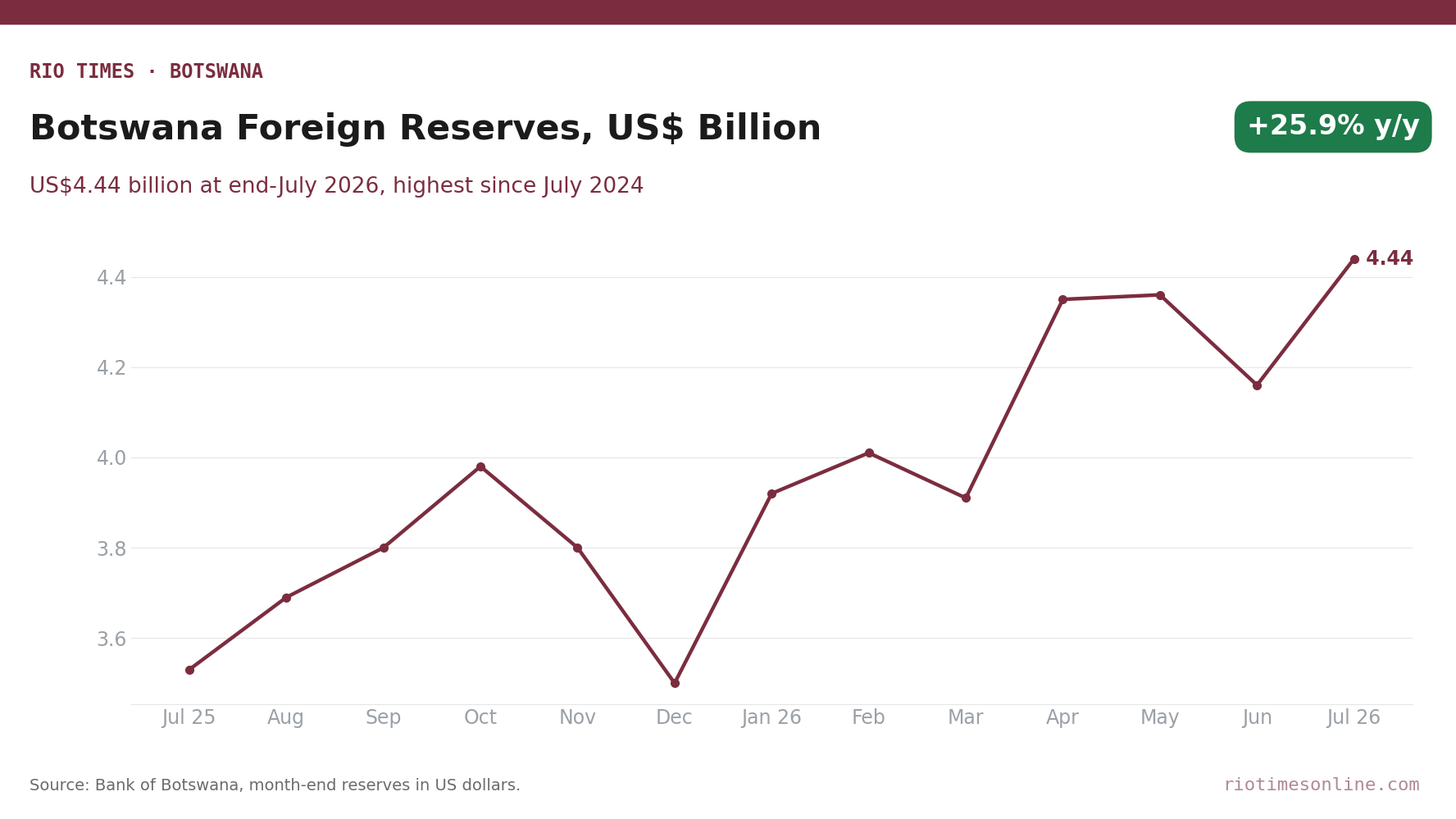
Botswana foreign reserves rose to 63.2 billion pula (about US$4.4 billion) at the end of July, the highest level since July 2024. The Bank of Botswana, the country’s central bank, released the July figure this week, the Gaborone daily Mmegi reported.
The reserves back the pula and pay for imports in an economy that relies on diamonds for most of its export earnings. For US investors, a thicker buffer lowers the risk of a currency shock and supports Botswana’s investment-grade rating.
Why Botswana Foreign Reserves Are Rising
The July total was 6.9% higher than June’s 59.1 billion pula (about US$4.2 billion), Bank of Botswana data show. It was also 32.2% above the 47.8 billion pula (about US$3.5 billion) held in July 2025.
In dollar terms, the central bank valued the reserves at US$4.44 billion, up 25.9% from a year earlier. The dollar values are the bank’s own month-end figures; its official rate on Wednesday 14 October was US$0.0747 per pula.
Mmegi also reported that the increase sat within the transaction balances tranche. That is the part of the central bank’s liquidity portfolio used to meet short-term needs for foreign currency.
The newspaper said the higher reserves could be linked to hard-currency loans taken on by the government. It added that published Finance Ministry details suggest those funds arrived in the months before July.
The central bank’s quarterly external sector bulletin, published in September, points to broader drivers. It credits Southern African Customs Union receipts, diamond dividends and royalties, and gains from price and exchange-rate movements.
The customs union shares revenue among Botswana, Eswatini, Lesotho, Namibia and South Africa. In the first quarter, reserves rose 20.7% from a year earlier to 55.9 billion pula (about US$3.9 billion), the bulletin showed.
A Recovery From a Deep Fall
The rebound follows a long decline during weak years for diamond output. Reserves stood at 70.2 billion pula (about US$5.4 billion) in July 2023, then fell to 45.0 billion pula (about US$3.4 billion) by June 2025.
Import cover, the months of imports the reserves could pay for, reached 7.3 months in the first quarter, up from 6.1 months. That is well above the three-month threshold set by the Southern African Development Community, the regional bloc.
Reserves equalled 76.5% of gross domestic product at the end of March, up from 71.5% a year earlier. Moody’s, the ratings agency, cut Botswana one notch to Baa2 on 25 September but raised its outlook to stable.
The central bank said the rating stays firmly in investment grade and above the one assigned by S&P Global Ratings. In its statement, the bank said Moody’s pointed to fiscal reforms and a likely recovery in diamond production.
The Risks Behind the Buffer
Inflation remains the main domestic worry. Headline inflation was 9.3% in August, central bank data show, well above the bank’s objective range of 3% to 6%.
The Monetary Policy Committee held its policy rate at 5.5% on 27 August and expects inflation above target until the first quarter of 2027. It blamed fuel prices, higher electricity tariffs and other supply-side pressures.
Growth is still weak. The economy expanded just 0.2% in the twelve months to March 2026, after shrinking 1.6% a year earlier.
The Finance Ministry projects growth of 3.1% in 2026, helped by a mining recovery. The central bank warned that slow progress on economic transformation could leave growth below that forecast.
The pula follows a crawling peg against a basket split equally between the South African rand and the IMF’s Special Drawing Rights. After its mid-year review, the central bank kept those weights and a downward crawl of 2.76% a year.
Earlier coverage is in Moody’s Cuts Botswana Rating as Diamonds Slump and Botswana Diamond Production Rises After Two Lost Years. For background, see Botswana Explained: Diamonds, Stability, the Economy and What to Watch, Botswana and Its Neighbours in Southern Africa and the Gaborone city guide.
What It Means for US Readers
For American investors in Botswana’s bonds or listed companies, larger reserves reduce the risk of a disorderly fall in the pula. They also give the government more room while diamond revenue recovers.
Botswana relies on diamonds for most of its export earnings, so jewellery demand in markets such as the United States matters directly. Weaker demand abroad would slow the rebuilding of the reserves.
The next test is the Monetary Policy Committee meeting on 29 October, according to the central bank’s calendar. Investors will watch whether slightly lower inflation lets the bank ease its 5.5% policy rate.
What Is Not Known
It is not known how much of the July increase came from diamond sales, customs union payments or government borrowing. The central bank’s monthly totals show the level of reserves, not where the inflows came from.
Figures for August and September have not yet been published. Whether the rebound lasts depends on diamond sales and on the government’s borrowing plans.
Frequently Asked Questions
How large are Botswana foreign reserves now?
The Bank of Botswana put reserves at 63.2 billion pula (about US$4.4 billion) at the end of July 2026. That was the highest level since July 2024.
Why did the reserves rise?
The central bank’s latest bulletin credits customs union receipts, diamond dividends and royalties, and valuation gains. Mmegi reported that the July increase sat in the liquidity portfolio’s transaction balances.
How many months of imports do the reserves cover?
Import cover reached 7.3 months in the first quarter of 2026, up from 6.1 months a year earlier. That is well above the three-month regional benchmark.
Is Botswana still investment grade?
Yes, Moody’s rates Botswana Baa2 after a one-notch cut on 25 September, with a stable outlook. The central bank said the rating is above the one assigned by S&P Global Ratings.
What is inflation in Botswana?
Headline inflation was 9.3% in August 2026, above the central bank’s objective range of 3% to 6%. The bank expects it to stay above that range until the first quarter of 2027.
Sources: Bank of Botswana, foreign exchange reserves July 2026, inflation and policy rate; Bank of Botswana, Economic and Financial Statistics, August 2026 (table 6.7); Bank of Botswana, External Sector Statistics Bulletin, September 2026; Bank of Botswana, Monetary Policy Committee decision, 27 August 2026; Bank of Botswana, statement on Moody’s rating, 25 September 2026; Bank of Botswana, exchange rates, 14 October 2026; Mmegi, Foreign reserves hit 23-month high, 14 October 2026.
Editorial responsibility: Matthias Camenzind, Editor-in-Chief · Editorial standards · Report an error
Part of our ongoing coverage
Africa: The New Scramble — the great-power contest over the continent.