Bolivia Keeps Petrol Subsidy Until January Review

ECONOMY · BOLIVIA
Key Facts
- —The country Bolivia, a landlocked Andean nation of about 11 million people, short of dollars and fuel, now under a 36-month IMF programme.
- —Why it matters Fuel subsidies are the most sensitive part of the IMF deal. The diesel subsidy has already gone; petrol, power and gas reach nearly every household.
- —Why now Reports this week said the IMF plan aligns pump prices with world prices in early 2027, raising fears of wider cuts.
- —What happened On Friday 9 October, Economy Minister Christian Morales said the IMF deal covers only motor fuels, not electricity or gas, and petrol stays subsidised in 2026.
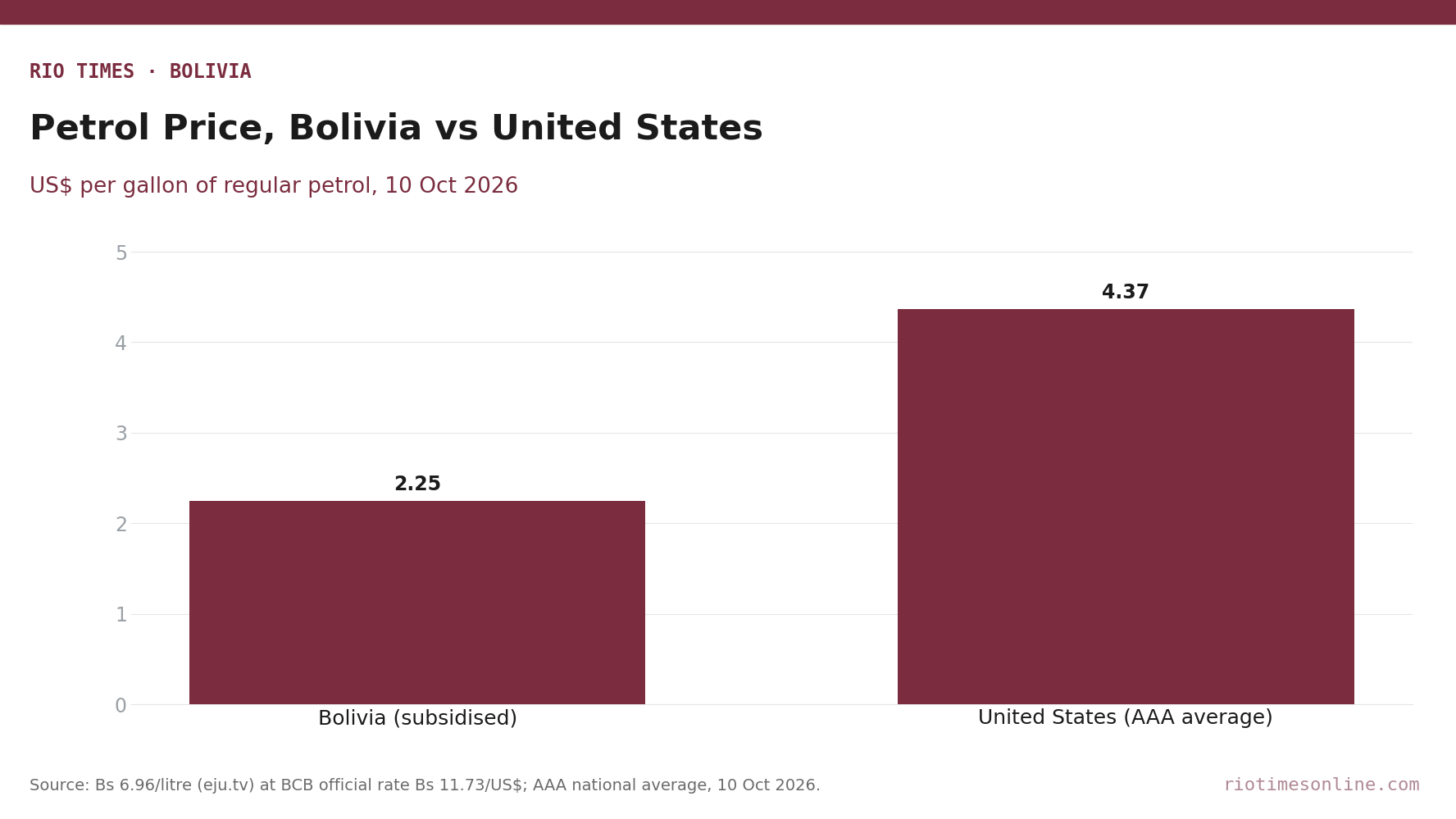
- —The numbers Subsidised petrol costs about US$2.25 a gallon, against a US average of US$4.37 (AAA, 10 October).
- —What it means for you Visitors and residents keep cheap petrol and current power and gas tariffs for now; the next decision point is a review in January.
- —Still open How fast petrol prices rise in 2027, and how much cash support poorer households and transport operators will get.
Bolivia will remove its fuel subsidy only for motor fuels and will not touch electricity or gas under its deal with the International Monetary Fund (IMF), Economy Minister Christian Morales said on Friday 9 October. He also ruled out lifting the Bolivia fuel subsidy on petrol (gasoline) for the rest of 2026. For US investors holding Bolivian bonds, the message is that the IMF programme stands, while the government tries to limit street protests.
Morales, who runs the Ministry of Economy and Public Finance under President Rodrigo Paz, spoke on the Red Uno programme Que No Me Pierda. He was asked directly whether power and gas subsidies could follow petrol and diesel.
“No. It is an issue that is not contemplated in the agreement; it is not an issue we will move on during the next administrative year,” he said, according to Red Uno. The outlet eju.tv reported the same remarks on Saturday.
What the Minister Said
Morales confirmed that the IMF agreement foresees the full removal of subsidies on motor fuels. “The agreement with the Monetary Fund establishes the lifting of the complete fuel subsidy,” he said.
He said the process began early with diesel, whose subsidy has already gone. Petrol is part of the deal too, but its timing depends on the economy, public finances and world oil prices.
“In this current year we do not plan to lift the gasoline subsidy,” Morales said. He added that a decree in force sets an evaluation date in January 2027, but he would not say that prices will rise on that day. “What is appropriate is precisely to carry out an evaluation on that date,” he said.
On electricity, Morales said the government is working on a change in the country’s energy mix to cut what it spends on power generation. He described this as a separate policy, not part of the IMF deal.
The IMF Executive Board approved Bolivia’s 36-month Extended Fund Facility arrangement on Friday 2 October, according to the Fund. According to eju.tv, the IMF foresees full alignment of retail fuel prices with international prices in early 2027. Our earlier report, Bolivia IMF Deal Sets Path to World Fuel Prices, covered that plan.
How Cheap Bolivian Fuel Is
The government raised petrol to Bs 6.96 a litre (about US$0.59) in December 2025, according to eju.tv. That is roughly US$2.25 a gallon at the central bank’s official rate of 11.73 bolivianos per US dollar, valid for 10 to 12 October.
The AAA national average for regular petrol in the United States was US$4.37 a gallon on 10 October. The comparison is not exact, because US prices include taxes, but it shows the size of the gap the subsidy covers.
Diesel is already sold without a subsidy, the minister said. The earlier diesel step and its effect on queues are covered in Bolivia Diesel Subsidy Ends: Price Rises 83% as Fuel Queues Shrink.
What It Means for You
For travellers and foreign residents, the practical change is small for now. Petrol prices should stay where they are until at least the January review, and household power and gas bills are not part of the IMF deal.
For investors, the statement narrows the political risk. A cut to electricity or cooking gas would hit almost every household at once. Limiting the reform to motor fuels makes the programme easier to defend, though the petrol step in 2027 remains the hardest one.
The government says it will protect poorer groups. Morales cited cash transfers, including the PEPE bonus paid after the diesel increase, according to Red Uno. He also mentioned a trust fund of Bs 800 million (about US$68 million) to help producers and transport operators get credit.
“We are not going to leave the most vulnerable sectors aside,” he said. The government plans talks with economic groups in the coming months to decide how to handle petrol in 2027.
What Is Not Known
We could not open the IMF programme document itself. The early-2027 price target rests on Bolivian media reports of its contents, and the minister’s account of what it excludes has not been published by the Fund.
It is not known how large the first petrol increase will be, or whether it will come in one step or several. Morales said world prices and public finances could change the plan, and that some decisions may need to be reviewed with the IMF.
The size and timing of any new cash transfers for 2027 have not been set. The minister gave no figure for how much the petrol subsidy costs the state each year.
The Bolivia fuel subsidy debate will return before January. For now, the government has drawn a clear line: motor fuels change, power and gas do not.
Frequently Asked Questions
Is Bolivia removing subsidies on electricity and gas?
No. Economy Minister Christian Morales said on 9 October that the IMF agreement does not include power or gas subsidies, and that the government will not move on them next year.
When will petrol prices rise in Bolivia?
Not in 2026, according to the minister. A decree sets an evaluation in January 2027, but he did not commit to a price rise on that date.
How much does petrol cost in Bolivia?
The subsidised price is about US$0.59 a litre, or roughly US$2.25 a gallon, compared with a US average of about US$4.37 a gallon on 10 October.
Sources: Red Uno · eju.tv · Banco Central de Bolivia (official exchange rate) · AAA national average gas prices
This article was produced by The Rio Times’ automated newsroom system. How we use AI · Report an error · Editorial responsibility: Matthias Camenzind, Editor-in-Chief
In depth
LatAm Markets: Live Signals → — real-time movers, turnover leaders and FX across Latin America.