Argentina Merval Falls 2.2% as Country Risk Breaks 500 Points Amid IMF Payment and Global Selloff
Argentine financial markets retreated sharply on Tuesday as a perfect storm of external pressures and domestic concerns pushed the S&P Merval index down 2.2% while country risk climbed back above the psychologically important 500-point threshold.
The selloff came as investors digested news of an $880 million payment to the International Monetary Fund and growing uncertainty surrounding proposed changes to inflation measurement methodology at INDEC, the national statistics agency.
Key Market Data
| Indicator | Value | Change |
|---|---|---|
| S&P Merval Index | 3,038,541 pts | -2.2% |
| Merval (USD) | 2,030 pts | -3.4% |
| Country Risk (EMBI) | 503 bps | +10 pts |
| Dollar Official (BNA) | $1,470 / $1,420 | Stable |
| Dollar Blue | $1,450 / $1,430 | -$25 |
| Dollar MEP | $1,453 | -1.5% YTD |
| Dollar CCL | $1,494 | +0.7% |
| Dollar Mayorista | $1,444 | Stable |
Performance Analysis
The Buenos Aires stock exchange experienced its steepest single-day decline in early February as a combination of external headwinds and local policy uncertainty weighed on sentiment.
The S&P Merval closed at approximately 3,030,000 points in pesos, extending February’s accumulated losses to roughly 5%.
In dollar-adjusted terms, using the contado con liquidación rate, the benchmark retreated 3.4% to 2,030 points, aligning with the broader weakness observed across emerging market equities.
The session proved particularly brutal for Argentine ADRs trading in New York, where biotechnology firm Bioceres collapsed 33% to just 57 cents per share, while technology unicorn Globant plunged 13%.

Vista Energy, one of the market’s preferred plays on Vaca Muerta’s shale potential, dropped 7% following reports that Abu Dhabi Investment Council was divesting a stake worth up to $625 million.
Despite these dramatic moves, the banking sector showed relative resilience, continuing a rotation trend that began in January as investors sought refuge from commodity-exposed names.
The exchange rate picture offered some consolation to peso-denominated investors. The parallel “blue” dollar actually declined $25 to $1,450, pushing the gap with the official wholesale rate into marginally negative territory—a phenomenon not witnessed with such consistency in years.
This remarkable convergence reflects growing confidence in the government’s floating band exchange regime, which now adjusts monthly according to the latest inflation reading published by INDEC.
Live Market IntelligenceArgentina — Live Market Board
Rio Times · Live Market Intelligence
Argentina — Live Market Board
+0.00%
204,302.33
-0.74%
64,653.33
-1.01%
10,999.64
-1.47%
2,824,123
+0.00%
2,534.92
-2.09%
60,766.81
-1.71%
| Instrument | Last | Change | YoY | Prev. | High | Low | Volume |
|---|---|---|---|---|---|---|---|
| MERVAL | 2,824,123 | +0.00% | +30.51% | 3,022,485 | 3,042,365 | 2,991,150 | — |
| USD/ARS | 1,493 | +0.10% | +12.96% | 1,491 | 1,494 | 1,480 | — |
| YPF | 7,810 | +0.26% | +72.84% | 7,790 | 7,850 | 7,600 | 1,763,858 |
| GGAL | 6,980 | -0.78% | +1.82% | 7,035 | 7,115 | 6,920 | 1,564,062 |
| PAMPA | 5,115 | +0.69% | +26.70% | 5,080 | 5,140 | 5,000 | 721,190 |
| TXAR | 747.50 | -2.35% | +18.67% | 765.50 | 770.00 | 742.50 | 771,892 |
| ALUAR | 938.00 | -1.21% | +29.83% | 949.50 | 951.00 | 932.50 | 135,426 |
| TGS | 8,870 | -0.17% | +15.05% | 8,885 | 9,075 | 8,720 | 143,546 |
| CEPU | 2,156 | +1.84% | +28.36% | 2,117 | 2,165 | 2,086 | 404,146 |
| MIRGOR | 1,650 | -1.20% | -92.90% | 1,670 | 1,670 | 1,635 | 20,877 |
| COME | 40.93 | -0.73% | -30.47% | 41.23 | 41.60 | 40.50 | 4,258,884 |
| LOMA NEGRA | 3,130 | +0.08% | +5.80% | 3,128 | 3,205 | 3,090 | 182,992 |
| BYMA | 275.00 | -1.70% | +35.14% | 279.75 | 282.50 | 272.00 | 1,409,575 |
| TELECOM ARG | 4,233 | -0.70% | +55.19% | 4,263 | 4,335 | 4,160 | 31,896 |
| GLOBANT | 38.10 | -2.26% | -49.65% | 38.98 | 38.70 | 36.77 | 793,552 |
| MERCADOLIBRE | 1,870 | -3.59% | -20.71% | 1,940 | 1,927 | 1,870 | 329,640 |
Key Drivers
Several interconnected factors drove Tuesday’s market correction. First and foremost, the global technology rout emanating from Wall Street spilled into Latin American markets with particular force, punishing growth-oriented names and triggering broad-based risk aversion.
The selloff coincided with mounting concerns about stretched valuations in the artificial intelligence sector following disappointing forward guidance from several major U.S. tech companies.
On the domestic front, Economy Minister Luis Caputo confirmed via social media that Argentina had completed its first significant debt payment of 2026 to the IMF, transferring approximately $880 million in Special Drawing Rights to meet interest obligations.
While the payment itself was anticipated, it served as a reminder that Argentina faces total IMF maturities of some $4.7 billion throughout the year.
The minister emphasized that the transaction involved purchasing SDRs from the United States Treasury rather than a direct dollar transfer, though skeptics noted this distinction offers little practical difference.
The petroleum sector bore the brunt of external commodity weakness, with global crude prices continuing to slide on demand concerns from China and an oversupplied market.
This exogenous shock hit Argentine energy producers hard despite strong operational fundamentals at Vaca Muerta.
Meanwhile, utility stocks experienced profit-taking after their stellar performance in the final months of 2025, when regulatory improvements and tariff normalization attracted substantial inflows.
Technical Outlook
| Indicator | Support | Resistance | Signal |
|---|---|---|---|
| S&P Merval | 2,866,730 | 3,195,428 (ATH) | Consolidation |
| USD/ARS Official | 1,438 | 1,447 | Range-bound |
| Country Risk | 450 bps | 550 bps | Testing resistance |
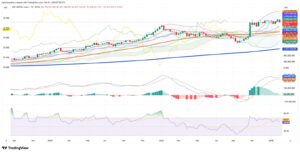
From a technical perspective, the Merval index remains in a broad consolidation phase after reaching all-time highs near 3,195,428 points in mid-December 2025.
The current pullback finds initial support around the 3,013,000 level, with stronger backing near 2,866,730 points where the 50-day moving average converges with previous reaction lows.
The RSI has retreated from overbought territory toward neutral readings near 47-54, suggesting the index could find footing for a renewed push higher should fundamental catalysts align.
For the exchange rate, the official dollar trades comfortably within the BCRA’s floating band, with the wholesale rate anchored near $1,444.
The central bank’s commitment to accumulating reserves while allowing monthly band adjustments tied to inflation has anchored expectations. Key technical resistance sits at $1,447 while support clusters around $1,438-1,440.
Analyst Perspectives
Roberto Geretto, analyst at Adcap Grupo Financiero, highlighted two factors supporting Argentine assets despite Tuesday’s weakness: “The issuance of debt by Ecuador and appreciation of emerging market currencies are two factors that help the local market.
The first aids country risk compression, as Ecuador represents a comparable sovereign to Argentina. Meanwhile, the latter supports the real multilateral exchange rate.”
Gustavo Ber, economist at Estudio Ber, provided context for the broader correction: “Despite balance sheets delivering positive readings—like Palantir’s—as well as a rebound in precious metals, Wall Street continues leaning toward a pause, seeking to consolidate the important levels reached that once again pushed indices to record highs.”
Looking Ahead
Market participants will focus on several key dates in February. The BCRA continues its pre-announced reserve accumulation program, having added approximately $700 million since January 5.
Fourth-quarter 2025 earnings season for local corporates begins later this month, with banking sector results expected to show material improvement in credit growth and net interest margins.
Additionally, investors await clarity on the government’s legislative agenda, including proposed labor and fiscal reforms that could significantly impact medium-term economic expectations.
Argentina’s country risk, while back above 500 basis points, remains dramatically compressed from the 1,456-point peak registered in September 2025, when electoral uncertainty peaked before the legislative elections that consolidated President Milei’s political position.
Markets will closely monitor whether the Merval can defend the 3,000,000 psychological level while watching for stabilization in global risk appetite that could reignite the rally toward record highs.
This is part of The Rio Times’ daily coverage of Argentine markets and Latin American financial news.
For regional context, see the Brazil’s Ibovespa report for the same date: Brazil’s Ibovespa.
For regional context, see the Mexico’s IPC report for the same date: Mexico’s IPC.
Key Facts
— Deep Dive
— For the complete picture, read our in-depth guide: Latin America Stock Markets 2026: Ibovespa, Merval, COLCAP, IPSA and IPC Guide
This article was produced by The Rio Times’ automated newsroom system. How we use AI · Report an error · Editorial responsibility: Matthias Camenzind, Editor-in-Chief
In depth
Read More from The Rio Times