Colombia Markets Retreat as BanRep Rate Hike Shakes Peso and COLCAP
Colombia’s financial markets navigated heightened volatility this week following Banco de la República’s unexpected decision to raise interest rates by 100 basis points to 10.25%, the first hike since May 2025.
The COLCAP index retreated from recent highs while the Colombian peso extended its remarkable appreciation trend against the dollar, creating a complex environment for investors balancing inflation concerns with equity valuations.
Key Market Data
| Indicator | Current Value | Weekly Change | YTD Change |
|---|---|---|---|
| COLCAP Index | 2,436.73 | -1.54% | +17.6% |
| USD/COP Rate | 3,630.00 | -1.25%* | -3.97%* |
| BanRep Policy Rate | 10.25% | +100 bps | +100 bps |
| Inflation (Dec 2025) | 5.1% | — | — |
*Negative USD/COP change indicates peso appreciation
Performance Analysis
The COLCAP index closed Tuesday’s session at 2,436.73 points, posting a modest daily gain of 0.59% but recording a weekly decline of 1.54% as investors digested the implications of the central bank’s hawkish pivot.
The benchmark Colombian equity index has pulled back from its all-time high above 2,470 reached in late January, though it remains firmly in positive territory for 2026 with gains exceeding 17% year-to-date following an exceptional 2025 that saw the index surge more than 50%.

Trading activity has remained robust, with financial sector heavyweights Bancolombia and Davivienda experiencing profit-taking alongside energy giant Ecopetrol, which faces its extraordinary shareholders’ meeting on February 5 to elect new board directors.
ISA and Grupo Energía Bogotá provided relative stability within the utilities space, benefiting from their regulated revenue streams in an environment of rising interest rates.
The Colombian peso demonstrated continued strength, trading near 3,630 per dollar after touching a multi-month low of 3,591.64 in late January.
The currency has appreciated nearly 13% over the past twelve months, making it one of the best-performing emerging market currencies globally despite persistent fiscal concerns and political uncertainty ahead of the May 2026 presidential elections.
Live Market IntelligenceColombia — Live Market Board
Rio Times · Live Market Intelligence
Colombia — Live Market Board
+0.46%
206,505.98
-0.18%
66,790.35
-0.26%
10,940.53
-0.23%
2,835,843
+0.00%
2,582.29
+0.46%
60,511.74
-1.60%
| Instrument | Last | Change | YoY | Prev. | High | Low | Volume |
|---|---|---|---|---|---|---|---|
| COLCAP | 2,582.29 | +0.46% | — | 9.04 | 9.05 | 9.02 | 4,133 |
| USD/COP | 3,140 | +0.03% | -22.04% | 3,139 | 3,141 | 3,105 | — |
| BRENT | 88.88 | -0.03% | +34.42% | 88.91 | 90.07 | 88.12 | 29,713 |
| WTI | 83.11 | -0.11% | +31.57% | 83.20 | 84.35 | 82.40 | 166,848 |
| ECOPETROL | 16.92 | -0.53% | +98.01% | 17.01 | 17.05 | 16.79 | 737,591 |
| BANCOLOMBIA | 95.87 | -2.18% | +96.15% | 98.01 | 100.36 | 95.73 | 188,740 |
| GRUPO AVAL | 5.40 | +2.66% | +76.89% | 5.26 | 5.49 | 5.32 | 146,447 |
| TECNOGLASS | 42.30 | -1.10% | -48.04% | 42.77 | 42.73 | 42.05 | 60,908 |
| CREDICORP | 375.17 | -0.49% | +49.60% | 377.00 | 384.43 | 372.27 | 88,375 |
| BUENAVENTURA | 34.45 | -1.02% | +88.07% | 34.80 | 35.62 | 34.33 | 275,831 |
| SOUTHERN COPPER | 193.97 | -0.26% | +104.01% | 194.48 | 199.36 | 192.59 | 367,102 |
Key Drivers
The dominant catalyst reshaping Colombia’s financial landscape was the January 30 decision by Banco de la República’s board to raise the benchmark interest rate by 100 basis points to 10.25%, a move that caught markets off guard.
The decision reflected growing concerns over inflation expectations, which jumped to 6.4% for end-2026 according to analyst surveys, well above the central bank’s 3% target.
Core inflation rose to 5.02% in December, underscoring the persistent price pressures despite headline inflation edging down to 5.1%.
External factors continue to influence Colombian markets significantly. Global trade tensions and uncertainty surrounding U.S. policy under the new administration have elevated risk premiums across emerging markets, though Colombia’s high real interest rates have attracted carry trade flows that support the peso.
Oil prices hovering near $62 per barrel provide a floor for Ecopetrol‘s earnings outlook and the country’s export revenues, though they remain below levels that would meaningfully boost fiscal coffers.
Domestically, President Gustavo Petro’s December announcement of a 22.7% minimum wage increase—the largest in decades—raised concerns about potential wage-price spirals that could complicate the central bank’s inflation-fighting mandate.
New fuel taxes taking effect January 1, including a 10% VAT on gasoline and diesel, have added to cost-of-living pressures that the central bank cited in justifying its aggressive rate action.
Technical Outlook
| Asset | Support Level | Resistance Level | RSI (Daily) | Trend Signal |
|---|---|---|---|---|
| COLCAP | 2,395 | 2,475 | 81.08 | Overbought |
| USD/COP | 3,596 | 3,695 | 45.50 | Neutral-Bearish |
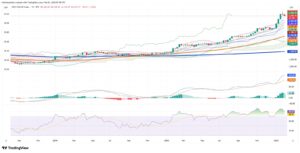
From a technical perspective, the COLCAP index is flashing overbought signals with its Relative Strength Index reading above 80 on both daily and weekly timeframes.
The index remains well above its 200-day moving average near 2,050, suggesting the primary uptrend remains intact despite near-term consolidation.
Immediate support sits at 2,395, coinciding with the lower Bollinger Band, while resistance clusters around the recent highs near 2,475. A deeper correction toward the 2,300 level would represent a healthy pullback within the broader bullish structure.
The USD/COP pair is exhibiting bearish momentum for the dollar, with the rate trading below all major moving averages.
The RSI near 45 on the daily chart suggests room for further peso appreciation, though the weekly RSI at 35 indicates the move is approaching oversold territory for the dollar.
Key support for USD/COP lies at 3,596, the year-to-date low, while resistance emerges at 3,695, the recent swing high from late January.
Analyst Perspectives
Felipe Campos, Director of Research at Alianza Valores, noted that “the central bank’s decision to raise rates surprised the market, but it signals a commitment to anchoring inflation expectations that should ultimately support both the peso and equity valuations once the initial shock is absorbed.”
He added that the financial sector stands to benefit from wider net interest margins, though higher rates could weigh on consumer lending growth.
Meanwhile, strategists at SURA Investments maintained a constructive outlook for 2026, highlighting that “despite overbought technical conditions, Colombian equities offer attractive valuations relative to historical norms, with the financial, energy, and consumer sectors presenting tactical opportunities as corporate earnings continue to recover.”
Looking Ahead
Key events on the horizon include Ecopetrol’s extraordinary shareholders’ meeting on February 5, which will determine board composition for the 2025-2029 term amid ongoing debates over the company’s energy transition strategy.
The company is expected to release fourth-quarter 2025 earnings in early March, providing clarity on capital allocation plans targeting investments of COP 22-27 trillion for 2026.
Investors will closely monitor January inflation data, due mid-February, for signs that the central bank’s hawkish stance is beginning to temper price pressures.
The next monetary policy meeting is scheduled for late March, where the board will assess whether additional rate increases are warranted.
Political developments will also command attention as campaign activity intensifies ahead of the May 31 presidential election, with economic policy remaining a central theme for voters navigating elevated living costs.
Colombia’s markets face a pivotal quarter as policymakers balance inflation containment against growth sustainability, with the peso’s strength and equity consolidation reflecting investors’ cautious optimism tempered by fiscal and political uncertainties.
This is part of The Rio Times’ daily coverage of Colombian markets and Latin American financial news.
For context on regional markets, see Brazil’s Ibovespa for the same session.
Also tracking regional peers: Chile’s IPSA closed the same session.
Key Facts
— Deep Dive
— For the complete picture, read our in-depth guide: Latin America Stock Markets 2026: Ibovespa, Merval, COLCAP, IPSA and IPC Guide
This article was produced by The Rio Times’ automated newsroom system. How we use AI · Report an error · Editorial responsibility: Matthias Camenzind, Editor-in-Chief
In depth
Read More from The Rio Times