Argentina Markets: Merval & the Peso — August 6, 2026
Key Facts
- The S&P Merval, Argentina’s main stock index, fell 1.02% to close at 3,156,332 points as traders booked profits on the recent rally.
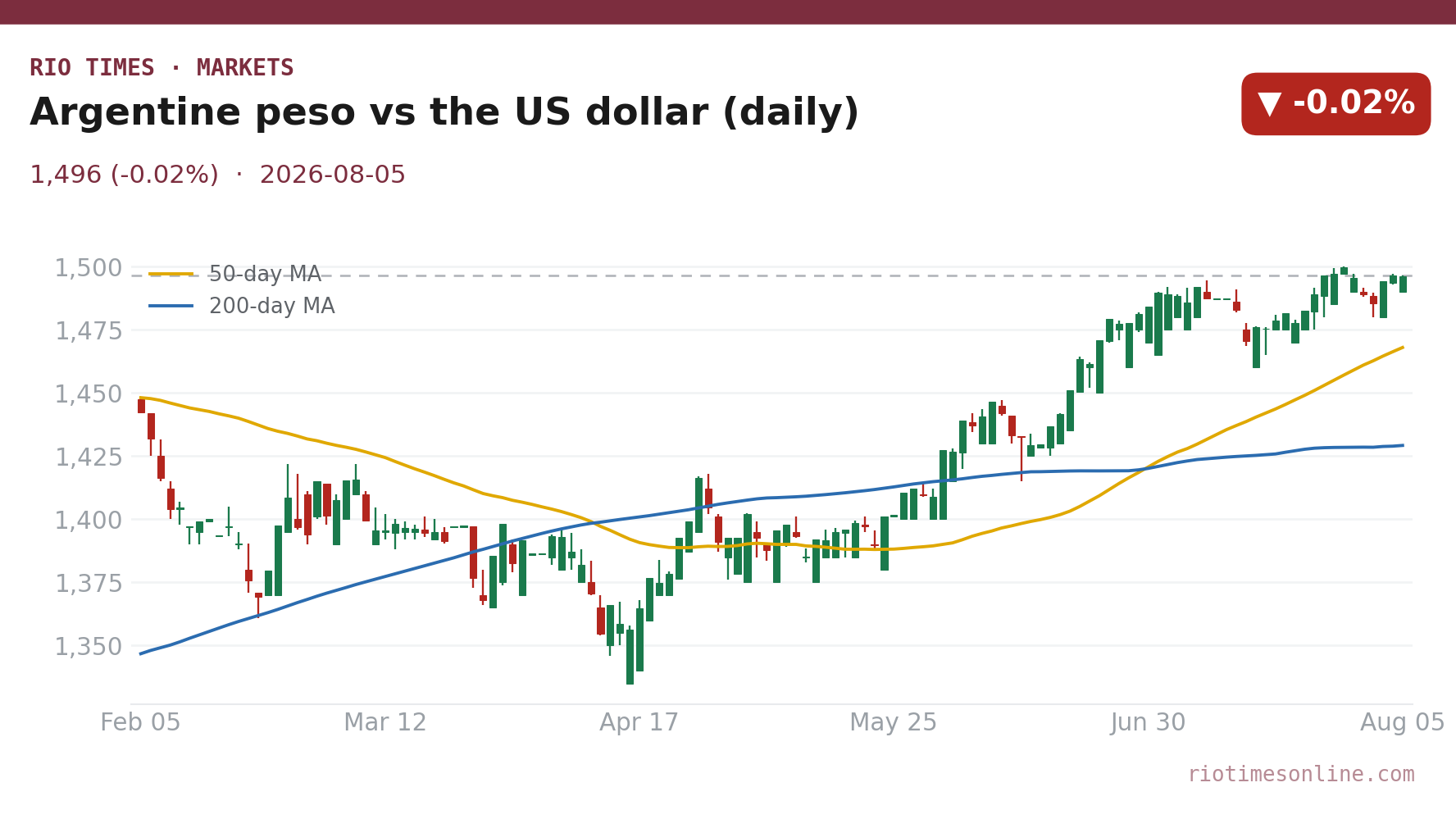
- The peso, trading as the USD/ARS exchange rate, was nearly flat at 1,496 per dollar, a whisper from the pair’s 52-week high of 1,500 — the peso’s weakest level in a year.
- Energy giant YPF was among the day’s heaviest blue-chip decliners, falling 2.0% with heavy turnover of US$12 million, making it the session’s most-traded domestic name.
- Banking heavyweight Grupo Galicia lost 1.3% on US$9 million in volume, reflecting a breather in the financial-reform trade.
- The session’s mood was one of cautious consolidation, with the Merval still hovering near multi-year highs despite the day’s dip.
Today’s Focus
Argentina’s stock market took a breather on Wednesday. The S&P Merval index slipped 1.02% to 3,156,332 points, easing back after a powerful rally driven by President Javier Milei’s free-market overhaul. Traders locked in profits on the very banks and energy companies that have come to symbolise the country’s reform trade.
The Argentine peso barely budged, with the official USD/ARS rate finishing at 1,496, just a whisper from the pair’s 52-week high of 1,500 touched on 28 July, the weakest the peso has been in a year. In a market where local investors constantly seek to protect wealth by moving into dollars, the steady currency provided a calm backdrop for an otherwise cautious equity session. Trading screens showed a clear theme: the most-loved names of the recent bull run were the ones getting sold.
Energy producer YPF fell 2.0% on a meaty US$12 million in volume, while bank Grupo Galicia lost 1.3% with US$9 million changing hands. The moves weren’t panic-driven — they looked like methodical profit-taking in a market that had raced ahead of short-term economic reality. Even as the index dipped, the peso stayed steady and no fresh shock rattled investors, suggesting the day was about repositioning rather than a change of heart.
What matters today. The Merval’s dip was a healthy consolidation after a blistering run, not a reversal of faith in the Milei reform story.

01 The session in one read
The Buenos Aires stock exchange had a clear case of post-rally fatigue on Wednesday. The S&P Merval, which tracks Argentina’s largest listed companies, fell 1.02% to settle at 3,156,332 points.
This was a day for counting winnings rather than chasing new highs. The heaviest selling fell on the stocks most closely tied to President Javier Milei’s ambitious reform agenda — a sign that investors were hitting pause to see if real-world improvements in the economy can catch up with the blazing rallies in their brokerage accounts.
The Argentine peso, trading at 1,496 to the dollar on the official market, remained barely changed. It now sits dangerously close to the pair’s 52-week high of 1,500 — the peso’s weakest level in a year — a line in the sand that keeps both local savers and foreign funds watching every tick.
Unlike a panic, the session was orderly. Volume concentrated in the biggest names, and while nearly every sector shaded lower, the exits were measured. It was the kind of trading day that asks the question every rally eventually faces: how much good news is already in the price?
Wednesday’s decline looks like a textbook cool-down, not the start of something more worrying. The stocks that sold off — YPF, TGS, Central Puerto and Grupo Galicia — are exactly the names that have led the Milei-reform rally, suggesting the selling came from investors banking recent gains rather than fleeing new risk. Turnover was solid but not panicked, and the peso held steady at the very edge of its 52-week range. The key variable to watch now is whether the 3.1-million-point area on the Merval can act as a floor, or if another wave of selling pushes the index into a deeper technical retreat.
02 The day’s numbers
| Measure | Level | Change | Read |
|---|---|---|---|
| S&P Merval | 3,156,332 | −1.02% | Profit-taking after recent highs |
| USD/ARS (official) | 1,496 | −0.02% | Peso steady, near 52-wk high of 1,500 |
| 52-Week Merval Pos. | — | — | Close to multi-year highs |
| Key Merval Level | 3,100,000 | — | Psychological support floor |
The Merval’s close at 3,156,332 points leaves the index comfortably above the 3.1-million round-number threshold that technical traders watch closely. While the 1.02% dip erases some of the previous week’s exuberance, the index is still perched near levels that would have seemed fantastical before the Milei administration began pushing its deregulation and austerity programme.
The currency market told a story of eerie calm. The USD/ARS rate barely twitched, slipping just 0.02%, and staying glued to the 1,496 mark. For a country where the exchange rate often sets off alarm bells, the quiet peso was the session’s most reassuring signal. Rio Times · Live Market Intelligence
Live Market IntelligenceArgentina — Live Market Board
Argentina — Live Market Board
Instrument Last Change YoY Prev. High Low Volume
MERVAL
3,021,926
-1.29%
+30.51%
3,022,485
3,042,365
2,991,150
—
USD/ARS
1,493
+0.10%
+12.96%
1,491
1,494
1,480
—
YPF
7,810
+0.26%
+72.84%
7,790
7,850
7,600
1,763,858
GGAL
6,980
-0.78%
+1.82%
7,035
7,115
6,920
1,564,062
PAMPA
5,115
+0.69%
+26.70%
5,080
5,140
5,000
721,190
TXAR
747.50
-2.35%
+18.67%
765.50
770.00
742.50
771,892
ALUAR
938.00
-1.21%
+29.83%
949.50
951.00
932.50
135,426
TGS
8,870
-0.17%
+15.05%
8,885
9,075
8,720
143,546
CEPU
2,156
+1.84%
+28.36%
2,117
2,165
2,086
404,146
MIRGOR
1,650
-1.20%
-92.90%
1,670
1,670
1,635
20,877
COME
40.93
-0.73%
-30.47%
41.23
41.60
40.50
4,258,884
LOMA NEGRA
3,130
+0.08%
+5.80%
3,128
3,205
3,090
182,992
BYMA
275.00
-1.70%
+35.14%
279.75
282.50
272.00
1,409,575
TELECOM ARG
4,233
-0.70%
+55.19%
4,263
4,335
4,160
31,896
GLOBANT
38.10
-2.26%
-49.65%
38.98
38.70
36.77
793,552
MERCADOLIBRE
1,870
-3.59%
-20.71%
1,940
1,927
1,870
329,640
03 Why it moved — Profit-taking hits the reform trade
Wednesday’s dip was about gravity, not a change in the weather. Among the day’s decliners — YPF at −2.0%, gas transporter TGS at −1.96%, power generator Central Puerto (CEPU) at −1.52%, Grupo Galicia at −1.3% and Pampa Energía at −0.9% — were the very names that have become synonymous with the ‘Milei trade’, the bet that Argentina’s president can successfully deregulate the economy, slash the fiscal deficit, and eventually stabilise the peso.
When a narrative stock like YPF, Argentina’s state-controlled oil and gas company, falls 2.0% on the heaviest volume of any local name, it suggests institutional investors were trimming positions rather than retail investors bolting for the exits. The US$12 million turnover tells you big money was moving, calmly.
Banking stocks softened in sympathy. Grupo Galicia, one of Argentina’s largest private financial conglomerates, lost 1.3%. The logic is straightforward: financial shares are a leveraged bet on the economy, and they had run up sharply on hopes that Milei’s reforms would end the era of capital controls and forced government lending.
Country risk, the extra yield investors demand to hold Argentine debt over US Treasuries, is the invisible hand shaping these moves. Any hint that the reform process is stalling sends this risk gauge higher, and the whole equity market wobbles in response. Wednesday’s measured selling suggests the market is waiting rather than worrying.
04 The day’s movers
| Driver | Level / Move | Change | Note |
|---|---|---|---|
| YPF (YPFD) | US$12m volume | −2.0% | Most-traded local; profit-taking on energy reform |
| Grupo Galicia (GGAL) | US$9m volume | −1.3% | Bank rally pauses as reform timeline remains unclear |
| Pampa Energía (PAMP) | — | −0.9% | Power-sector tariff hopes cool slightly |
| Advanced Micro Devices (AMD) | US$6m volume | −7.9% | Mirrored US tech sell-off; cross-listed CEDEAR |
Domestic energy and financial shares dominated the losers’ board. YPF’s 2.0% decline on US$12 million in turnover made it the session’s most telling move — a heavyweight falling on heavy volume is never just noise. Grupo Galicia followed with a 1.3% slip on US$9 million, reinforcing the theme that the bank trade was taking a breather.
The board’s biggest gain was a domestic one: steelmaker Ternium Argentina (TXAR) rose 5.66%, far clear of anything else. Aluminium producer Aluar added 0.75% and cement maker Loma Negra 0.58%, while Telecom Argentina finished unchanged. The cross-listed CEDEARs — local certificates representing foreign shares — were split rather than uniformly weak: the MercadoLibre certificate gained 1.98% and the Globant certificate 0.30%, while AMD was the session’s worst faller at −7.9%. The real story remained the orderly retreat of the market’s biggest reform-sensitive names.
05 The regional scoreboard
| Index | Country | Change |
|---|---|---|
| S&P Merval | Argentina | −1.02% |
| Ibovespa | Brazil | −0.09% |
| IPC | Mexico | −0.46% |
| IPSA | Chile | +1.47% |
| COLCAP | Colombia | −1.26% |
Latin American markets mostly tilted lower on Wednesday, with Argentina’s 1.02% dip second only to Colombia among the region’s decliners. Chile’s IPSA bucked the trend with a 1.47% advance, while Colombia’s COLCAP was the session’s weakest link, falling 1.26%.
Brazil’s Ibovespa slipped a quiet 0.09%, a near-flat finish that reflected the same cautious global mood, with traders holding their breath ahead of a busy week of US and regional economic data. The moves across the board were modest, suggesting the session lacked a single unifying regional catalyst.
06 The technical picture
The Merval’s drop back to 3,156,332 points leaves it testing the strength of its recent breakout. The index is still in the upper reaches of its multi-year range, but technical traders will be watching the 3,100,000 area as a key near-term floor. A close below that round-number level could trigger a second wave of programmed selling.
On the currency side, USD/ARS at 1,496 is pressed just below the symbolic 1,500 mark, the pair’s 52-week high. A push above 1,500 would set a fresh 52-week peak for the pair and could rattle equity investors who use the exchange rate as their primary gauge of economic stress. For now, the chart says consolidation, not capitulation.
07 What to watch
- The 1,500 peso line: A break above 1,500 on USD/ARS — the pair’s 52-week high — would mark a fresh low for the peso and could rattle confidence; the official rate is a market-wide pressure gauge.
- YPF volume patterns: Heavy profit-taking in YPF suggests institutions are trimming; watch if selling accelerates on fresh economic data.
- Country risk spread: Milei’s reform momentum needs to translate into falling sovereign risk, or the Merval’s rally loses its anchor.
- US payrolls report: A global risk-off move on Friday’s US jobs data could hit thin Latin markets disproportionately.
Background: Argentina’s YPF Executes Stock Split in Push for Global Top 20.
Background: Argentina’s Central Bank Opens Door to Dollar Payroll Accounts.
Merval — More: Argentina news in English, every day from The Rio Times.
Frequently Asked Questions
What is the S&P Merval?
The S&P Merval is Argentina’s main stock-market index, tracking the largest and most-traded companies listed on the Buenos Aires exchange.
Why did YPF fall?
YPF, Argentina’s state-controlled oil producer, fell 2.0% as investors locked in profits after a strong rally tied to hopes for energy deregulation under President Milei.
What does USD/ARS 1,496 mean?
It means one US dollar buys 1,496 Argentine pesos on the official market — a rate that has weakened significantly, putting the peso near its weakest level in a year.
Is the Merval’s decline a bad sign?
Not necessarily. The 1.02% dip looked like healthy profit-taking after a strong rally, not a panicked flight from Argentine stocks.
This article was produced by The Rio Times’ automated newsroom system. How we use AI · Report an error
LatAm Markets: Live Signals → — real-time movers, turnover leaders and FX across Latin America.
Read More from The Rio Times