A documentary about Sebastián Moro, the journalist who died during the coup in Bolivia
By Sebastián Ochoa
The death of the Argentine journalist during the coup against Evo Morales in 2019 has not yet been clarified by the Bolivian justice system.
Filmmaker María Laura Cali spoke to Sputnik about the premiere of the documentary ‘Sebastián Moro, el caminante’, which recounts the last days of the reporter’s life in La Paz.
The Argentine journalist, who worked for the largest peasant organization in Bolivia and a newspaper in Argentina, left testimony of his last hours in several messages he sent to his mother and sisters in the province of Mendoza.
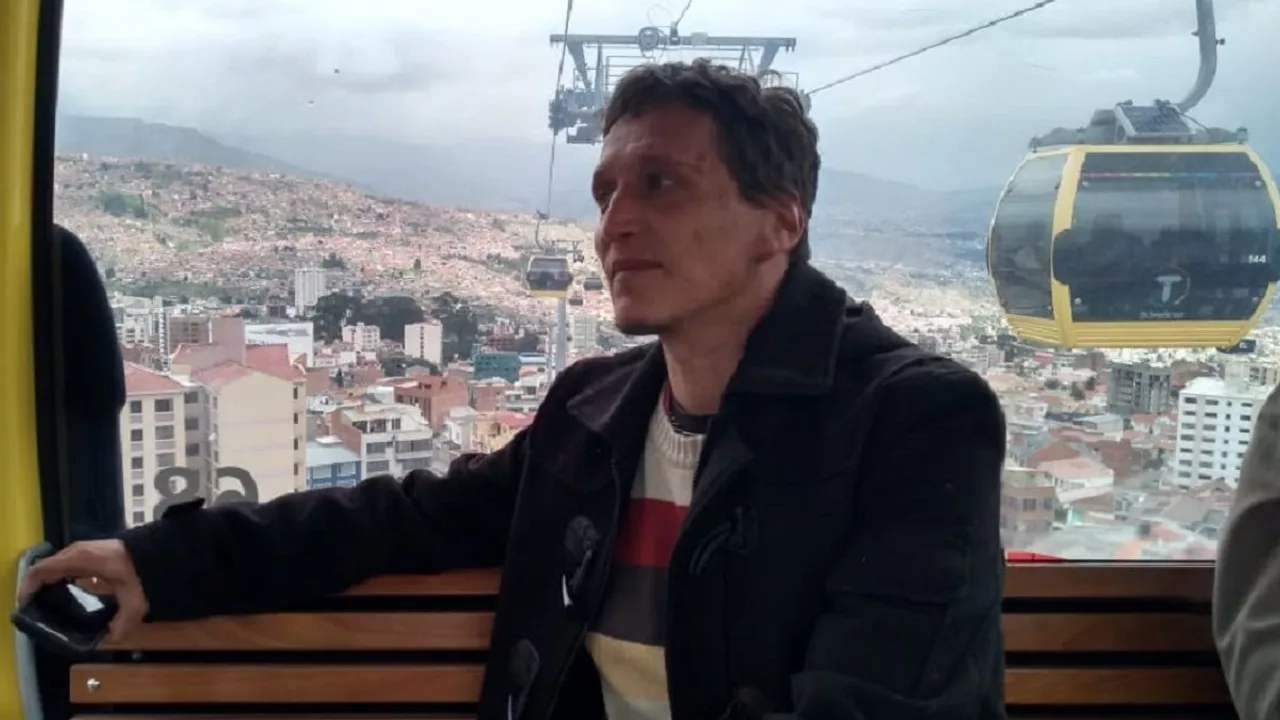
His voice unexpectedly cut off on November 10, 2019, is the basis for weaving the story of Sebastián Moro, the walker, a documentary that tells who this Argentine journalist was and what happened to him in his last days.
Sputnik spoke with María Laura Cali, the documentary’s director, and Raquel Rochietti, Sebastián’s mother, who shared their impressions about the film, which is about to be released in Buenos Aires, as is the course of the legal case for his possible murder.
https://youtu.be/rb1hWnD9LWo
“I have finally rested. I relaxed until I got to work, but making that note announcing a little bit of the panorama of what was coming wasn’t very complicated.”
“Tomorrow is going to be very heavy again, very heavy. So getting ready for the war”, says Moro in one of the audios in Cali’s documentary.
Despite the exhaustion and stress left by the last days of Evo Morales‘ presidency (2006-2019), the journalist felt the obligation to be in Bolivia and continue with his work beyond his family’s requests in Argentina for him to return immediately.
“I can’t withdraw from this no matter how much I want to because Bolivia is revolving around what is happening,” he explained in another of the messages to his family.
After sending his last note to the newspaper Página 12, Moro went for a walk in the La Paz neighborhood of Sopocachi to clear his head.
“Now, I will go for a walk. I will keep you updated later,” he says in his last communication on the night of November 9, 2019.
By that time, the police forces of the nine departments had already revolted against Morales, demanding his resignation.
A JOURNALIST’S PASSION
“Hi mom, everything okay? Hey, don’t laugh at the belly. It’s an effect of the clothes, what do I know,” the journalist’s voice is heard by his family, commenting on a full body photo he sent them in the previous days.
Cali could access Sebastian’s communications in the days before the coup and his death.
In conversation with Sputnik, Cali mentioned that with ‘Sebastián Moro, el caminante,’ she tried to capture the lives of dozens of Latin Americans, who day after day dedicate their lives to their ideals.
The director recalled that Moro left his native Mendoza with the advent of Mauricio Macri’s government (2015-2019).
A worker of the state-owned Radio Nacional, with the deployment of Macrismo, the journalist was left aside after a decade of coverage of trials against humanity of prominent repressors of the last military dictatorship (1976-1983).
“He also covered cases of institutional violence.”
“He was a guy dedicated to [reporting on] all kinds of abuses, seeking justice for the most vulnerable,” Cali said.
He chose Bolivia “because he was in love with the change process. He came with the illusion of a better destiny.”
Moro worked for the newspaper Prensa Rural of the Confederación Sindical Única de Trabajadores Campesinos de Bolivia (CSUTCB) while he had his program on Radio Comunidad.
The journalist began writing for Página 12 in the October 2019 elections, when Morales was re-elected with 47%.
But allegations of fraud by the opposition heated the political climate, leading to the November 10 coup.
With the imposition of the de facto government of Jeanine Áñez (2019-2020), the elections were annulled.
THE SILENCE
On November 10, due to the lack of response to calls from his family, one of his friends went to his house.
He found him “fainted, with bruises on his body. He took him to the Rengel clinic, where he died on November 16,” Cali said.
At that time, it was said that he had suffered a cerebrovascular accident, which would have caused a coma leading to his death.
Given the unpredictable political context, his family was pressured to cremate the journalist’s body and take it to Argentina as soon as possible in an urn.
For this reason, and in the unavailability of institutions of justice, they had to take his ashes without performing the corresponding autopsy.
At the time, Cali was in La Paz recording the moment of the coup.
Days earlier, she had spoken briefly with Moro.
“I never imagined the violence with which the shock groups from Santa Cruz, La Paz, Cochabamba, and Tarija acted,” she recalled.
Cali commented that during the days following Moro’s hospitalization, his family asked the Macri Government for a medical airplane to take him to his country.
However, “the Embassy denied it, the same day he died.”
They told his family: “You are not going to be able to move the body; you’d better cremate it”.
The director of the documentary highlighted that “in those days, a Hercules airplane arrived with weapons and projectiles used in the massacres of Senkata (La Paz) and Sacaba (Cochabamba)”.
Therefore, “When I speak of Sebastián, I speak of all the victims. He is a metaphor for many other lives.”
A MOTHER’S LONGING
The journalist’s mother told Sputnik that when she saw ‘Sebastián Moro, el caminante,’ “I wanted to enter that giant screen and be closer to my son”.
And she considered it “a necessary documentary to understand what happened”.
Rochietti commented that last May 10, Journalist’s Day in Bolivia, the Argentine ambassador Ariel Basteiro held a ceremony attended by the Attorney General of Bolivia, Wilfredo Chávez, who “made it very clear that Sebastián’s legal case had not had the scope that was expected”.
The journalist’s mother asked the agencies committed to investigating the death in Argentina and Bolivia to do their job so that “what happened to her son is not diluted”.
“Sebastián’s death is political. Both States must commit to investigating it so that it is not diluted,” he said.
In both countries, legal cases were opened for the death of the journalist, but more than three years later, they are not progressing as fast as expected.
With information from Sputnik
News Bolivia, English news Bolivia, Bolivian coup, Bolivian film
Editorial responsibility: Matthias Camenzind, Editor-in-Chief · Editorial standards · Report an error
Read More from The Rio Times