Driving in Costa Rica: Licence, Marchamo, Inspection and Apps
Key Facts
- What happened — A 2024 reform rewrote the foreign-licence rule, so your home licence now lasts as long as the stay stamped on arrival.
- The standing rule — Driving in Costa Rica runs on traffic law Ley 9078. Every vehicle needs the annual marchamo permit and the yearly RTV inspection.
- The numbers — Converting a licence costs ¢5,000 (about US$11). A light-vehicle inspection runs about ¢6,794 (about US$15) with tax.
- Why it matters — The 2026 marchamo raised ¢349.2 billion (about US$773 million), and the compulsory car insurance inside it rose 17.15 percent.
- The catch — Uber, DiDi and inDrive all operate without a legal framework, and it is the driver, not the passenger, who is exposed.
- What it means for you — Book the conversion free online and pay at the bank. Your plate’s last digit sets your inspection month.
The three-month rule you have read about was replaced in 2024, and Riteve no longer runs the inspection. Most of the people killed on these roads are on a motorcycle.
Driving in Costa Rica is simpler than most guides suggest, because the rule that mattered changed in 2024. Your home licence is now valid for as long as your legal stay, not for three months.
This guide sets out the current position on licences, the annual marchamo and the technical inspection. It also covers the fines and the ride-hailing apps.
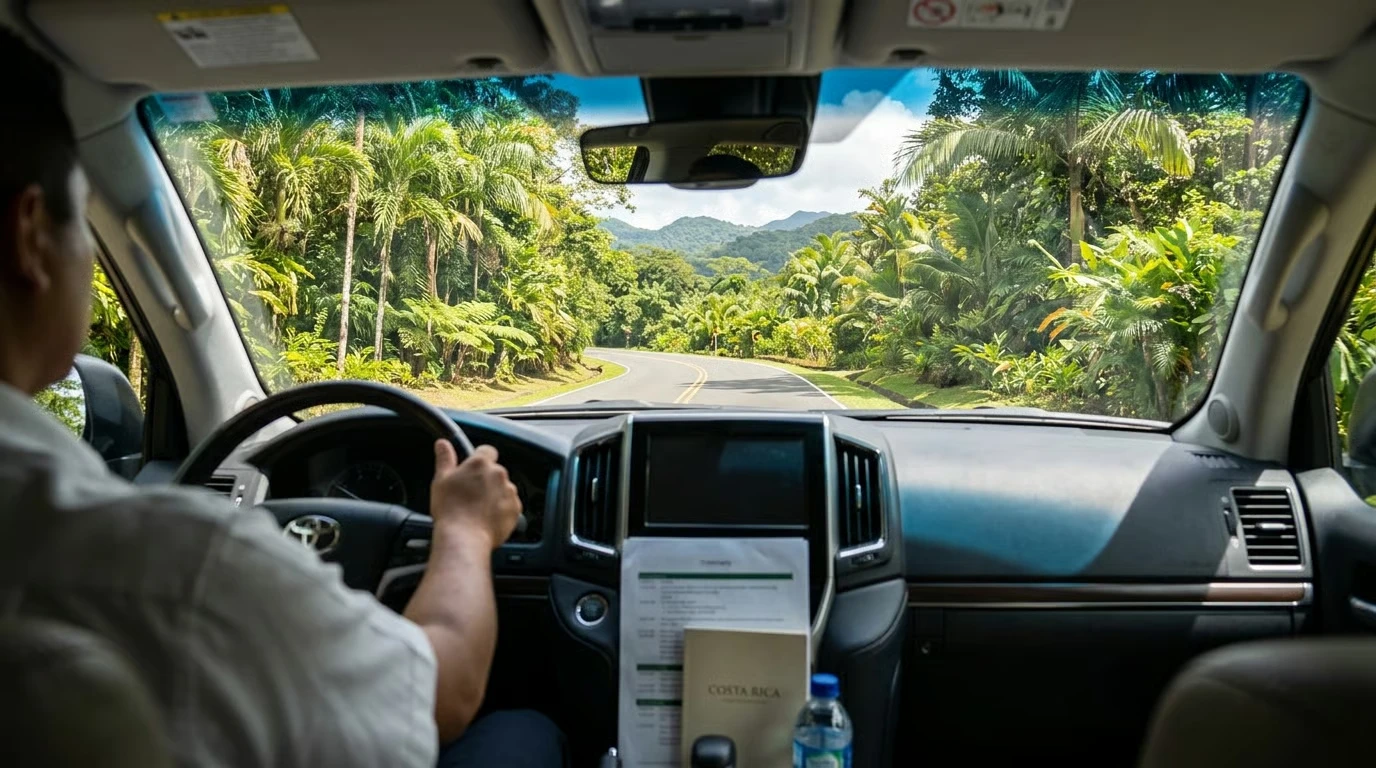
Driving in Costa Rica on a foreign licence
Article 91 of the traffic law, Ley 9078, was rewritten by Ley 10591, published on 2 December 2024. The law is titled, in part, an act to recognise driving licences issued abroad.
Under the reform a visitor may drive on a foreign licence for as long as the legal stay granted lasts. In plain terms, you may drive for as long as the stamp in your passport allows.
British and United States citizens may be admitted for up to 180 days without a visa, both governments say. Neither treats that as a right: the officer on arrival sets the figure, and the old three-month driving cap no longer exists.
The same law removed the fine for not carrying the card itself where your country issues the licence digitally. Overstaying is a separate matter, and the British government warns of a fine of US$100 for each month beyond the permitted stay.
Converting to a Costa Rican licence
Conversion is called homologación, and the road safety education directorate at the transport ministry runs it. The directorate said in November 2025 that no minimum period of residence in the country is required to apply.
The old rule made you wait 91 uninterrupted days after your DIMEX card arrived. That card is the identity document issued to foreigners here.
Filing a residency application is now enough to start the process. You no longer need approved status.
You need an official translation of your licence, a certification of it and current migratory status. You also need a medical report, your passport or home identity card, and no unpaid fines.
The service is personal and in person, at one of 13 offices around the country. Book the appointment free through the driver accreditation system online, with nothing to pay in advance.
The ministry says waits run under a week at most offices, though San José can reach 15 days.
Once your papers are approved, book a second slot at Banco de Costa Rica to have the card printed. That costs ¢5,000 (about US$11) plus a bank commission and can be done the same day.
Colón figures in this guide are converted at a rate of 452 to the US dollar. That is the Ministerio de Hacienda reference selling rate for 23 September 2026.
The marchamo, the annual bill everybody talks about
The marchamo is the circulation permit, and it bundles several charges into one annual payment. It carries the vehicle property tax, the compulsory accident insurance called the SOA, value added tax, stamps and any unpaid fines.
For 2026 the property tax took about 60 percent of the money and the SOA about 25 percent. Those shares come from INS, the state insurer that runs the collection.
The property tax is charged on the vehicle’s fiscal value in bands. Each rate applies only to the slice of value that falls inside its own band.
The SOA premium for a private car is ¢30,238 (about US$67), a rise of 17.15 percent approved by the insurance regulator Sugese. Only heavy cargo and special equipment vehicles rose by more; a motorcycle pays ¢99,623 (about US$220), the dearest premium of any class.
Collection for the 2026 marchamo ran from 3 November to 31 December 2025, and INS billed 1,943,587 vehicles. The permit raised ¢349.2 billion (about US$773 million), and roughly 124,000 owners had still not paid by September 2026.
Paying late brings the category D fine of ¢60,680 (about US$134) plus interest and penalties. The 2027 window opens on 2 November 2026.
From that date the permit goes digital, INS says, and one windscreen sticker will last up to ten years. The circulation document will arrive by email or through the INS Móvil app.
The technical inspection, now run by DEKRA
The annual inspection is the RTV, and Riteve no longer runs it. DEKRA took over at the end of October 2022, so any guide still naming Riteve is out of date.
Under the tariff set by resolution RE-0006-IT-2025 of 19 February 2025, a light vehicle pays ¢6,012 (about US$13) before tax. That comes to about ¢6,794 (about US$15) once the 13 percent value added tax is added.
A motorcycle pays ¢4,562 (about US$10) before tax, about ¢5,156 (about US$11) with it. Electric and historic vehicles pay ¢4,700 (about US$10) before tax.
Re-inspections cost less, and cash payments round down to the nearest ten colones. Your month is set by the last digit of your number plate.
Plates ending one to nine are inspected from January through September, and plates ending zero in October. The law lets you bring the inspection forward by one month, DEKRA says.
Public transport and hazardous goods vehicles go twice a year. The only document the station asks for is a licence valid for that class of vehicle.
DEKRA works from 13 fixed stations and three mobile units. Appointments are booked on its own website.

Fines, road safety and the apps
Traffic fines changed on 1 January 2026 under circular 220-2025 of the judiciary’s governing council. They fell by 0.22 percent, tracking a fall in consumer prices.
Category A, which covers drink-driving and speeds above 120 kilometres an hour, is ¢362,839 (about US$803). Using a mobile phone at the wheel is category C at ¢122,597 (about US$271).
Driving with no valid marchamo or inspection is category D at ¢60,680 (about US$134). Category B sits between them at ¢245,195 (about US$542).
The safety numbers are the hardest part of driving in Costa Rica. Between January and August 2026, 425 people died on these roads, and 247 of them were motorcyclists.
That is 58 percent of the total, on transport ministry figures, and excessive speed was involved in 146 deaths. The road safety council counted 572 deaths at the scene across 2025.
A wider count, which includes people who died later of their injuries, put that year at 903. Motorcyclists are the group most exposed.
Costa Rican addresses are descriptive rather than numbered, which is why navigation apps matter more here than any street atlas. Uber, DiDi and inDrive all operate in the metropolitan area, and none of them is regulated.
Uber started on 21 August 2015, inDrive in April 2019 and DiDi on 19 November 2019. Eleven years and four governments later there is still no legal framework, El Observador reported in August 2026.
That matters in a specific way: the driver, not the passenger, is the one outside the law. An officer may fine the driver under the traffic law, or open a case under Ley 7593.
Article 38 of that law carries fines of five to twenty base salaries and impounds the vehicle. The two routes cannot be used at once.
The government filed a bill to regulate the platforms on 3 May 2023. It returned to the floor of the assembly on 29 July 2026, after a committee worked through 282 amendments.
The committee approved nine of those amendments. Under the text each affiliated driver would pay ¢25,000 (about US$55) a year at first.
The road safety council would run the authorisations and the registers. One approved amendment would bar platform drivers from airports, ports and international marine terminals.
Uber’s country manager, Laura Santillán, said that measure works against tourism and consumer choice. The bill has not been voted, and the 57 deputies can still change it.
Uber meanwhile lets travellers hail an official airport taxi through its own app at Juan Santamaría, the main international gateway. Taxi organisations back the bill.
Driver associations say it would reduce them to taxis in all but name. For now, nothing has changed on the street.
Frequently Asked Questions
How long can I drive in Costa Rica on my own licence?
For as long as the stay stamped in your passport lasts. Ley 10591 rewrote article 91 of the traffic law in December 2024, and the old three-month cap is gone. British and United States citizens may be admitted for up to 180 days, but the officer on arrival sets the figure.
What does converting my licence cost?
The card costs about US$11 at Banco de Costa Rica, plus a bank commission. The appointment with the road safety education directorate is free and booked online. You also pay for an official translation and for a medical report.
Who runs the vehicle inspection now?
DEKRA, which replaced Riteve at the end of October 2022. A light vehicle pays roughly US$15 including tax. The last digit of your number plate sets the month you are due.
Is Uber legal in Costa Rica?
It operates without a legal framework, eleven years after arriving, and the driver rather than the passenger carries the risk. A bill to regulate the platforms returned to the floor of the assembly on 29 July 2026. It has not been voted.
This article was produced by The Rio Times’ automated newsroom system. How we use AI · Report an error
Read More from The Rio Times